What are the standard book dimensions and why do they matter for self-publishers?
Key Takeaways
Understanding standard book dimensions is essential for successful publishing, as trim size directly impacts production costs, reader expectations, and distribution opportunities. Here are the critical insights for choosing and implementing the right book dimensions:
• The 6×9 inch format dominates trade publishing, with 5×8 and 5.5×8.5 accounting for over 70% of published books—start here when uncertain about sizing.
• Larger trim sizes reduce page count and printing costs—a 60,000-word manuscript produces 280 pages at 5×8 inches but only 210 pages at 6×9 inches.
• Genre dictates dimension expectations—mass-market paperbacks measure 4.25×6.87 inches, while children’s picture books use 7.5×7.5 or 7×10 inch formats for illustrations.
• Non-standard sizes limit distribution channels—custom dimensions may exclude books from expanded distribution programs like IngramSpark, restricting bookstore placement opportunities.
• Print-ready files require precise specifications—include 0.125-inch bleed on all sides, maintain 0.25-inch minimum text margins, and export as PDF/X-1a with 300 DPI resolution.
Selecting the appropriate book dimensions balances genre conventions, content requirements, manufacturing economics, and distribution goals. Authors should research comparable titles in their category, consider their manuscript’s word count and visual elements, and ensure compatibility with chosen printing platforms before finalizing trim size decisions.
What is Standard Book Dimensions?
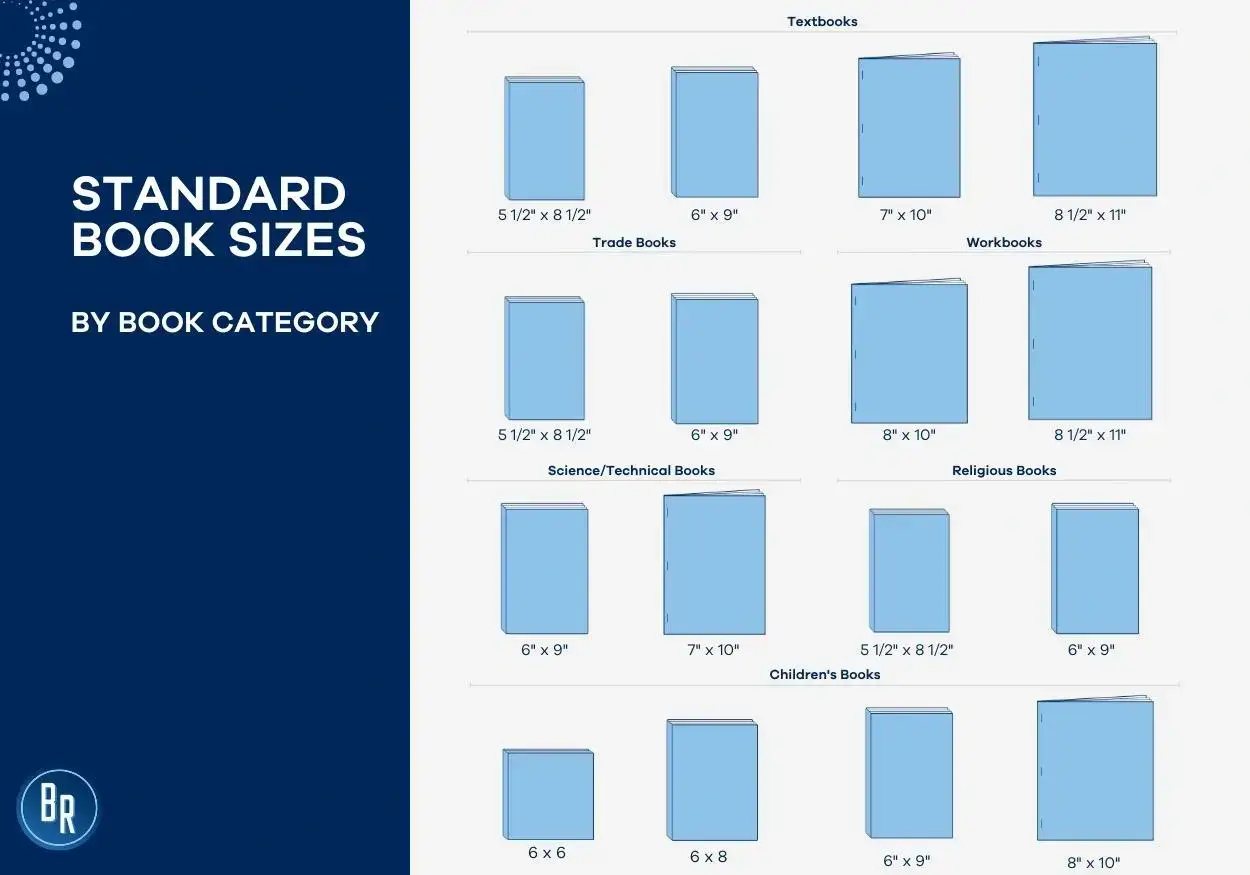
Image Source: BR Printers
“Based on 12,000+ books published through Books.by, 5×8 and 5.5×8.5 account for over 70% of all orders. When in doubt, start there.” — Ash Davies, Founder
Standard book dimensions refer to the final physical measurements of a book’s pages after printing and trimming, expressed as width by height. The publishing industry uses the term trim size to describe these dimensions, which represent the actual size of a book page once it has been cut to its finished format[7][1]. These measurements determine the physical appearance of a book and influence manufacturing costs, readability, and distribution requirements.
The concept of book dimensions originates from historical printing practices where books were classified by folding patterns. A folio was created by folding a sheet of paper once to produce two leaves or four pages. A quarto resulted from folding twice to create four leaves or eight pages[2]. An octavo, produced by folding three times to form eight leaves or sixteen pages, became one of the most common formats[2]. The size of the resulting book depended on the dimensions of the original paper sheet and the amount of trimming before binding[2].
The United States publishing market features standard book sizes that range from 4.25 x 6.87 inches for mass-market paperbacks up to 8.5 x 11 inches for textbooks and reference materials[1][31]. Trade paperbacks, which represent the majority of fiction and non-fiction titles sold in bookstores, measure between 5.5 x 8.5 inches and 6 x 9 inches[1][24]. Mass-market paperbacks, the smaller pocket-sized editions found in supermarkets and airports, measure 4.25 x 6.87 inches[1][24]. Children’s books tend toward larger formats to accommodate illustrations. Standard sizes include 7.5 x 7.5 inches for square formats and 7 x 10 inches for portrait orientation[1][24].
The most common standard book size for trade paperbacks is 6 x 9 inches, used for fiction, non-fiction, and memoir titles[1][24]. Publishers and authors can deviate from these dimensions when projects require unique specifications. Storyloft can format and export books as professional, print-ready PDFs using industry-standard trim sizes for platforms such as KDP, IngramSpark, and commercial print houses. Authors can generate high-resolution, 300 DPI PDFs with support for precise page dimensions, margins, gutters, and print bleeds. Beyond standard book sizes, every page dimension can be customized. This gives authors the flexibility to create novels, workbooks, children’s books, journals, and specialty publications.
Common Standard Book Sizes by Region
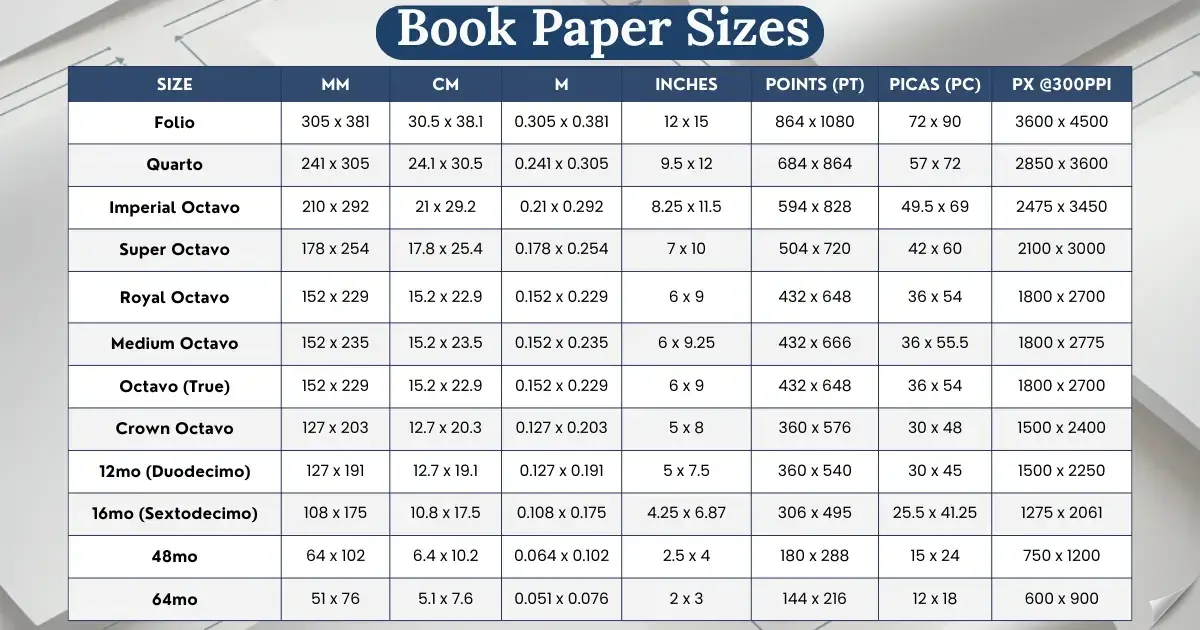
Image Source: Paper Size Chart
Publishing markets in different regions maintain distinct size conventions. Local printing standards and reader priorities shape these conventions. Regional variations reflect historical paper manufacturing practices and industry norms that continue to influence modern book production.
United States standard book sizes
The United States publishing market organizes book sizes into regular and large trim categories. Books exceeding 6.12 inches in width or 9 inches in height are classified as large trim sizes[24]. The 6 x 9 inch format serves as the most common trim size for paperbacks in multiple genres[24]. Print-on-demand platforms offer extensive trim options. Paperback specifications range from compact 5 x 8 inch formats to expansive 8.5 x 11 inch layouts[24].
Mass-market paperbacks are the pocket-sized editions distributed through airports and grocery stores. They measure 4.25 x 6.87 inches[32]. Trade paperbacks for general fiction use 6 x 9 inches. Thrillers and mysteries employ 5.25 x 8 inches[10]. Non-fiction titles measure 5.5 x 8.5 inches, and reference works use both 6 x 9 inches and 7 x 10 inches[10]. Young adult fiction adopts sizes between 5 x 7 inches and 5.5 x 8.5 inches depending on subgenre[10].
United Kingdom book formats
British publishing employs named format categories with metric measurements. A-Format books measure 110 mm x 178 mm and serve mass-market novels and classic literature reprints[33]. B-Format is the most prevalent paperback size in the UK at 129 mm x 198 mm. It dominates contemporary fiction publishing[33]. Demy format at 138 mm x 216 mm provides a larger paperback option for biographies and memoirs. Royal format measures 156 mm x 234 mm for general non-fiction and hardcover novels[33].
European book dimensions
European markets base book dimensions on the ISO paper size system. A5 (148 mm x 210 mm) and variations serve as primary novel formats[34]. Publishers use modified dimensions including 130 x 205 mm, 135 x 210 mm, and 140 x 215 mm for fiction[34]. Non-fiction titles employ B5 or adjusted sizes such as 170 x 240 mm and 160 x 220 mm[34].
International A-series formats
The ISO 216 standard defines international paper sizes through the A-series system. A4 measures 210 x 297 mm, A5 measures 148 x 210 mm, and A6 measures 105 x 148 mm[8]. These standardized dimensions enable consistent production across international markets and make paper utilization easier in manufacturing processes.
Storyloft supports regional trim size variations for authors publishing in different markets. The platform generates print-ready files compatible with both imperial and metric specifications for global distribution channels.
Standard Book Size Dimensions by Genre
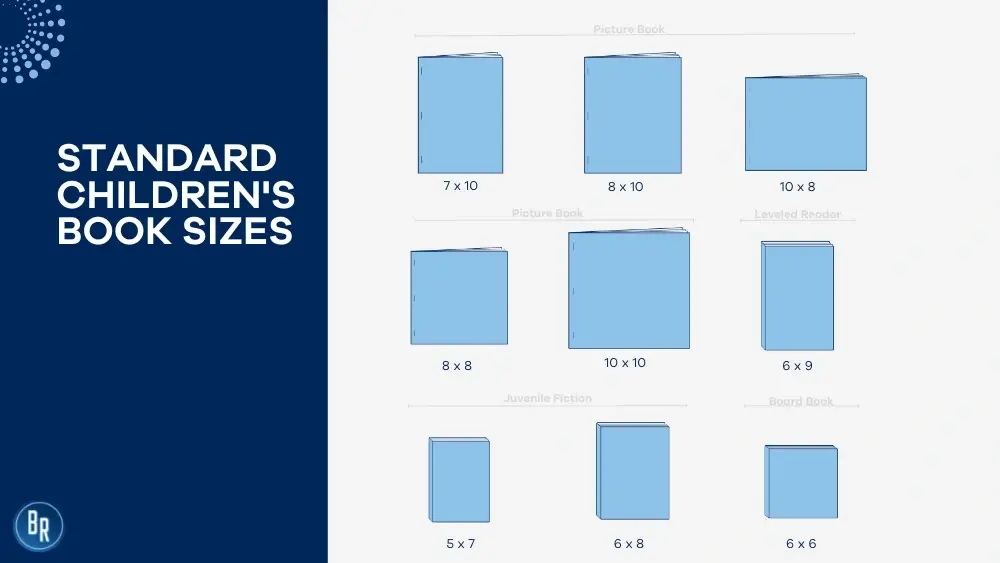
Image Source: BR Printers
Book trim size varies by genre to meet reader expectations and functional needs. The publishing format determines whether a book uses compact pocket dimensions or expansive layouts for visual content.
Fiction and novel sizes
Mass-market paperbacks measure 4.25 x 6.87 inches and are designed for portability and distribution through grocery stores and airports[7]. Trade paperbacks for fiction range from 5 x 8 inches to 6 x 9 inches[9]. Romance novels use the compact 5 x 8 inch format for extended reading sessions[6]. Thrillers and mysteries employ 5.25 x 8 inches for shorter works and expand to 5.5 x 8.5 inches for titles exceeding 80,000 words[10]. Literary fiction uses 5.5 x 8.5 inches to match novels published through traditional channels[6]. Science fiction and fantasy adopt 5.5 x 8.5 inches for standard works. Epic narratives surpassing 100,000 words increase to 6 x 9 inches[6].
Non-fiction book dimensions
Non-fiction titles measure 5.5 x 8.5 inches or 6 x 9 inches in most cases[9]. Reference books, workbooks and illustrated non-fiction employ larger formats of 7 x 10 inches or 8.5 x 11 inches[9]. Memoirs use 5.25 x 8 inches or 5.5 x 8.5 inches and line up with narrative-driven content[7]. Business and professional books adopt 6 x 9 inches as standard, with 5.5 x 8.5 inches serving compact editions[11]. Self-help and personal development titles measure 5.5 x 8.5 inches. This provides space for exercises and reflection prompts[11]. How-to and instructional books employ 7 x 10 inches or 8 x 10 inches to accommodate diagrams and step-by-step visuals[11].
Children’s book formats
Picture books for ages 3-5 measure 7.5 x 7.5 inches (square), 7 x 10 inches (portrait), or 10 x 8 inches (landscape)[9]. Early reader books for ages 6-8 use 6 x 9 inches[4]. Chapter books for ages 8-10 measure between 5.25 x 7.75 inches and 6.5 x 8 inches[4]. Middle grade novels for readers aged 8-12 employ 5.25 x 7.5 inches or 5.25 x 7.75 inches[4]. Young adult books use 5.25 x 8 inches, 5.5 x 8.5 inches, or 5.5 x 8.25 inches[4]. Board books for ages 0-2 use 6 x 6 inch square formats[12].
Textbook and workbook sizes
Textbook dimensions range from 6 x 9 inches to 8.5 x 11 inches[9]. Academic publishing employs 7 x 10 inches as the standard for textbooks that need diagrams and margin notes[6]. The US Letter size of 8.5 x 11 inches serves detailed textbooks and reference materials[13]. Workbooks and journals measure 6 x 9 inches for portable formats or 8.5 x 11 inches for full-page worksheets and activity books[6].
Storyloft creates print-ready PDFs with customizable page dimensions for novels, workbooks, children’s books, journals and specialty publications in any genre-specific trim requirements.
How Book Dimensions Affect Page Count and Printing Cost
Trim size selection creates a direct relationship between physical dimensions and manufacturing economics. Larger formats accommodate more words per page and reduce total page count for similar manuscripts. Smaller dimensions increase pagination and associated production expenses.
Page count calculations for different sizes
A 60,000-word manuscript produces around 280 pages at 5 x 8 inches, 240 pages at 5.5 x 8.5 inches, and 210 pages at 6 x 9 inches[6]. The words-per-page ratio varies by format. Books measuring 5 x 8 inches average 250 words per page, while 5.5 x 8.5 inch formats hold 290 words per page. The 6 x 9 inch dimensions accommodate 340 words per page[14]. Page count calculations for 10-point type divide word count by 400 for 5 x 8 inch books, by 475 for 5.5 x 8.5 inch books, and by 600 for 6 x 9 inch books[15].
Printing cost variations
Print-on-demand providers calculate costs using a fixed base charge plus per-page multiplication. Amazon KDP charges USD 1.00 base plus USD 0.012 per page for black-and-white paperbacks exceeding 110 pages[3]. A 250-page manuscript costs USD 4.00 through Amazon KDP and USD 5.26 through Books.by[5]. Color printing increases per-page costs significantly. Premium color ink costs USD 0.065 per page compared to USD 0.012 for black-and-white[3].
Print-on-demand vs traditional printing
Print-on-demand produces books individually at USD 8.00 to USD 25.00 per unit with zero minimum quantities[16]. Offset printing requires 500 to 1,000 copy minimums but delivers USD 2.00 to USD 6.00 per-unit costs. This represents 60-75% savings at volume[16]. A 150-page softcover book costs USD 6.26 per unit at 250 copies through offset printing versus higher POD rates[17].
Storyloft creates print-ready PDFs with precise page dimensions, margins, gutters, and bleeds compatible with KDP, IngramSpark, and commercial printers. This enables authors to optimize production costs across different printing methods.
Choosing the Right Book Dimensions for Your Project
Selection criteria for book dimensions prioritize genre as the main decision factor. Readers and retailers have expectations about trim sizes within specific categories that go back decades[18].
Matching genre expectations
Genre determines the original parameters for dimension selection, with most categories adhering to recognized standards. Research into comparable successful titles within the same niche reveals prevalent sizing patterns[19]. Romance novels measuring 50,000 words benefit from smaller 5 x 8 inch formats that increase page count and perceived value. The same manuscript at 6 x 9 inches reduces pagination and printing expenses[20]. Analyzed data from five bestselling books in a target genre through retailer listings or physical inspection provides dimension standards[6].
Content type matters
Word count influences appropriate trim size selection. Manuscripts under 75,000 words need smaller dimensions to avoid appearing insubstantial[7]. Books containing images, charts, diagrams, or illustrations need larger formats, with 6 x 9 inches serving as the minimum for visual content[6]. Font selection affects final page count, as three-point adjustments add approximately 140 pages to similar manuscripts[19].
Distribution channels matter
Print-on-demand platforms support predetermined size lists that constrain available options[18]. Non-standard dimensions exclude books from expanded distribution programs through services like IngramSpark and limit physical bookstore placement[21]. Storyloft generates customizable print-ready PDFs with precise dimensions, margins, and bleeds for KDP, IngramSpark, and commercial printers.
Creating Custom Book Dimensions and Print-Ready Files
Authors who want non-standard formats can specify custom dimensions within printer constraints. Minimum sizes start at 4 x 6 inches and maximum dimensions reach 8.5 x 11 inches[22]. Most print-on-demand facilities don’t charge extra for custom sizes, though pricing calculations round to the nearest standard template[22].
Setting up custom page dimensions
You must adjust document dimensions in layout software before placing content to configure page size[23]. Books with bleed need an extra 0.125 inches added to width and 0.25 inches to height beyond the intended trim size[23]. A 6 x 9 inch trim book with bleed needs a 6.125 x 9.25 inch page setup[23][24].
Margin and gutter requirements
Inside margins increase with page count to accommodate spine thickness[23][371]. Books with 24 to 150 pages just need 0.375 inch gutter margins. Those with 151 to 300 pages need 0.5 inches, 301 to 500 pages need 0.625 inches, 501 to 700 pages need 0.75 inches, and 701 to 828 pages need 0.875 inches[23][371]. Outside margins without bleed measure at least 0.25 inches. Books with bleed need minimum 0.375 inch outside margins[23][371].
Bleed settings for professional printing
Bleed extends 0.125 inches beyond trim lines on all sides and prevents white borders during cutting[25][26][27]. Images and background colors must reach into bleed areas. Text stays at least 0.25 inches from trim edges[26][28].
Exporting production-ready PDFs
Print-ready files follow PDF/X-1a:2001 standards with embedded fonts and 300 DPI image resolution[29][30]. Export settings need single-page layouts rather than spreads, CMYK color space for color books, and grayscale for black-and-white interiors[29][361].
FAQs
Q1. What are the most common book sizes used in publishing? Trade paperbacks typically range from 5.5 x 8.5 inches to 6 x 9 inches, with 6 x 9 inches being the most popular format for fiction and non-fiction. Mass-market paperbacks measure 4.25 x 6.87 inches, while hardcover books generally range from 6 x 9 inches to 8.5 x 11 inches. Children’s picture books often use larger formats like 7.5 x 7.5 inches (square) or 7 x 10 inches (portrait).
Q2. How does book size affect printing costs? Larger book dimensions reduce page count for the same manuscript, which can lower printing costs. For example, a 60,000-word manuscript produces approximately 280 pages at 5 x 8 inches but only 210 pages at 6 x 9 inches. Print-on-demand services typically charge a base fee plus a per-page rate, so fewer pages mean lower production costs.
Q3. What book size should I choose for my novel? The ideal size depends on your genre and word count. Romance novels often use 5 x 8 inches, while literary fiction typically measures 5.5 x 8.5 inches. Thrillers and mysteries commonly use 5.25 x 8 inches for shorter works and 5.5 x 8.5 inches for longer manuscripts. Science fiction and fantasy may use 6 x 9 inches for epic narratives exceeding 100,000 words.
Q4. What are the differences between US and UK book formats? The US uses inch-based measurements with common sizes like 6 x 9 inches for trade paperbacks and 4.25 x 6.87 inches for mass-market editions. The UK employs named metric formats: A-Format (110 x 178 mm) for mass-market books, B-Format (129 x 198 mm) as the most common paperback size, and larger formats like Demy (138 x 216 mm) and Royal (156 x 234 mm).
Q5. What technical specifications do I need for print-ready book files? Print-ready files should be PDF/X-1a:2001 format with 300 DPI resolution and embedded fonts. Add 0.125 inches of bleed on all sides beyond your trim size, and maintain minimum margins of 0.25 inches from trim edges for text. Gutter margins should increase with page count, ranging from 0.375 inches for books under 150 pages to 0.875 inches for books over 700 pages.
References
[1] – https://www.blurb.com/book-dimensions?srsltid=AfmBOoqVFAWGGMfjLYT9mWlJm4tkVcSdtg8fTNroXX3SaPC0hQvOaC-y
[2] – https://en.wikipedia.org/wiki/Book_size
[3] – https://kdp.amazon.com/help/topic/G201834340
[4] – https://brookevitale.com/blog/childrens-book-trim-size
[5] – https://books.by/guides/print-cost-comparison
[6] – https://books.by/guides/best-book-sizes
[7] – https://reedsy.com/studio/resources/standard-book-sizes
[8] – https://www.neenahpaper.com/resources/paper-101/international-sizes
[9] – https://www.blurb.com/book-dimensions?srsltid=AfmBOoqcTw-1DZ5gTnjaiDSH7N6XauS6tq24zWU4rqklhmEcmXINI5hT
[10] – https://www.ingramspark.com/blog/picking-a-popular-trim-size-for-your-book
[11] – https://writeandsellnonfictionbooks.substack.com/p/size-matters-the-ultimate-guide-to
[12] – https://readnlearn.com/childrens-book-dimensions-by-age-group/
[13] – https://www.template.net/documents/textbook-sizes/
[14] – http://bbebooksthailand.com/blog/print-page-count.html
[15] – https://www.bookdesignmadesimple.com/calculate-book-page-count-using-word-count/
[16] – https://prcbookprinting.com/print-on-demand-vs-offset-printing-guide/
[17] – https://gorhamprinting.com/quoting/
[18] – https://www.blurb.com/book-dimensions?srsltid=AfmBOopTUgxKzjkLs54sW8VWug-mr4hrDnZOff2c7msh8ZmFgLibsYca
[19] – https://blog.lulu.com/choosing-the-right-book-size/
[20] – https://blog.bookbaby.com/how-to-self-publish/printed-books/books-trim-size
[21] – https://barkerbooks.com/traditional-book-sizes/
[22] – https://www.diggypod.com/book-printing/sizes
[23] – https://kdp.amazon.com/help?topicId=G202145400
[24] – https://kdp.amazon.com/help/topic/GVBQ3CMEQW3W2VL6
[25] – https://www.blurb.com/book-dimensions?srsltid=AfmBOooYRdI0b0mLvWwB8yeTSdQT-jO8mw-Qy2xWJPaNjaPmVW6akRgQ
[26] – https://www.bookbaby.com/resources/formatting-book-for-print-trim-margins-bleed
[27] – https://support.bookbaby.com/hc/en-us/articles/206285857-What-is-bleed
[28] – https://support.onpressbookprinting.com/hc/en-us/articles/27028838279187-What-is-bleed-in-book-printing
[29] – https://books.by/guides/how-to-format-a-book-for-print
[30] – https://www.indiekidsbooks.com/p/print-ready-files
[31] – https://www.blurb.com/book-dimensions?srsltid=AfmBOorq6sUTgXTbtgZWdg-dZLsnu0wXRgBTL6bJtX_5enw0HYxz8uQF
[32] – https://www.blurb.com/book-dimensions?srsltid=AfmBOor1jAwx_AsdsGc8gfF9mqTL9F3Ag4AKkwuEz2rxvpXOT7XybUQL
[33] – https://spiffingpublishing.com/blog/standard-book-sizes-uk/
[34] – https://martadec.eu/standard-book-sizes/