How Do You Write an Outline That Organizes Your Ideas

Ever found yourself staring at a blank page, wondering, “What’s the best way to organize my thoughts?” This question often haunts writers, and it can feel like a challenge from the universe. But fear not! Crafting an effective outline can transform that chaos into clarity.
Creating a solid outline is less about rigid structure and more about harnessing the beautiful chaos swirling in your mind. It serves as a roadmap, guiding your writing journey from start to finish. With the right plan, your ideas can flow seamlessly, making the writing process not just easier but also enjoyable.
Whether you’re gearing up for NaNoWriMo or just trying to finish that novel, mastering the art of outlining is crucial. It turns vague ideas into a coherent narrative, giving your story a fighting chance to resonate with readers. In this guide, I’ll share insights on overcoming psychological hurdles and practical frameworks, along with a tool that can make outlining feel like magic.
Key Takeaways
- Outlining helps transform chaotic thoughts into structured ideas.
- A good outline serves as a roadmap for your writing journey.
- Mastering outlining can enhance your storytelling abilities.
- Tools like Storyloft’s Free Book Outline Generator simplify the outlining process.
- Effective outlines capture the emotional arc of your story.
Understanding What You Really Mean When You Ask, “How Do You Write an Outline?”
Imagine staring at a white screen, with ideas swirling but nowhere to land. When most writers ask this question, they’re not seeking a dictionary definition. Instead, they’re confessing that the blank page has become a personal nemesis. Their ideas are staging a mutiny in their mind.
I’ve come to realize that the real questions lurking beneath that surface-level query are often more profound. Writers wonder, “How do I start without feeling overwhelmed?” or “Is there a way to organize my thoughts that doesn’t require a PhD in structural engineering?” These questions highlight the emotional struggle many face.
The word “outline” can trigger flashbacks to high school English class and those dreaded Roman numerals. However, modern outlining for creative writing is a different beast. It respects your unique process instead of forcing you into a rigid box.
Every writer I know has, at some point, stared at a jumble of brilliant ideas. They wonder if there’s a way to wrangle them into something resembling a story without losing the magic that made those ideas exciting in the first place.
The point I want to drive home is this: outlining isn’t about restricting your creativity. It’s about giving your creativity a playground with boundaries so it doesn’t run off into the woods and get lost forever.
When you strip away all the jargon and pressure, what you’re really asking is how to build a container for your words. It should be sturdy enough to hold them but flexible enough to let them breathe. That’s exactly what a good outline accomplishes.
Understanding your own relationship with structure is the first step. Some writers need a detailed chapter-by-chapter breakdown, while others just need a few guiding questions answered before diving into their writing.
Why Outlines Matter: What I Learned About Structuring Stories (and Staying Sane)
Crafting a story without a clear outline is like sailing without a compass. I spent years resisting outlines like they were some kind of creative straitjacket. However, I discovered that a good outline actually freed me to write faster and with more confidence. No longer did I wonder what came next.
The structure an outline provides is like the framing of a house. You can’t hang drywall until the beams are in place. Similarly, you can’t write a compelling story until you know where the load-bearing plot points need to go.
One of the biggest things I noticed after I started outlining was how much better my pacing became. I could see at a glance whether I’d crammed too much action into act one or left my poor character languishing in exposition for fifty pages.
Character development transformed from something I hoped would happen organically into something I could actually plan. I could map out exactly where my protagonist would face the trials that would force them to grow.
Moreover, the plot stopped meandering off into dead-end subplots. This saved me time and spared me the heartbreak of killing my darlings after I’d already fallen in love with them.
Outlining also helped me identify research areas early. Instead of stopping mid-writing to Google “medieval blacksmithing techniques,” I could compile my questions ahead of time. This kept my writing flow intact.
For my thesis and academic papers, outlines became non-negotiable. There’s nothing quite like realizing your argument has more holes than Swiss cheese halfway through a twenty-page paper to make you a convert to the church of pre-writing structure.
The sanity-saving aspect cannot be overstated. Knowing I had a roadmap meant I could write even on days when inspiration was nowhere to be found. The outline had already done the heavy lifting of deciding what happens next.
| Benefits of Outlining | Description |
|---|---|
| Provides Structure | Helps organize thoughts and ideas coherently. |
| Improves Pacing | Allows for better control over the story’s rhythm. |
| Aids Character Development | Enables planned growth for characters throughout the story. |
| Progresses the Plot | Helps avoid dead-end subplots and keeps the narrative focused. |
| Identifies Research Areas | Facilitates gathering information before writing. |
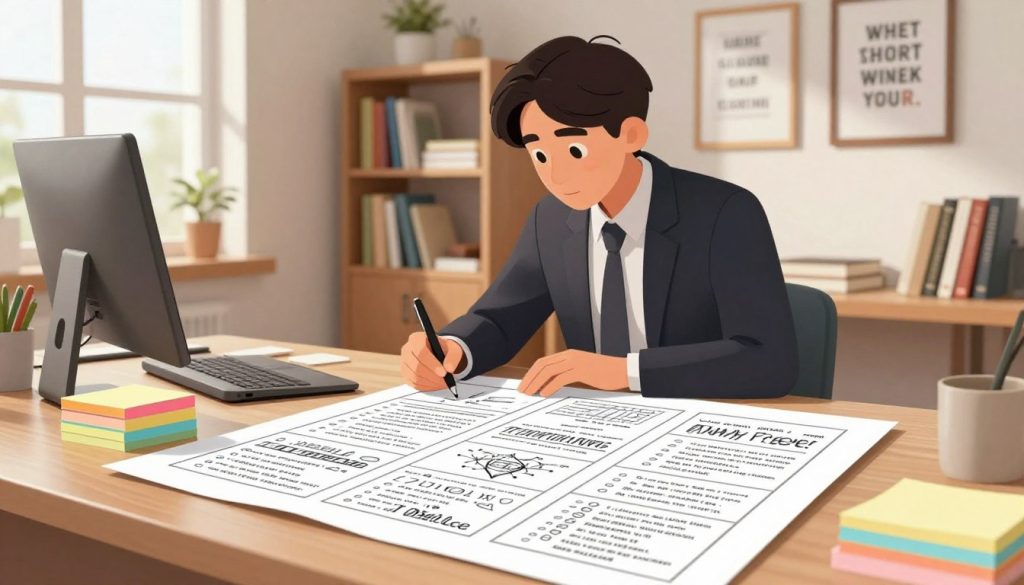
How Do You Write an Outline: Using Storyloft’s Free Book Outline Generator
Let’s face it: staring at a blank page can feel like a cruel joke. But what if there was a way to transform that daunting emptiness into a structured plan? Enter Storyloft’s Free Book Outline Generator, your new best friend in the writing process.
This tool is a game-changer for authors looking to turn a fleeting idea into a solid book plan in mere minutes. Instead of wrestling with a blank canvas, you’ll partner with Eddy, Storyloft’s AI writing companion. Eddy guides you through a simple and intuitive process, making outlining feel less like a chore and more like a conversation.
As you answer a few straightforward questions, Storyloft crafts a complete, usable outline. It’s not just about generating chapter titles; it’s about creating a comprehensive workspace that includes:
- Sections and Chapters: A well-organized framework for your story.
- Detailed Subpoints: Break down each chapter into manageable pieces.
- Chapter Descriptions: Understand the purpose of each section.
- Creative Notes: Jot down those brilliant ideas that strike you.
- Reader Direction: Keep your audience in mind as you write.
- Supporting Context: Helps you see how everything fits together.
But that’s not all! Storyloft also generates a concept book cover based on your idea. There’s something magical about seeing your project take shape visually. It transforms the abstract into something tangible, motivating you to move forward.
For those of us who have spent too much time staring at a blank page, Eddy’s guided experience breaks the outlining process into simple, answerable questions. This eliminates the paralysis that often accompanies starting a new project. Whether you’re working on fiction or non-fiction, the generator adapts to your needs, providing a solid foundation for your book.
And let’s not forget about the intelligent planning notes. These capture those “aha!” moments that often come late at night, ensuring your best creative insights don’t vanish by morning. By the end of your session, you’ll have a robust plan that sets you up for success.
So, if you’re ready to say goodbye to blank pages and hello to a structured plan, check out Storyloft’s Free Book Outline Generator. It’s the perfect tool to help you turn your ideas into a real book!
Popular Story Structures That’ll Supercharge Your Outline
Every great story begins with a structure that can guide its journey. Whether you’re a seasoned writer or just starting, understanding these frameworks can significantly enhance your outlining process. Let’s dive into some popular story structures that can help you shape your narrative effectively.
The Three-Act Structure: The Classic Framework for Your Story’s Journey
The Three-Act Structure is the little black dress of storytelling; it never goes out of style. This framework divides your story into three acts:
- Act One: Exposition, Inciting Incident, Turning Point
- Act Two: Rising Action, Midpoint, Low Point
- Act Three: Climax, Falling Action, Resolution
For example, in The Hobbit, Bilbo’s journey from Bag End through trolls, goblins, and the Battle of Five Armies perfectly illustrates this structure.
Save the Cat Beat Sheet: Hollywood’s Secret Sauce for Storytelling
Save the Cat is the beat sheet that Hollywood screenwriters swear by. It includes 15 beats, from the Opening Image to the Final Image. This structure helps you deliver on the promise of your premise, ensuring your readers stay engaged.
The “Fun & Games” beat is particularly enjoyable, as it allows you to showcase your characters in their element before the stakes rise.
The Hero’s Journey: Crafting Epic Character Arcs That Transform
The Hero’s Journey isn’t just for epic fantasies. Its twelve steps apply to various genres, including contemporary romance. This structure focuses on a character’s transformation through trials and tribulations, making it universally relatable.
The Snowflake Method: Growing Your Story from a Tiny Idea
Initially, I thought the Snowflake Method sounded like overkill. However, starting with a single sentence and gradually expanding it into a full synopsis forces you to ensure every element connects to your central thesis. This method encourages thorough development.
Freytag’s Pyramid: The Five Stages That Build Your Narrative Arc
Freytag’s Pyramid outlines five stages: Exposition, Inciting Incident, Rising Action, Climax, Falling Action, and Resolution. While it may seem simple, mapping your scenes onto this structure reveals deeper insights into your story’s flow.
For academic papers, this structure adapts surprisingly well. Your thesis can act as the inciting incident, while your body paragraphs represent the rising action.
| Story Structure | Description | Example |
|---|---|---|
| Three-Act Structure | Classic framework dividing the story into three acts. | The Hobbit |
| Save the Cat Beat Sheet | 15 beats that guide the storytelling process. | Hollywood screenplays |
| The Hero’s Journey | A framework for character transformation through trials. | Star Wars |
| The Snowflake Method | Expands a single idea into a full synopsis. | Randy Ingermanson’s method |
| Freytag’s Pyramid | Five stages that build a narrative arc. | Academic essays |
Tips and Tricks I Swear By: Staying Flexible and Avoiding Outline Overwhelm
Writers often find themselves caught in the whirlwind of outlining, but there’s a way to keep your sanity intact. Here’s the thing about outlining that nobody tells you: it’s incredibly easy to spend so much time perfecting your outline that you never actually write the book. I’ve fallen into that trap more times than I’d like to admit.
To combat this, I now set myself a strict time limit for outlining—one month max. After that, I’m not planning anymore; I’m just procrastinating with extra steps and prettier bullet points. Some of the best writers I know keep their outlines to a single page. This forces them to focus on the big-picture story beats instead of getting lost in the weeds of chapter seventeen’s third subplot.
My personal rule for chapter summaries is three sentences per chapter, no more. If I can’t capture the essence of a chapter in three sentences, I probably don’t understand what that chapter is actually about yet. I’ve learned to treat my outline as a living document rather than a sacred text. When my character does something unexpected in the first draft that’s actually better than what I planned, I revise the outline instead of forcing the story back into the box.
The notes and information you gather during the outlining process should serve your writing, not replace it. I keep a separate document for all the brilliant tangents and world-building details that don’t fit into the outline itself. One of the most liberating things I’ve discovered is that you can start writing before your outline is “finished.” Sometimes, the act of writing the first few chapters reveals what the rest of the outline needs in a way that pure planning never could.
If you find yourself asking the same questions over and over without making progress, it’s time to step away from the outline and just write something—anything. Momentum beats perfection every single time. The point of an outline is to reduce the friction between you and your first draft, not to create a new form of friction disguised as productivity.
Real-Life Examples: How Outlines Took My Stories from Chaos to Clarity
Navigating the world of storytelling can feel overwhelming, especially when your ideas are scattered like leaves in the wind. Let me give you a concrete example of how an outline saved one of my stories. I had a protagonist who was supposed to undergo a massive transformation, but without an outline, her character development was happening in random bursts that felt unearned and confusing.
Once I mapped her arc onto the Hero’s Journey structure, everything changed. I could see exactly where she needed to refuse the call, where her mentor needed to appear, and where her ordeal should push her to the breaking point. Suddenly, the whole story clicked into place.
I watched a writer friend of mine struggle with a novel for two years before she finally broke down and created an outline. Within three months of outlining, she had a complete first draft because she finally knew what each scene needed to accomplish.
Tolkien’s The Hobbit is a masterclass in outlining, whether he used a formal outline or not. Bilbo’s journey from comfortable hobbit to reluctant hero follows the Three-Act Structure so perfectly that you can map every major plot point onto the framework without breaking a sweat.
When I applied the Save the Cat beat sheet to a romantic comedy I was working on, I realized my “All is Lost” moment was happening too early. My “Dark Night of the Soul” wasn’t dark enough, which explained why my beta readers said the ending felt rushed.
For academic writing, I once turned a rambling twenty-page paper into a tight, persuasive argument simply by reverse-outlining what I’d already written. I reorganized my points into a logical order that actually served my thesis.
The power of seeing your story through your reader’s eyes is something an outline gives you that pure drafting never can. You can spot the pacing problems, character inconsistencies, and plot holes before you’ve invested fifty thousand words in the wrong direction.
One of my favorite examples of outline-as-lifesaver came when I was writing a multi-POV novel. Without a scene-by-scene outline tracking which character knew what information at which point, I would have tied myself in narrative knots that no amount of revision could untangle.
The common thread in all these examples is that the outline didn’t constrain creativity; it channeled it. It gave all those brilliant ideas a structure that allowed them to shine instead of competing with each other for the reader’s attention.
| Example | Description |
|---|---|
| Character Transformation | Using the Hero’s Journey to map character arcs effectively. |
| Tolkien’s The Hobbit | Demonstrates the Three-Act Structure seamlessly. |
| Save the Cat Beat Sheet | Helps identify pacing issues in romantic comedies. |
| Academic Writing | Reverse-outlining for clarity and focus in arguments. |
| Multi-POV Novel | Scene-by-scene outlines prevent narrative confusion. |

Conclusion: From Idea to Manuscript — Your Outline’s Power Play
Transforming scattered ideas into a structured narrative is an essential skill for every writer. Here’s the bottom line: an outline helps you do the hard thinking upfront. This way, when you sit down to write, you can focus on crafting sentences and weaving your story instead of wondering what happens next.
Remember, outlining doesn’t have to be complicated or rigid. It should enhance your creative process, not stifle it. Whether you opt for the Three-Act Structure, the Hero’s Journey, or let Storyloft’s Eddy guide you, the power lies in finding what suits your unique style.
Don’t let chaos win. Your outline is a collaborator, adapting as your characters surprise you and your plot takes unexpected turns. So, before diving into your next essay, paper, or novel, take a moment to create an outline. The time invested will pay off in saved revision hours and a clearer path to your finished manuscript.
With Storyloft’s Free Book Outline Generator, turning your idea into a structured plan is just a few questions away. Embrace this tool and watch your outline take shape. Your future self, holding a completed manuscript, will thank you for these first steps!
FAQ
What is the purpose of an outline?
An outline serves as a roadmap for your writing, helping to organize thoughts and ideas in a logical sequence. It keeps you on track and ensures that no important points are overlooked.
How detailed should my outline be?
The level of detail in an outline depends on personal preference. Some prefer a broad overview, while others dive deep into specific scenes or character arcs. Find what works best for you!
Can I change my outline later?
Absolutely! Flexibility is key. An outline is a living document that can evolve as your story develops. Embrace the chaos and adapt as needed.
What tools can I use to create an outline?
There are numerous tools available, from traditional pen and paper to digital platforms like Storyloft’s Free Book Outline Generator. Choose what feels most comfortable for you!
Do I need an outline for every type of writing?
While outlines are incredibly helpful for longer pieces, like novels or essays, shorter works may not require one. It ultimately depends on your writing style and the complexity of the project.
How can I overcome writer’s block when outlining?
Take a break, switch your environment, or try brainstorming freely without worrying about structure. Sometimes stepping away can spark new ideas!