Sections of a Book: A Complete Guide for Writers

I still remember the first manuscript I printed out years ago. It was 200 pages of pure story. There was no title page, no copyright notice, no table of contents. I handed it to a friend who worked in publishing, and she looked puzzled.
“Where does the book actually start?” she asked. That question changed everything I knew about writing.
Think of a book like a building. The cover is your facade — the thing that catches someone’s eye from across the street. The front matter is your lobby, greeting readers and helping them find their way. The body is where they spend most of their time, exploring different floors and rooms. The back matter? That’s the archive room packed with bonus resources and useful extras.
Understanding the parts of a book isn’t just for publishers and editors. It matters for every writer who wants their work taken seriously. Whether you’re self-publishing your debut novel or preparing a nonfiction manuscript for a traditional house, book structure shapes how readers experience your words.
Every book is built in three layers. Front matter includes everything before the main content — title pages, copyright details, forewords, and dedications. These pages use lowercase Roman numerals (i, ii, iii) instead of regular numbers. The body holds your chapters and core material. Back matter wraps things up with supporting pages like your author bio, appendices, and endnotes.
In this guide, I’ll walk you through each of the sections of a book so you can build yours with confidence. No guessing. No missed pages. Just a clear, professional layout from the first page to the last.
Key Takeaways
- Every book contains three main sections: front matter, body, and back matter — each serving a distinct purpose for readers.
- Front matter pages are numbered with lowercase Roman numerals, while the body starts fresh with Arabic numerals at page one.
- Book structure differs between fiction and nonfiction, especially for elements like the table of contents and appendices.
- Back matter isn’t filler — it’s a powerful space for reader engagement, marketing, and credibility-building resources.
- Proper parts of a book formatting signals professionalism to agents, publishers, and readers alike.
- Some sections of a book are required (title page, copyright page), while others are optional depending on your genre and goals.
Understanding Book Structure: Front Matter, Body, and Back Matter
Every book you pick up has a familiar structure. Whether it’s a thriller or a self-help guide, books are divided into three main parts. Let’s explore each part to see how it shapes your reading experience.
The Three Core Sections Every Book Needs
Think of your book as a three-act play. Front matter introduces the book with publishing details and introductory pages. The body is where your main content goes, organized into chapters. Back matter includes supporting pages like the author bio and endnotes.
How Books Are Organized from Cover to Cover
Book organization is not just about the pages. The cover includes the title, author name, and artwork. Hardcovers have sewn pages, while paperbacks use glued pages.
Front matter pages use lowercase Roman numerals. The body starts with Arabic numerals.
| Book Components | What’s Included | Numbering Style |
|---|---|---|
| Front Matter | Title page, copyright page, table of contents, foreword | Lowercase Roman numerals (i, ii, iii) |
| Body | Chapters, parts, subheadings, prologue, epilogue | Arabic numerals (1, 2, 3) |
| Back Matter | Author bio, appendix, glossary, index, “Also By” page | Continues Arabic numerals |
Why Structure Matters for Writers and Readers
Good structure makes a book easy to follow. In fiction, it controls the pace and suspense. In nonfiction, it helps build understanding step by step.
When readers know where to find information, they stay engaged. They’re more likely to recommend your book.
Now that you know the basics, let’s dive into the front matter components that start every book.
Essential Front Matter Components
When I design a book layout, I focus on the pages before the story starts. The front matter sets the tone for your book. It’s important to get it right from the start.
Title Page and Half Title Page
The half title page is the first page printed. It shows only the book title. It uses a different typeface to make a clean start.
The full title page comes next. It has your name, the full title, and the publisher’s name. Some books have a frontispiece, an illustration on the left page facing the title page.
Copyright Page and ISBN Requirements
This page protects your work from plagiarism. It should include:
- Copyright notice with the year of publication
- ISBN — a unique 13-digit code
- Publisher information and edition details
- Library of Congress catalog number
- Legal disclaimers and printing history
Amazon offers a free ISBN, but it’s only for their use. If you plan to distribute widely, buy your own ISBN from Bowker.
Table of Contents Placement and Formatting
In nonfiction, a table of contents is key. It gives readers a quick overview of your book. It goes right after the copyright page.
In fiction, it’s optional. Some authors avoid it to prevent spoilers. I decide based on the reader’s experience I aim for.
Dedication and Acknowledgments Pages
Before readers start your book, they often see your dedication page. It’s like a peek into your world. It shows who inspired you or kept you going at night.
A dedication can be for anyone — a parent, friend, or mentor. Some authors even dedicate their work to something funny, like coffee.
“To the simple coffee bean, for none of this could have been accomplished without you.”
This kind of dedication makes readers smile. It sets a friendly tone before the book starts. These personal touches help connect you with your readers.
The acknowledgments page is like the dedication’s partner. It thanks everyone who helped, like editors and friends. This page is optional, but it’s a great way to say thank you.
| Feature | Dedication Page | Acknowledgments Page |
|---|---|---|
| Purpose | Honors a specific person or inspiration | Thanks multiple contributors |
| Typical Length | One to three sentences | One to two pages |
| Tone | Personal and emotional | Grateful and professional |
| Placement in Book Structure | Front matter only | Front matter or back matter |
| Required? | No, completely optional | No, completely optional |
Both pages are short and very meaningful. I think every writer should include one. They show that real people make the books we love.
Writing Effective Forewords, Prefaces, and Introductions
Forewords, prefaces, and introductions are often mixed up. Each part has its own role. Knowing the difference can make your book better. These sections are in the front of the book, after the table of contents.

Understanding the Difference Between Foreword and Preface
A foreword is written by someone other than the author. It’s usually from a respected person. They talk about why the book is important. It’s common in nonfiction, like self-help books.
A preface is written by you, the author. It’s your chance to talk about why you wrote the book. You can share your journey and what you hope readers learn.
A great foreword doesn’t summarize the book—it tells the reader why this book matters right now.
When to Include an Introduction
An introduction is part of the main text, especially in nonfiction. It introduces the topic, explains key points, and previews what’s coming. Include one if your topic needs background before chapter one.
Who Should Write Each Section
| Front Matter Element | Written By | Purpose |
|---|---|---|
| Foreword | Outside expert or notable figure | Endorses the book’s value and relevance |
| Preface | The author | Shares personal motivation and writing journey |
| Introduction | The author | Sets up the book’s subject and main arguments |
Knowing about these sections helps you decide what your book needs. Not every book needs all three. Pick based on your genre, audience, and goals.
The Role of Epigraphs in Your Book
An epigraph is like the appetizer before your main meal. It’s a short quote or excerpt before your first chapter. It sets the mood for what’s to come. Among all the parts of a book, an epigraph is very powerful but often overlooked.
An epigraph can come from almost any source. It lets you signal your book’s theme in a subtle, artistic way. Here are some common sources writers use:
- A famous quote from a well-known figure
- A line from a poem or song lyric
- An excerpt from a classic or contemporary novel
- A passage from a speech or letter
- Something memorable you overheard from a stranger
Chinua Achebe’s Things Fall Apart is a great example. He used a passage from W.B. Yeats’ poem The Second Coming as his epigraph. This choice set the novel’s theme of collapse and upheaval before readers started reading.
When you look at a book’s anatomy, the epigraph sits between the front matter and the body text. It acts as a bridge, signaling readers to get ready for what’s coming. It hints at the subject matter without giving too much away.
You don’t need an epigraph in every book. But when chosen well, it’s something readers remember long after finishing the book. Keep it short, relevant, and let it set the stage for your readers’ journey.
Main Sections of a Book: Organizing Your Body Content
The body of your book is its heart. It makes up most of your pages and holds the story or key information. Good book organization here keeps readers engaged, not bored.
Chapter Structure and Organization
Chapters are the building blocks of any book. Each chapter should focus on a specific scene, idea, or theme. Chapters and sections act as natural pause points for readers.
Chapters don’t have to be the same length. Some might be 2,000 words, while others are 5,000. The goal is to explore each topic fully without losing reader interest. Keep chapter titles, spacing, and scene breaks consistent.
Using Parts or Sections to Group Chapters
Some books need more organization. Parts group related chapters together, like acts in a play. A history book might have each part for a different era, while a sci-fi saga could have parts for different planets or character arcs.
| Book Type | Typical Number of Parts | Chapters Per Part |
|---|---|---|
| Literary Fiction | 2–3 | 5–10 |
| Epic Fantasy | 3–5 | 8–15 |
| Nonfiction Guide | 3–4 | 3–6 |
Incorporating Subheadings in Nonfiction
Subheadings are like signposts in your chapters and sections. They make dense information easier to scan and understand. For nonfiction writers, subheadings are essential for quick reference.
- Use descriptive subheadings that preview the content below
- Keep them consistent in tone and formatting
- Pair subheadings with page numbers for easy navigation
With a solid body content structure, you’re ready to explore prologues and epilogues in fiction writing.
Prologues and Epilogues in Fiction Writing
Prologues and epilogues are key parts of fiction. They act like bookends, drawing readers in and sending them off. They’re not needed, but they can make your story better.
When Prologues Help Your Story
A prologue gives readers a sneak peek into your story. It dives right into the action, skipping the slow start. Prologues are great for showing unseen dangers, the villain’s plans, or events from another time.
The goal is to create intrigue. A good prologue is mysterious at first but makes sense later. Unlike other parts, the prologue is where your story really starts.
Creating Meaningful Epilogues
An epilogue wraps up your story and answers questions. It’s like a final chapter that ties everything together. J.K. Rowling’s use of an epilogue in Harry Potter and the Deathly Hallows is a great example. It shows what happened 17 years later and hints at more stories.
An epilogue is perfect for setting up a sequel or sparking interest in a new series. It leaves readers wanting more.
Common Mistakes to Avoid
Misusing prologues and epilogues can hurt your story. Here are common errors:
- Writing a prologue that dumps backstory instead of building tension
- Creating an epilogue that introduces new conflicts without resolution
- Making either section too long — both should be concise
- Using a prologue when Chapter One would work just as well
| Feature | Prologue | Epilogue |
|---|---|---|
| Placement | Before Chapter One | After the final chapter |
| Purpose | Hook readers with intrigue | Provide closure or set up sequels |
| Time Setting | Often a different time period | Often set in the future |
| Point of View | May differ from main narrator | May differ from main narrator |
| Required? | No — purely optional | No — purely optional |
Back Matter Elements That Add Value
When I think about a book, I see how readers miss the parts after the last chapter. That’s a big mistake. The back matter turns your book into a resource people will keep coming back to.
Just like the front, the back of a book is important. It shows your research and invites more learning. It keeps your brand in the reader’s mind.
Here are the key back matter elements worth including:
- Afterword — a reflective note written after the main text wraps up
- Appendix or addendum — supplementary data that supports your arguments
- Glossary — definitions for specialized or complex terms
- Bibliography and endnotes — citations that build credibility
- Author bio — a snapshot of who you are and why you wrote this book
- Coming soon and “read more” pages — a teaser for your next project
I always suggest adding a “coming soon” page or an “also by” list. These pages can turn casual readers into loyal fans. They’re free marketing space right inside your book.
Publishing is changing, too. Some authors now put parts of a book, like appendices and glossaries, online. The Alliance of Independent Authors found in 2024 that digital back matter can boost newsletter sign-ups by up to 30%.
Knowing about front and back matter lets you control the reader’s experience fully. Next, I’ll dive deeper into appendices, glossaries, and indexes.
Appendices, Glossaries, and Indexes
After finishing the main part of your book, some special sections can help your readers. Appendices, glossaries, and indexes are often overlooked. Yet, they add depth and make the book more useful.
When to Include an Appendix or Addendum
An appendix is great for extra stuff that supports your main text. Think charts, data tables, maps, timelines, or photos. Nonfiction writers use them for research or extra figures. Fiction authors might include maps or character timelines.
An addendum is different. It adds new stuff after the first print. It’s for corrections, updates, or new insights. Addenda are less common today and often appear in later editions.
Creating Useful Glossaries for Complex Terms
A glossary is like a dictionary in your book. It lists important terms with short definitions. If your book uses special terms, a glossary makes it easier to understand. Readers can quickly look up terms instead of searching through chapters.
The Purpose of an Index in Nonfiction Books
An index is a list of key people, places, and ideas with page numbers. It’s a big help for research or study. You’ll find indexes in academic books, technical guides, and detailed histories. Fiction books usually don’t have indexes since they’re meant to be read from start to finish.
| Back Matter Element | Best For | Common In |
|---|---|---|
| Appendix | Charts, maps, extra data | Nonfiction and some fiction |
| Addendum | Corrections, updates after first edition | Later editions of nonfiction |
| Glossary | Defining technical or specialized terms | Nonfiction, sci-fi, fantasy |
| Index | Locating specific topics by page number | Academic and reference nonfiction |
These sections may be at the back, but they make a big difference. They show your commitment to thoroughness and easy use.
Author Bio and About the Author Pages
Your book’s back matter is very important. The About the Author page is at its heart. It’s a chance to talk to someone who just read your book. They already care about you. Now, make a strong impression.
Crafting Your Professional Author Bio
Think of the author bio as a mini pitch. It can be in the back matter or on a dust jacket flap. A good bio answers a few important questions:
- Who are you, and where are you from?
- How did you start writing?
- Have you won awards or hit bestseller lists?
- Where can readers find you online?
If you’ve been in Publishers Weekly or The New York Times, say so. This shows you’re credible. Keep your tone friendly but professional, matching your book’s voice.
Building Reader Connection Through Personal Details
Don’t hide your personal side. Share hobbies, where you live, or a fun fact. These details connect you with readers. A good bio can turn a one-time buyer into a loyal fan.
End with a call to action. Ask readers to check out your next book or sign up for your newsletter. This encourages them to come back for more.
If your book had co-writers or a ghostwriter, consider a Contributors page. It keeps your book organized and gives credit where it’s due.
Bibliography, Endnotes, and Citation Pages
Writing nonfiction means always citing your sources. A bibliography is key in your book’s back matter. Without it, you risk plagiarism, damage to your reputation, and legal issues.
A bibliography lists all sources you used. This includes books, articles, interviews, websites, and reports. It proves you did your research and gives readers a chance to learn more.
A copyright permissions page is also important. If you used copyrighted material, you need permission. This page shows you got that permission legally.
Endnotes are notes at the end of a chapter or book. They’re tied to specific parts of the text. Unlike footnotes, they don’t clutter the pages. They’re great for adding depth without interrupting the flow.
Here’s a quick comparison to help you decide what fits your book layout best:
| Feature | Bibliography | Endnotes | Footnotes |
|---|---|---|---|
| Placement | Back matter | End of chapter or book | Bottom of each page |
| Purpose | Lists all sources used | Provides extra commentary or citations | Offers quick, in-context notes |
| Best For | Academic and research-based books | Nonfiction with lengthy asides | Short, essential clarifications |
| Reader Experience | Referenced as needed | Read after finishing a section | Read immediately in context |
| Common Style Guides | APA, MLA, Chicago | Chicago Notes-Bibliography | Chicago, Turabian |
Proper citations protect you and respect others’ work. They’re crucial for any serious author. They also prepare the ground for your marketing pages.
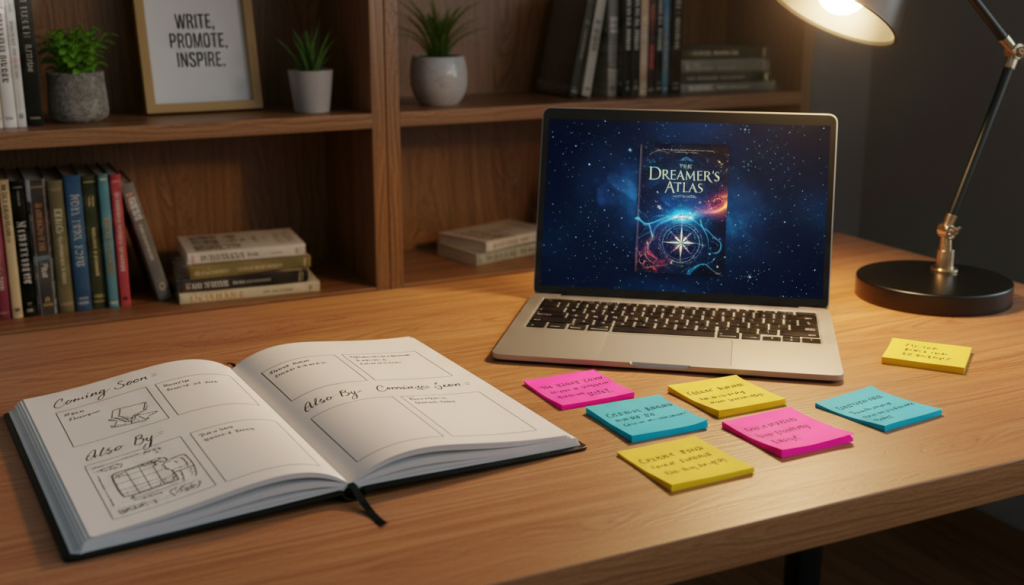
Marketing Elements: Coming Soon and Also By Pages
The end of your book is a great chance. Readers are ready for more after finishing. This is your chance to make them fans for life.
Authors use their book’s end as a marketing tool. These pages help a lot.
Converting Readers into Repeat Customers
An “Also By” page lists your books. It’s easy and works well. If you have many books, this page helps readers find their next one.
Put it after your last chapter so it’s hard to miss. This is great for authors with many books. Your back matter should lead readers to their next book.
Promoting Your Next Book or Series
A “Coming Soon” page gets readers excited for your next book. Series authors often share a sample chapter or teaser. eBooks can have direct links to buy.
But remember Amazon’s rules. Don’t use misleading language or content that breaks their rules.
Here’s what works best:
- A short, exciting blurb about your next book
- A cover image if available
- A direct link to pre-order or purchase
Including Reader Magnets and Newsletter Sign-ups
Reader magnets, like bonus chapters or guides, help grow your email list. Add a simple link to sign up. Make it easy for readers to join.
The best time to ask a reader to join your world is the moment they finish loving your book.
These pages can turn readers into loyal fans. Whether you’re teasing your next book or asking for email sign-ups, they’re key.
Conclusion
I hope this guide has shown you how a book is structured. Your book’s journey starts with the cover and binding. Then, the front matter pages like the title page welcome readers into your world.
The body of your book tells your story or message. It has chapters, parts, and subheadings to keep it organized. The back matter adds value with appendices, glossaries, and author bios.
This structure is not random. It’s based on centuries of tradition that readers trust. Knowing how a book is structured helps you write and publish with confidence. Use this guide to make your book engaging and worth reading again.
FAQ
What are the three main sections of a book?
Every book has three main parts: front matter, body, and back matter. Think of it like a building. The front matter is like the lobby, with pages like the title page and table of contents. The body is where the story or main information is.
The back matter is like the archives, with extra resources like an appendix and author bio. Knowing this structure is key for writing or publishing a book.
What is front matter in a book, and what does it include?
Front matter includes pages before the main content starts. It prepares readers and handles publishing details. It includes the title page, copyright page, and table of contents.
Front matter pages use lowercase roman numerals. Covers are not part of the front matter.
What is the difference between a foreword and a preface?
A foreword is written by someone else, like an expert. It talks about the book’s importance. A preface is written by the author, explaining why they wrote the book.
Forewords are common in nonfiction, especially self-help books.
Do I need a table of contents in my book?
It depends on your book type. Nonfiction books need a table of contents. It helps readers navigate the book.
Fiction books might not need one, especially thrillers. The table of contents goes before the foreword or preface.
What is the difference between a prologue and a foreword?
A prologue is part of the story, at the beginning. It introduces the narrative. A foreword is written by someone else, recommending the book.
Think of the prologue as part of the story, and the foreword as a recommendation.
What should I include on my copyright page?
Your copyright page is very important. It includes copyright notices and legal disclaimers. It also has the book edition, publisher info, ISBN, and printing history.
Amazon offers a free ISBN, but you might need to buy one for wide distribution.
What is back matter, and why is it important?
Back matter includes pages after the main content. It includes the afterword, appendix, and author bio. It’s key for nonfiction and academic texts.
For fiction, it’s great for marketing. A “Coming Soon” page can turn readers into repeat customers.
How should I organize chapters, parts, and sections in my book?
Chapters are the main units of your book. They should focus on specific events or ideas. Fiction chapters don’t have to be the same length.
For larger works, group chapters into parts or sections. This is like acts in a play. Nonfiction might use a Part for each era.
What is an epigraph, and where does it go in my book?
An epigraph is a quote at the beginning of your book. It hints at the theme or content. It’s like an appetizer for your story.
It usually appears before the first chapter. A great example is Chinua Achebe’s *Things Fall Apart*.
What is the difference between an appendix and an addendum?
An appendix provides extra details. It’s common in nonfiction and fantasy/sci-fi. An addendum adds new material after the first printing.
Addenda are rare in modern publishing. They appear in later editions.
Do I need a bibliography if I write fiction?
No, for most fiction. But nonfiction needs a bibliography to avoid plagiarism. It lists every source used.
Even in historical fiction, a bibliography can build credibility.
How do I write an effective author bio for my book?
Your author bio is a chance to connect with readers. Answer key questions like “Who are you?” and “What do you do?”
Include any notable achievements. Keep it friendly and authentic. Use it to invite readers to check out your next book.
What marketing pages should I include in my book’s back matter?
Include a “Coming Soon” page and an “Also By” page. You can also offer a bonus chapter or short story for newsletter sign-ups.
For eBooks, include direct links to your next book. Make sure to follow Amazon’s guidelines.
What are the exterior parts of a book and are they considered part of the anatomy of a book?
Yes, the exterior is part of the book’s anatomy. It includes the front cover, back cover, and spine. Hardcovers have dust jackets with flaps.
The binding is important too. Hardcovers are sewn, while paperbacks are glued. The exterior grabs the reader’s attention first.
What is the difference between footnotes and endnotes in book structure?
Footnotes are at the bottom of the page, while endnotes are at the end of chapters or the book. Footnotes are better for quick references.
Endnotes are for longer asides or source lists. The choice depends on the reader’s experience.
Should I include a glossary or an index in my book?
It depends on your content. A glossary defines technical terms. An index lists key people, places, and ideas with page numbers.
Indexes are common in nonfiction, especially academic texts. Both elements make your book a valuable reference.