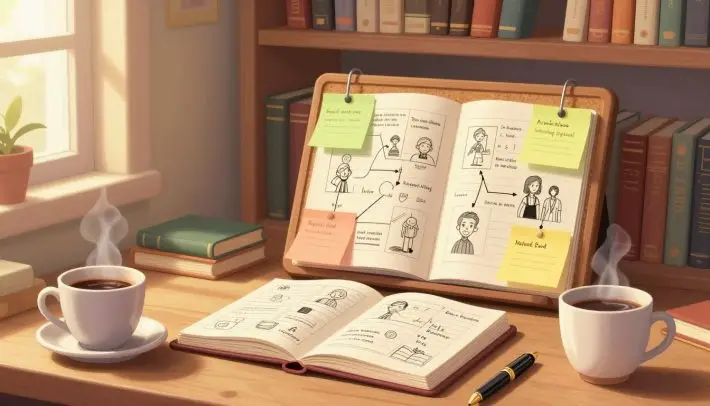
Chapter of the Book: My Complete Writing Guide

In 2018, I saw a woman in Barnes & Noble. She picked up a novel, read a few pages, and put it back. She did this with three more books before finding one she liked. This moment made me realize how crucial the first chapter is.
Chapters have a long history. They started around 400 AD as numbered summaries in manuscripts. Now, they help control pacing and suspense, giving readers breaks.
I’ve studied how authors write chapters. Anne R. Allen spent years learning about books. She even created software for formatting. Her work shows that writing chapters is both an art and a skill.
This guide is what I wish I had when I started. It covers everything from chapter structure to revision. It’s for anyone writing their first novel or their tenth nonfiction book.
Key Takeaways
- Every chapter must grab the reader’s attention, especially the first one.
- Book chapter structure has evolved but its goal remains the same: guiding readers.
- Writing chapters is a skill that gets better with practice and revision.
- Chapter length, titles, and formatting should be intentional, not random.
- Strong chapter openings and endings keep readers engaged from start to finish.
- Revising chapters after the first draft is crucial — weak chapters can ruin a book.
Understanding What Makes a Chapter of the Book Essential
Before we get into writing chapters, let’s talk about why they matter. Chapters do more than just break up your manuscript. They help shape how readers enjoy your story. Good chapter organization can make or break whether someone finishes your book in one sitting.
The Historical Development of Book Chapters
Chapters have been around for a long time. Scholars say they started before 400 AD. Back then, they helped readers find their way in long scrolls and manuscripts. Over time, chapter divisions grew from simple tools to key storytelling elements.
Why Modern Books Need Chapter Divisions
Chapter divisions act as pause points for readers. They let readers stop and come back without losing their spot. Good chapter organization helps with big changes in the story:
- Changes in point of view between characters
- Jumps forward or backward in time
- Shifts to a new location or setting
- Transitions in emotional tone or pacing
Without clear chapter divisions, readers get lost in too much text. This can quickly lose their interest.
The Difference Between Chapters and Scenes
Understanding the difference between chapters and scenes took me a while. Here’s how I see it now:
| Feature | Chapter | Scene |
|---|---|---|
| Definition | A marked division identified by number or title | A sequence set in a specific time and place |
| Structure | Can contain multiple scenes | Exists within a single chapter |
| Separation | Page breaks or new pages | Whitespace or typographic ornaments |
| Purpose | Organizes the reader’s journey | Delivers moment-to-moment action |
Most novels put related scenes in one chapter, separated by line breaks. Knowing this helps you master chapter organization. I’ll show you how to plan your chapter structure as we go.
How I Learned to Master Chapter Writing Through Experience
I’ll be honest — I once spent months stuck on my opening chapter. I’d sit at my desk, stare at a blank screen, and rewrite my first sentence over and over again. Some days, that single sentence ate up my entire writing session. Sound familiar?
The breakthrough came when I stopped obsessing. I realized I was trying to perfect chapter content before I even knew where my story was heading. That’s like decorating a house before you’ve poured the foundation. It just doesn’t work.
“Write your first draft with the door closed. Rewrite with the door open.” — Stephen King
My approach shifted to something far more practical. I began sketching placeholder openings — rough, imperfect starts that let me keep moving forward. Once I completed my manuscript chapters, I circled back to polish those openings with full knowledge of the story’s arc. The difference was night and day.
Here’s what that learning curve looked like for me over the years:
| Writing Stage | My Old Approach | My New Approach | Time Saved |
|---|---|---|---|
| Opening chapter | Perfected before moving on | Drafted a placeholder, revised later | 2–3 months |
| Chapter content planning | No outline, pure instinct | Loose outline with key beats | 3–4 weeks |
| Manuscript chapters revision | Edited each chapter immediately | Completed full draft first | 6–8 weeks |
This experience taught me a simple truth. Mastering manuscript chapters isn’t about getting it right the first time. It’s about giving yourself permission to get it wrong, keep writing, and fix the chapter content during revision. That mindset changed everything for me — and it set the stage for how I now approach opening chapters specifically.
The Opening Chapter: Your Most Critical First Impression
Your opening chapter can make or break your book. Readers, agents, and editors judge your work by those first pages. The opener needs the most care and attention.
Why I Write My First Chapter Last
This might seem odd, but it works. Author Anne R. Allen rewrote the start of Catfishing in America after feedback. I do the same. After planning the whole book, I go back to the start.
Many writers find their story starts later. The first chapters are just getting ready. Writing the opener last helps me know where the story goes and what readers need first.
Common Mistakes in Opening Chapters
New writers often make the same mistakes. Here are the most common ones:
- Spending pages on a character who gets killed off right away
- Loading the opener with too much backstory and flashbacks
- Introducing too many minor characters readers won’t see again
- Starting with a dream sequence or alarm clock scene
These mistakes upset readers. They get invested in characters only to see them go or nothing happen.
Creating That Perfect Hook
“A great first sentence is the doorbell that tells the reader someone interesting has arrived.” — Ruth Harris
Your hook doesn’t need to be dramatic. It should ask a question that readers must answer. When writing, I aim to create tension from the start. A good chapter breakdown starts with an opener that grabs the reader’s interest.
Determining the Ideal Chapter Length for Your Genre
Many ask: How long should a chapter of the book actually be? The answer varies by genre. Each genre has its own length and pace expectations. Knowing these helps you create a structure that keeps readers hooked.
Fiction Chapter Length Guidelines
Fiction chapters usually range from 1,500 to 4,500 words. Novels often have 12 chapters, but this can change. Thrillers by James Patterson have short chapters for quick action. Literary fiction, like Donna Tartt’s, has longer chapters for deep dives.
- Short chapters (under 2,000 words) emphasize fast action or pivotal moments
- Mid-range chapters (2,000–3,500 words) suit most genres comfortably
- Longer chapters (3,500–5,000 words) work for complex narratives with layered scenes
Nonfiction Chapter Length Standards
Nonfiction chapters explore a single concept fully. I aim for 3,500 to 5,500 words per chapter. Most nonfiction books have 10 to 20 chapters.
| Genre | Average Chapter Length | Typical Chapter Count |
|---|---|---|
| Thriller/Mystery | 1,500–3,000 words | 20–40 |
| Literary Fiction | 3,000–5,000 words | 10–15 |
| Self-Help | 3,500–5,500 words | 10–15 |
| Business/Nonfiction | 4,000–6,000 words | 12–20 |
When to Break the Rules
Consistent chapter lengths create a rhythm readers feel. I use this rhythm to signal important moments. A chapter that’s shorter or longer than usual means something big is happening.
Long chapters can mean slow pacing or unrelated scenes. This is a sign to fix your structure before focusing on chapter endings.
Planning Your Chapter Structure Before Writing
I’ve learned that a solid plan saves me hours of rewriting. Before I type a single word, I map out my chapter organization. This gives every section a clear purpose. It’s like planning a road trip — you need to know the stops before you hit the highway.
Not every writer plans the same way. Plotters love mapping out chapter content in advance. On the other hand, pantsers prefer to discover the story as they write. Both approaches work. If you’re an organic writer, you can carve out your chapter divisions during revision.
The key is that every chapter gets structured at some point in the process.
Before writing each chapter, I ask myself a few critical questions:
- What emotional state is my reader in after the previous chapter?
- Does the intensity level need to rise, fall, or shift?
- What must readers learn or experience in this section?
- How does this chapter content serve the bigger story?
Nonfiction writers benefit the most from detailed chapter organization. A logical outline keeps your argument tight and helps you write faster. According to a 2023 survey by the Alliance of Independent Authors, nonfiction authors who outlined their chapters before drafting completed manuscripts 40% quicker than those who didn’t.
Every chapter should feel like its own complete experience while still being a vital piece of the whole puzzle.
Each chapter must pull double duty. It needs to satisfy readers in the moment and push them toward what comes next. Once you master this balance in your planning stage, writing strong openings and endings becomes much easier.
Essential Elements Every Chapter Must Accomplish
Every chapter in your book must do its part. Think of chapters as tiny engines that drive the story forward. Each chapter must achieve specific goals, or readers will lose interest quickly. Let me show you the four key elements I include in every chapter I write.
Introducing and Developing Characters
Your characters should appear on page one and earn the reader’s attention. I used to focus on making my protagonists likable. But that was a mistake. Characters like Sherlock Holmes, Scarlett O’Hara, and Jay Gatsby are fascinating, not necessarily likable.
Make your characters interesting, not just sympathetic.
Setting Tone and Atmosphere
The mood of your chapters must match the genre from the start. A dark thriller shouldn’t begin with light banter at a coffee shop. A beach romance shouldn’t start on a stormy night. I set the emotional tone early to guide readers.
Advancing Your Plot Meaningfully
If nothing changes in a chapter, cut it. I ask, “What is different now?” after writing. Something must change — a decision, a revelation, or a new challenge. Each chapter must move the story forward.
Creating Conflict and Tension
Conflict should start on page one. Stories thrive on struggle. I introduce problems early, not waiting for the midpoint. Even with a hero’s journey, small conflicts should appear right away. Here’s a quick guide I use:
| Element | Purpose | When It Should Appear |
|---|---|---|
| Character Introduction | Build reader investment | First page of the chapter |
| Tone and Atmosphere | Set genre expectations | Opening paragraphs |
| Plot Advancement | Keep momentum alive | Throughout the chapter |
| Conflict and Tension | Create urgency and stakes | Page one, building steadily |
Master these four elements in your chapters, and readers will keep turning pages. This is where strong chapter openings come in.
Starting Each Chapter with Maximum Impact
The first few lines of a chapter can make or break it. Your book sections must grab attention right away. No slow starts allowed. Every chapter should start at the latest possible moment in the scene, diving readers into something important.
Beginning in the Middle of Action
I never start a chapter with a character just sitting or waiting. I jump in where the tension is already high. It’s not always a car chase. A heated conversation, an awkward reunion, or a surprising discovery works too. The goal is momentum. Readers should feel like they’re entering a scene where something is already happening.
Establishing Setting Without Info-Dumping
Readers need just enough detail to know where they are. Are we in a Los Angeles homeless encampment or an alien throne room? That’s the clarity I aim for. Author William L. Hahn calls this “sneaky worldbuilding.” It’s about adding setting details through character actions and dialogue, not long descriptions. A single image can do more than a whole paragraph of text.
The Four-Step Chapter Opening Method
I follow a simple method for every chapter:
- Orient the reader — Use a title, dateline, or opening sentence to establish location and time.
- Spark curiosity — Offer a partial image or open question that demands the reader’s mental energy.
- Focus attention — Zero in on a specific character, movement, or problem.
- Unfold naturally — Let the chapter’s action flow from that focused starting point.
This method keeps your book sections tight and focused. Once you’ve nailed the opening, crafting strong chapter endings becomes easier.
Crafting Chapter Endings That Keep Pages Turning
A great chapter opening gets readers in the door. A great chapter ending makes them refuse to leave. When writing book chapters, I treat the last few paragraphs of each one as a promise — a reason for the reader to stay up past midnight.

The cliffhanger is the most popular tool for this, but I want to be honest: not every chapter needs one. Ending mid-action works in thrillers and suspense. It feels forced in a quiet literary novel or a self-help guide. The key is matching your chapter divisions to the emotional rhythm of your story.
For fiction, I focus on these closing strategies:
- End with a revelation that shifts the reader’s understanding
- Leave a question unanswered — but make it one readers care about
- Close on a character decision that carries real stakes
- Cut the scene right before a major event unfolds
Nonfiction chapter divisions work differently. I wrap up each chapter after the core idea feels complete, often with a brief summary or a bridge sentence pointing toward the next topic. Readers should feel satisfied and curious at the same time.
| Genre | Best Ending Strategy | Reader Effect |
|---|---|---|
| Thriller / Mystery | Mid-action cliffhanger | Immediate page turn |
| Literary Fiction | Emotional resonance or quiet revelation | Reflective anticipation |
| Romance | Unresolved tension between characters | Emotional investment |
| Self-Help / Nonfiction | Summary with a transition to the next concept | Clarity and motivation |
| Fantasy / Sci-Fi | World-building twist or prophecy hint | Deep curiosity |
Whether someone bookmarks the page or keeps reading, your chapter ending shapes that choice. I always draft my endings with one goal: make putting the book down feel like the wrong decision.
Chapter Titles and Numbers: Making Strategic Choices
Choosing chapter titles is a big deal for writers. A good title can hint at what’s to come. It can also set the mood or place the story in time.
A bad title can confuse readers before they even start. This can make them lose interest.
When titles and numbers work together, your book chapter structure gets stronger. I’ll show you how to do this for fiction, nonfiction, and manuscript formatting.
When to Use Chapter Titles in Fiction
Fiction books often use numbers or titles, or both. I try to keep chapter titles short, under seven words. They should give a hint of what’s coming without giving too much away.
Here are some tips:
- Name the viewpoint character — key for stories with many viewpoints
- Include dates, times, or locations if the story depends on a timeline
- Use a memorable line of dialogue or description from the chapter
- Foreshadow events with abstract or concrete imagery
Writers like Karen Russell and Chuck Palahniuk use chapter titles as tools. They might use countdown clocks or character-status markers. In Notes on an Execution by Danya Kukafka, titles like “12 Hours” and “0” keep tension high. In The Open Curtain by Brian Evenson, repeated chapter numbers show the protagonist’s fractured mind.
Creating Informative Nonfiction Chapter Headings
Nonfiction needs both numbers and descriptive titles. Readers should be able to find what they’re looking for fast. Each chapter should promise what readers will learn inside.
Formatting Consistency Throughout Your Manuscript
Choose a chapter structure and stick to it. If Chapter 1 has a title and subtitle, so should every chapter. The only time to break this rule is for special sections like a prologue or an interlude from a different narrator.
A chapter title isn’t decoration. It’s a contract between you and your reader about what comes next.
Connecting Chapters for Seamless Story Flow
Writing chapters alone is one thing. But making them flow like a single story is another challenge. I see each chapter as a bridge, not a wall. The content before and after must feel connected, even when settings, time, or view change.
Managing Pacing Between Chapters
I think about the intensity of the last chapter when writing the next. If it was intense, I give readers a break. If two chapters were slow, the story feels slow too. Here’s how I manage:
- After an intense chapter, slow down with reflection or reaction
- After a quiet chapter, speed up with new conflict or a revelation
- Vary chapter length to match the story’s rhythm
“A story’s rhythm is not in its words — it’s in its silences.” — Ursula K. Le Guin
Transitioning Emotional Tones
Big emotional shifts between chapters can confuse or tire readers. When moving from sadness to humor, I add a brief moment to ground the reader. I let the character react to what happened before moving on. This keeps readers engaged and emotionally connected.
Building Reader Anticipation
Every chapter ending should leave a question. Every chapter opening should hint at an answer while raising a new question. I don’t repeat what happened. Instead, I let curiosity grow by changing focus or introducing a new problem.
This pattern of question, partial answer, new question keeps readers turning pages. It turns a collection of chapters into an experience readers can’t stop reading.
Avoiding Common Chapter Writing Pitfalls
I’ve made every mistake on this list. That’s why I can warn you about them now. When you look at your chapters again, you’ll see weak writing patterns.
The biggest trap is Morning routine chapters. Your hero wakes up, eats, brushes teeth, and drives to work. Then, the story starts. These chapters are easy to write but put readers to sleep. Skip to the conflict.
“Setting is not just a backdrop — it influences and even drives plot.”
— Ruth Harris, author and former book editor
Here are common pitfalls I watch for:
- The “darling” chapter — a scene you love but the story doesn’t need
- The transport chapter — moving characters with nothing happening
- The info-dump chapter — too much backstory or world-building
- The setup chapter — getting characters ready for the next chapter
Location changes can be done with one sentence. Your readers don’t need a travel log. Infodumps should be spread out, making information feel natural and relevant.
When I find weak chapters, I dig deeper. A bad chapter often means a bigger problem. Maybe the plot stalls or a character lacks motivation. Fixing the surface issue without solving the root cause creates new problems.
Be honest with yourself during this process. Every chapter must earn its place in your manuscript — no exceptions.
Revising Your Chapters After the First Draft
I have one golden rule: wait until you type “the end” before revising. Make notes in the margins. Flag weak spots. But do not rewrite while still drafting. This can slow down your book for months or years.
After finishing the draft, do a detailed chapter breakdown. Some writers write one big file and then divide it into chapters. Others split chapters as they write. What’s important is that your chapter organization helps the reader during revision.

Identifying Chapters Where Nothing Happens
Read each chapter and ask: what changes here? If a chapter feels unmemorable, even with good plot advancement, it needs something special. Cut or merge anything that doesn’t belong.
Eliminating Unnecessary Setup Chapters
Setup chapters might seem like they’re needed, but think again. Check if each chapter supports the main event or if it’s just extra. If the story really starts later, then the early chapters might need to go.
Strengthening Weak Chapter Openings
Make sure every chapter opening grabs the reader’s attention. Go back to the tips on starting strong. Replace slow starts with action, dialogue, or a question that makes you curious.
Testing Chapter Breaks with Beta Readers
Give your edited book to early readers before publishing. Their feedback will show if your chapter breaks work. Use their suggestions to make every chapter better.
| Revision Task | What to Look For | Recommended Action |
|---|---|---|
| Empty chapters | No character growth, conflict, or plot shift | Cut or merge with a stronger chapter |
| Excessive setup | Backstory or worldbuilding that delays the story | Weave details into active scenes |
| Weak openings | Slow starts, weather descriptions, waking-up scenes | Begin mid-action or with tension |
| Poor chapter breaks | Readers report losing interest at certain points | Adjust breaks based on beta reader feedback |
Conclusion
Books are made one chapter at a time. You can plan every detail or let the story unfold naturally. Writing each chapter with purpose makes your manuscript stronger.
Every chapter has a job. It might move the plot, deepen a character, or teach something new. Knowing what each chapter must do gives your writing direction and energy.
Chapter divisions are more than just page breaks. They control the pace, build suspense, and guide readers. Using them with purpose makes writing less overwhelming and more rewarding for everyone.
One of the best things I did was talk to other writers about my chapters. Sharing ideas about structure and purpose helped me see my work in new ways. I suggest finding a community, whether local or online, to make writing book chapters easier.
Writing with others makes chapter divisions second nature. With practice and honest feedback, you’ll get better at it.
FAQ
How long should a chapter of the book be for fiction versus nonfiction?
Fiction chapters usually have 1,500 to 4,500 words. Nonfiction chapters are often longer, with 3,500 to 5,500 words. But, there’s no strict rule for chapter length.
Long chapters might mean slow pacing or unrelated scenes. Short chapters are great for quick action or highlighting a key moment. Let the story guide your chapter divisions, not just word count.
How many chapters should my book contain?
Novels usually have about 12 chapters. Nonfiction books might have 10 to 20 chapters. But, there’s no one-size-fits-all number.
Your chapter structure should fit the story or subject. Some novels have 50 short chapters, while others have fewer but longer ones. Focus on making each chapter meaningful, not just the number.
Should I write my opening chapter first or last?
Write your opening chapter after finishing the rest of the book. Anne R. Allen, who created Atticus formatting software, found starting early can be a waste of time.
She rewrote her novel’s opening based on feedback after finishing the draft. Start with a placeholder and come back to perfect the first chapter once you know your story.
What’s the difference between a chapter and a scene in book sections?
A scene is a specific time and place with characters experiencing events. A chapter is a broader division with a number or title. Most novels have chapters with multiple scenes.
Think of scenes as building blocks and chapters as rooms. Chapters help with viewpoint shifts, location changes, or time jumps.
When did book chapters originate, and why do they matter today?
Chapters started before 400 AD as part of early indexing systems. Today, they help readers navigate and remember the story. They’re crucial for grabbing readers’ attention, especially in the opening chapter.
How do I start a chapter with maximum impact?
Use a four-step method for opening chapters. First, tell readers where they are. Second, grab their attention with questions or images. Third, focus on characters or problems. Fourth, unfold the chapter action naturally.
Start each chapter at the latest possible scene point. Avoid unnecessary waiting or thinking scenes. Use “sneaky” worldbuilding to set settings without info dumps.
Should I use chapter titles, numbers, or both in my chapter organization?
Fiction allows flexibility, with many using both numbers and titles. Chapter titles should hint at content without spoiling it. Nonfiction should use both for easy reference.
Chapter titles can tease events, include character names, or pull memorable dialogue. Named chapter divisions help in multiple-POV novels.
Do I need to outline my chapter breakdown before writing?
It depends on your writing style. Planners organize chapters in advance, while organic writers add them later. Nonfiction benefits from detailed outlines for structure.
Consider the reader’s mindset, intensity, and emotional tone when planning. Some writers divide chapters while writing, while others do it later.
How do I craft chapter endings that keep readers turning pages?
Chapter endings should keep momentum like beginnings. Cliffhangers work by ending mid-action. But, don’t force cliffhangers in every chapter.
Nonfiction chapters should end with complete understanding of main ideas. The goal is to keep readers engaged, whether they bookmark or return later. Think about what will pull them back.
What are the biggest mistakes new writers make with chapter writing?
New writers often waste time on unnecessary scenes. Remove chapters that don’t advance the plot. Avoid minor characters who disappear quickly.
Don’t create infodump chapters. Some writers keep chapters for beloved scenes, even if the story can survive without them. Every element should influence and advance the plot.
How do I connect chapters for seamless story flow and manage pacing?
Consider the previous chapter’s intensity when deciding the next one’s energy. Decide whether to elaborate on previous changes or switch focus. Plant questions for the next chapter to keep interest.
Consistent chapter lengths create a rhythm. Break it for effect at key moments, like with a short chapter in a series of longer ones.
Should I revise my chapters as I write them or wait until I finish the manuscript?
Wait until you’ve written “the end” before revising. Make notes but don’t revise too soon. It can keep you stuck.
Once done, question each chapter’s importance. Chapters that feel unmemorable might need more action or original handling. Get feedback from early readers before publishing.
Do protagonists introduced in the opening chapter need to be likeable?
No, but they must be interesting. Characters like Sherlock Holmes show that protagonists don’t need to be likable. Focus on making them compelling and complex.
Introduce main characters on the first page. Give them something memorable. Let their depth unfold through the story.