Writing from Different Perspectives: Key Techniques
You've written a scene that works beautifully from one character's viewpoint, then discovered that the other person in the room has an equally important story. The temptation is to switch narrators immediately. Sometimes that solves the problem. Just as often, it drains the scene of tension, repeats information, or leaves readers unsure whose mind they're inhabiting.
Writing from different perspectives isn't just a matter of replacing “I” with “she” or adding another chapter narrator. Perspective determines what a reader can know, how closely they experience emotion, and whether an argument feels balanced or one-sided. Used deliberately, it gives a story greater range and gives nonfiction a more credible structure. Used casually, it creates head-hopping, diluted voices, and unnecessary complexity.
The practical skill is choosing the right lens for each passage, then controlling the consequences of that choice. You need to know what a perspective reveals, what it conceals, and why a shift earns its place.
Table of Contents
- Understanding Narrative Perspectives
- Shifting Perspectives Within Scenes
- Why Perspective-Taking Improves Writing Quality
- First-Person Trends Versus Multi-Perspective Benefits
- Maintaining Voice Consistency Across Shifts
- Your Perspective-Mastery Action Plan
Understanding Narrative Perspectives
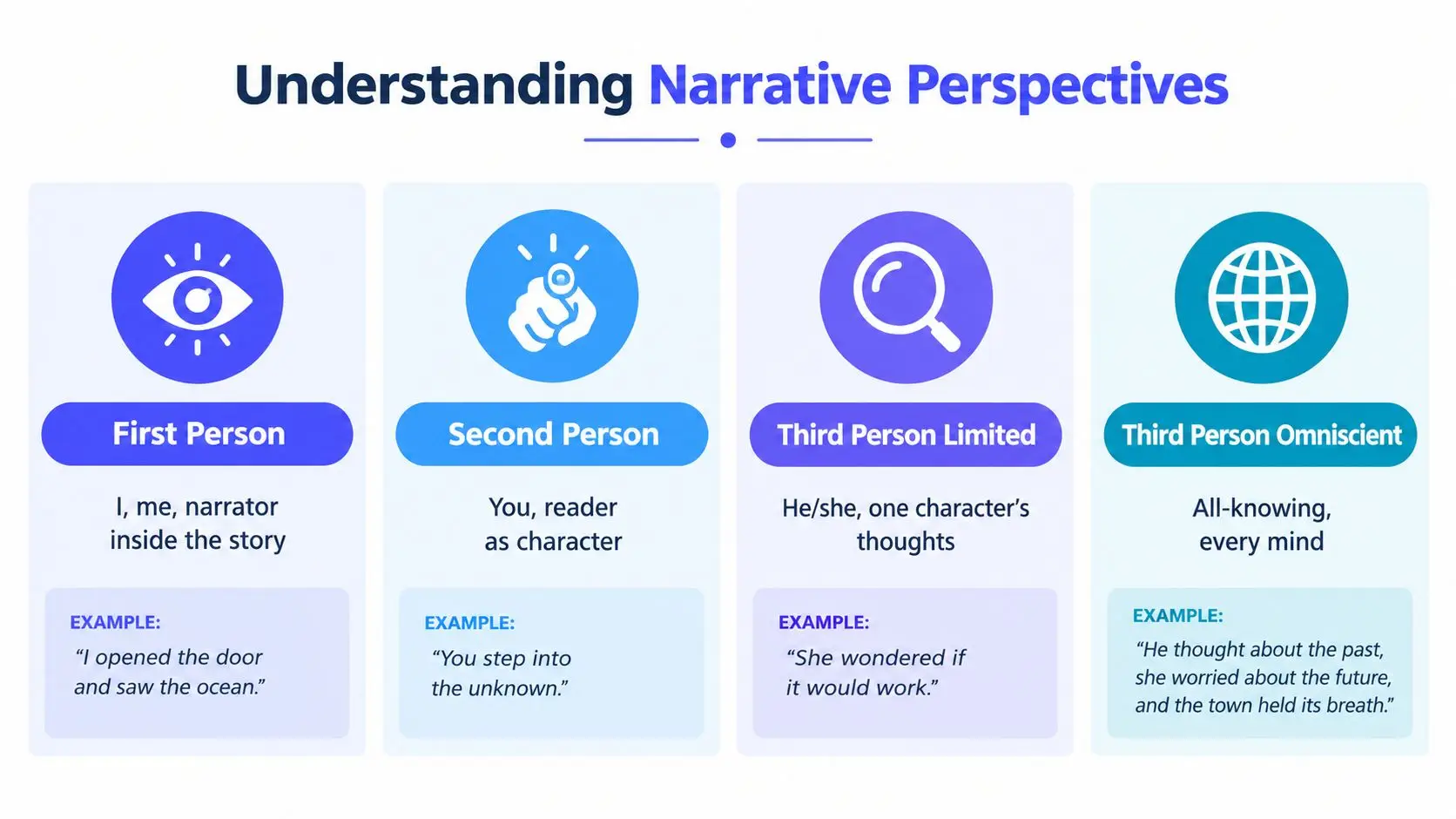
Narrative perspective is the position from which a reader experiences events. It controls the pronouns on the page, but its deeper function is informational and emotional. A narrator decides what the reader sees, what remains uncertain, and how much distance exists between an event and the person interpreting it.
Four useful lenses
- First person uses “I,” “me,” and “my.” The narrator is inside the story, so the prose can deliver immediate emotion, private judgment, and deliberate unreliability. The cost is restricted knowledge. If the narrator doesn't witness an event or understand a motive, the reader generally shouldn't receive it directly.
- Second person uses “you” and “your.” It places the reader, or a character addressed as the reader, inside the action. That can create urgency and intimacy, but it can also feel coercive if the supposed “you” wouldn't plausibly make the choices the narration assigns.
- Third person limited uses “he,” “she,” or “they” while staying inside one character's awareness at a time. It offers emotional closeness without requiring the entire book to sound like a diary. You can change viewpoint characters between scenes or chapters, but each passage needs a stable interior anchor.
- Third person omniscient gives the narrator access to multiple minds, locations, and layers of context. It suits stories that need breadth or dramatic irony, though the narrator's voice must be strong enough to connect those movements.
A useful diagnostic is simple: who knows this, who feels this, and who would notice this detail? If the answer changes halfway through a scene without a clear structural signal, you may have slipped into head-hopping.
For a closer explanation of the most flexible option, compare your draft with this guide to third person POV in fiction. Then choose based on the scene's job. First person is often strongest for confession. Second person can sharpen an instruction or psychological disturbance. Third person limited handles sustained character arcs well. Omniscience earns its space when the story needs a narrator who can interpret more than any one character could know.
Shifting Perspectives Within Scenes
Take one dramatic moment, such as a confrontation over a missing key. Don't start by redesigning your whole manuscript. Write the same moment three times, keeping the action constant while changing only the viewpoint.
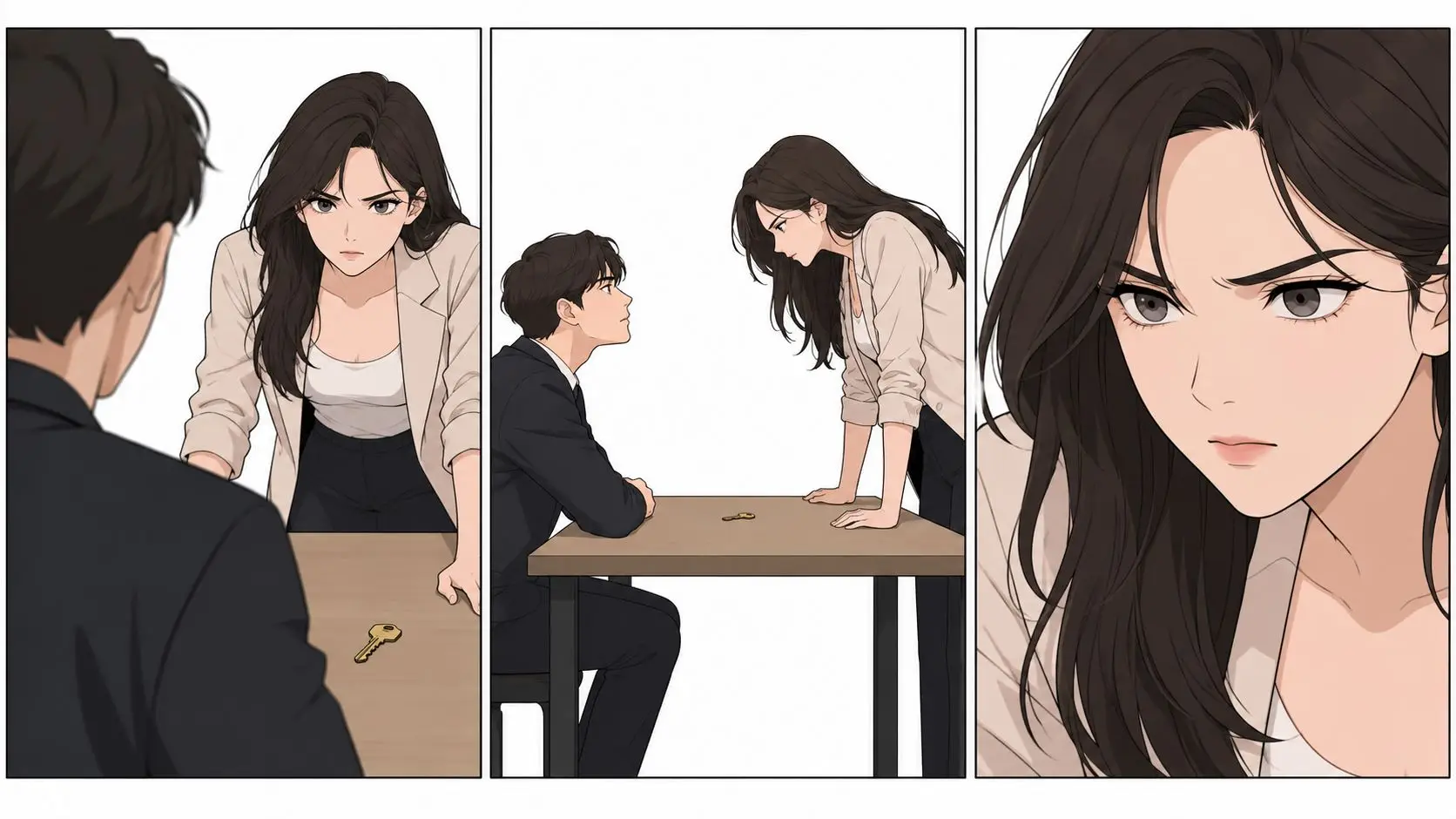
Run the three-draft exercise
First person might sound like this: I put the key between us because I needed him to see what he'd taken. The sentence gives you motive and emotion immediately, but it also carries the narrator's interpretation. If she's angry, ashamed, or mistaken, the language should reflect that bias.
Second person changes the reader's position: You place the key between you, though you know he'll deny touching it. This creates complicity and pressure. It works when the direct address is a deliberate artistic device, not when the writer uses “you” merely to avoid choosing a character.
Third person limited creates slightly more room: Mara placed the key between them. Daniel looked at it, and she mistook his silence for guilt. The narration remains close to Mara, yet the grammatical distance lets the sentence expose a possible error in her reading.
After each version, make two columns titled revealed and withheld. Record the information that became available and the information that disappeared. First person may expose physical sensations and private rationalization. Second person may make the reader feel accused or responsible. Third person limited may highlight the gap between observation and truth.
Practical rule: A perspective shift should change the reader's access to the scene, not merely change the pronouns.
Now test the shift inside the manuscript. Keep one viewpoint per scene unless the break itself has a strong purpose. Signal a new perspective with a chapter break, scene break, location change, or immediate voice marker. If the passage depends on an unreliable narrator, study the mechanics in this guide to writing an unreliable narrator, especially the difference between deliberate distortion and accidental inconsistency.
Use the exercise as a diagnostic, not a command to include all three versions. The best final choice is the one that delivers the scene's necessary emotion and information with the least friction.
Why Perspective-Taking Improves Writing Quality
A scene can contain accurate facts and still feel thin if every character interprets them the same way. Perspective practice makes writers separate what they believe from what another person can understand. That separation strengthens revision in fiction, analysis, and practical writing. Represent a reader's objection, a stakeholder's concern, or an opposing character's motive, and the argument gains clearer limits and sharper stakes.
Research supports that craft benefit. A 2007 study found that writers communicated more effectively after taking the reader's perspective. In one experiment, writers revised after completing a perspective-taking task, and readers improved in identifying geometric figures, while the control group did not show a reliable improvement. The same research connected higher-level perspective-taking with stronger essays after accounting for demographics and essay length. The educational research summary explains the findings.
Own-side writing versus dual perspective
Source-based analytical writing distinguishes among own-side, dual-perspective, and integrative-perspective arguments. Own-side writing develops the writer's position. Dual-perspective writing includes that position and another viewpoint. Integrative writing connects or reconciles those views within a broader claim.
The practical problem is that writers usually begin with the frame they already understand. In the summarized educational data, seventh-grade students wrote about 13 T-units on average. Fewer than half reflected an own-side perspective, and only about 1 unit on average reflected a dual perspective. Perspective-taking does not appear automatically because an assignment uses the word “analysis.”
A study of 195 seventh graders writing source-based analytical essays found that students strongly favored their own perspective. Greater perspective-taking, particularly dual perspective, was associated with higher writing quality after controlling for demographics and essay length. Apply that finding at revision: draft the position you understand, then identify the strongest alternative and show how it changes the claim. Avoid a decorative counterargument. Represent what that stakeholder knows, wants, fears, and misunderstands.
Apply the method to any draft
For each major claim, annotate three elements:
- Your position, including the evidence supporting it.
- The affected reader or stakeholder, including the likely challenge.
- The relationship between the views, whether they conflict, overlap, or serve different needs.
Revise at paragraph level. Add the other viewpoint where it creates productive tension, not where it interrupts a clear explanation. In character work, connect this exercise to developing a character's motivation. A character's motives determine which facts feel persuasive, threatening, or irrelevant. In business or research writing, the same discipline prevents an author from answering only the question they wished readers had asked.
First-Person Trends Versus Multi-Perspective Benefits
First person has a genuine strategic advantage in genres built on immediacy. A 2026 industry report described a notable rise in first-person narratives in romance and related commercial fiction, with bookstore inventory increasingly dominated by first-person books and readers explicitly asking for consistent viewpoint without omniscient interruptions, as reported by Slate's discussion of current POV preferences.
That preference doesn't make first person universally superior. It means reader expectation is part of the craft decision. A romance reader seeking sustained emotional access may experience an unexpected omniscient aside as a broken promise. A literary novel about a community may need several consciousnesses to show how the same event distributes harm and responsibility.
| Choose first person when | Choose multiple perspectives when |
|---|---|
| The narrator's inner life carries the main tension | Different characters hold necessary information |
| Subjective bias or unreliability is central | The conflict depends on competing interpretations |
| Emotional immediacy matters more than broad context | The story needs social, ethical, or geographic scope |
| A consistent voice strengthens genre expectations | A second viewpoint changes the meaning of earlier events |
The trade-off is concentration versus range. First person gives you a powerful filter, but every scene must justify how the narrator knows what it reports. Multiple perspectives give you contrast, but each narrator needs a distinct reason to exist. Adding a viewpoint merely to explain a plot detail usually produces a weaker scene than revising the existing narrator's access.
Writers working in commercial fiction can use first person narrator tips to refine intimacy, reliability, and voice before deciding whether a second narrator is necessary. For nonfiction, don't confuse a personal “I” with a complete argument. A strong essay may use first person for experience, then introduce another stakeholder's perspective to test the conclusion.
A market convention can guide your opening choice, but it can't replace a scene-level reason.
Stay in one perspective when a continuous emotional experience matters. Shift when the new viewpoint reveals a consequence, motive, or contradiction that the current narrator cannot deliver.
Maintaining Voice Consistency Across Shifts
A new viewpoint should feel like a new mind, not the same author wearing a different name. Voice emerges from vocabulary, rhythm, attention, judgment, and emotional baseline. Two characters may witness the same rain, but one notices traffic hazards while another notices the smell of wet stone.
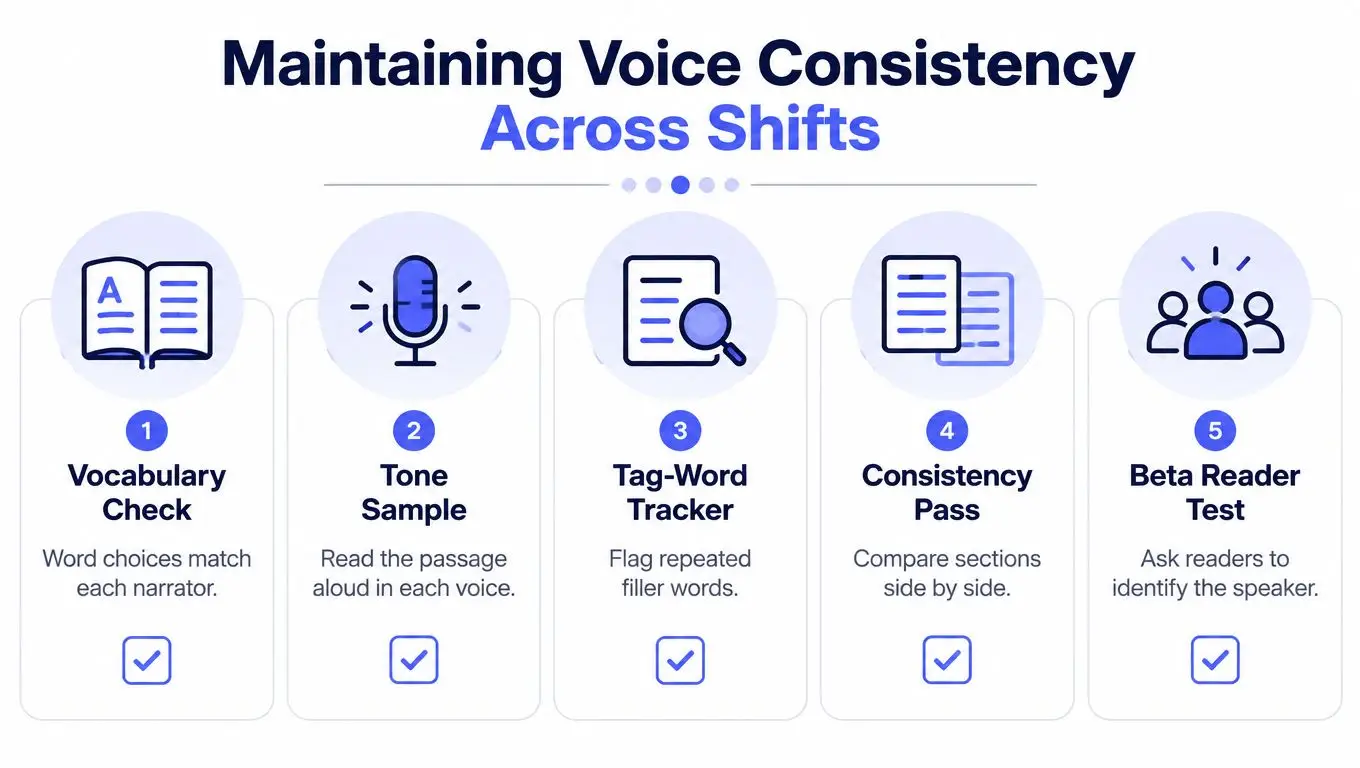
Build a working voice profile
Create a compact profile for every viewpoint character. Include:
- Vocabulary: words they prefer, avoid, misunderstand, or use incorrectly.
- Syntax: clipped statements, long qualifications, fragments, or formal constructions.
- Attention: objects, risks, people, or patterns they notice first.
- Worldview: the belief they use to explain other people's behavior.
- Emotional baseline: guarded, eager, suspicious, amused, exhausted, or another dominant state.
Write a short neutral paragraph in each voice. Don't make it a dramatic monologue. Describe a room, a delayed train, or an ordinary meal. If the passages sound interchangeable, the profiles haven't reached the level of worldview. Add each character's private metaphor system and their habitual way of assigning blame.
Place and test the shifts
Signal the change early. A chapter label is clean. A scene break works if the first sentence immediately establishes the new consciousness through voice, setting, and attention. Avoid moving from one mind to another within a continuous scene unless you're intentionally using an omniscient narrator. Most readers will interpret an unexplained interior jump as an error.
Read each viewpoint aloud, then compare passages side by side. Mark repeated filler words, identical sentence openings, and descriptions no character would naturally make. A beta reader can perform a useful blind test by identifying the speaker without seeing the character label.
The editor inside a long-form platform such as Storyloft can also support this workflow through manuscript notes, side-by-side research, comments, tone analysis, and voice-aware revision tools. Treat any automated suggestion as a draft aid, not a substitute for deciding what each narrator knows and values. For a broader distinction between character language and narrative delivery, consult this guide to narrative voice.
Your Perspective-Mastery Action Plan
Start with one scene, not an entire manuscript. Choose a moment containing conflict, discovery, or a decision, then rewrite it in first person, second person, and third person limited on separate days. Keep the facts stable and mark what each version reveals, hides, intensifies, or softens.
Next, audit your current project. For every viewpoint character, write one sentence answering: What can only this person show the reader? Remove or combine narrators whose answer duplicates another character's function. Keep a viewpoint when it changes the emotional meaning or supplies necessary knowledge, not because the character happens to be present.
For analytical writing, use a second pass focused entirely on perspective. Annotate each major claim with your position, the strongest affected stakeholder, and the point of tension between them. The research on dual-perspective writing supports this as more than a creativity drill. It gives you a disciplined way to test clarity, anticipate objections, and make reasoning visible.
Finish with a voice consistency pass:
- Read each narrator's opening paragraph aloud.
- Compare vocabulary, rhythm, and descriptive attention.
- Check every shift for a clear scene or chapter signal.
- Ask a reader to identify the speaker without a label.
- Cut any perspective that adds repetition rather than consequence.
Mastery doesn't mean using every viewpoint type. It means choosing a lens deliberately, shifting only when the reader gains something, and making every narrator sound like a person with a distinct history of attention.
Storyloft brings drafting, manuscript-aware AI editing, research organization, character development, illustration, cover design, and publishing workflows into one cloud-based workspace for long-form projects. If you're practicing alternate viewpoints or managing a manuscript with several narrators, visit Storyloft and test the perspective workflow in your own draft.