8 Examples of Voice in Writing Explained
Voice is the feeling behind the words, and readers usually notice it before they can name it. In writing, voice is not the same as plot, tone, or point of view, even though the three often work together. Readers pick it up from recurring choices in vocabulary, sentence length, rhythm, imagery, distance, and attitude, which is why examples of voice in writing are best understood by looking at the language itself rather than a label on the page.
That matters because voice has long been treated as a serious part of writing, not a vague extra. Writing scholarship has studied it for more than half a century, and modern guidance breaks it into macro, middle, and micro functions so writers can see how structure, source use, and language all contribute to a unified effect University of Melbourne voice guidance. The practical payoff is simple, readers infer voice from repeated textual signals across an entire manuscript, not from one clever sentence.
Below, each sample passage gets the same lens, diction, sentence movement, reader relationship, emotional effect, risks, and revision tactics. Keep that lens nearby. It turns voice from a mystery into a repeatable editing habit.
Table of Contents
- 1. Conversational Voice
- 2. Academic and Formal Voice
- 3. Narrative and Storytelling Voice
- 4. Humorous and Comedic Voice
- 5. Inspirational and Motivational Voice
- 6. Stream of Consciousness Voice
- 7. Minimalist Voice
- 8. Expert and Authority Voice
- Comparison of 8 Writing Voices
- Turn Voice Recognition Into a Revision Method
1. Conversational Voice
Conversational voice sounds like someone talking with you rather than lecturing at you. It usually uses everyday diction, shorter sentences, direct address, and a relaxed rhythm that lowers the barrier between writer and reader. In memoir, self-help, and contemporary fiction, that style makes hard ideas feel usable because the author seems present, responsive, and human.
A line like, “You don't need a perfect plan. You need a first step,” shows the shape of this voice. The diction is plain, the syntax is punchy, and the reader relationship is intimate without becoming sloppy. That's why conversational passages often feel welcoming in books such as Brené Brown's Dare to Lead or in personal essays that read like a smart friend explaining something useful.
What to watch for
- Diction: Choose contractions, everyday verbs, and clear nouns. If a sentence sounds like a seminar handout, it's probably drifting away from this voice.
- Sentence movement: Mix short setup lines with slightly longer explanations. That keeps the cadence natural instead of robotic.
- Reader relationship: Use “you” when the point is guidance, but don't overuse it so the prose starts sounding pushy.
- Revision risk: Too much casual phrasing can flatten authority. Conversational doesn't mean careless.
Practical rule: If a paragraph sounds formal when you read it aloud, simplify the syntax before you add more detail.
A useful test is to compare the passage with dialogue-heavy or direct-address writing. The linked guidance on how to write better dialogue can help you hear whether the speaker sounds natural or staged. If you're refining a manuscript, you can also use tone notes to mark where the voice suddenly stiffens, especially when a chapter moves from story to explanation.
2. Academic and Formal Voice
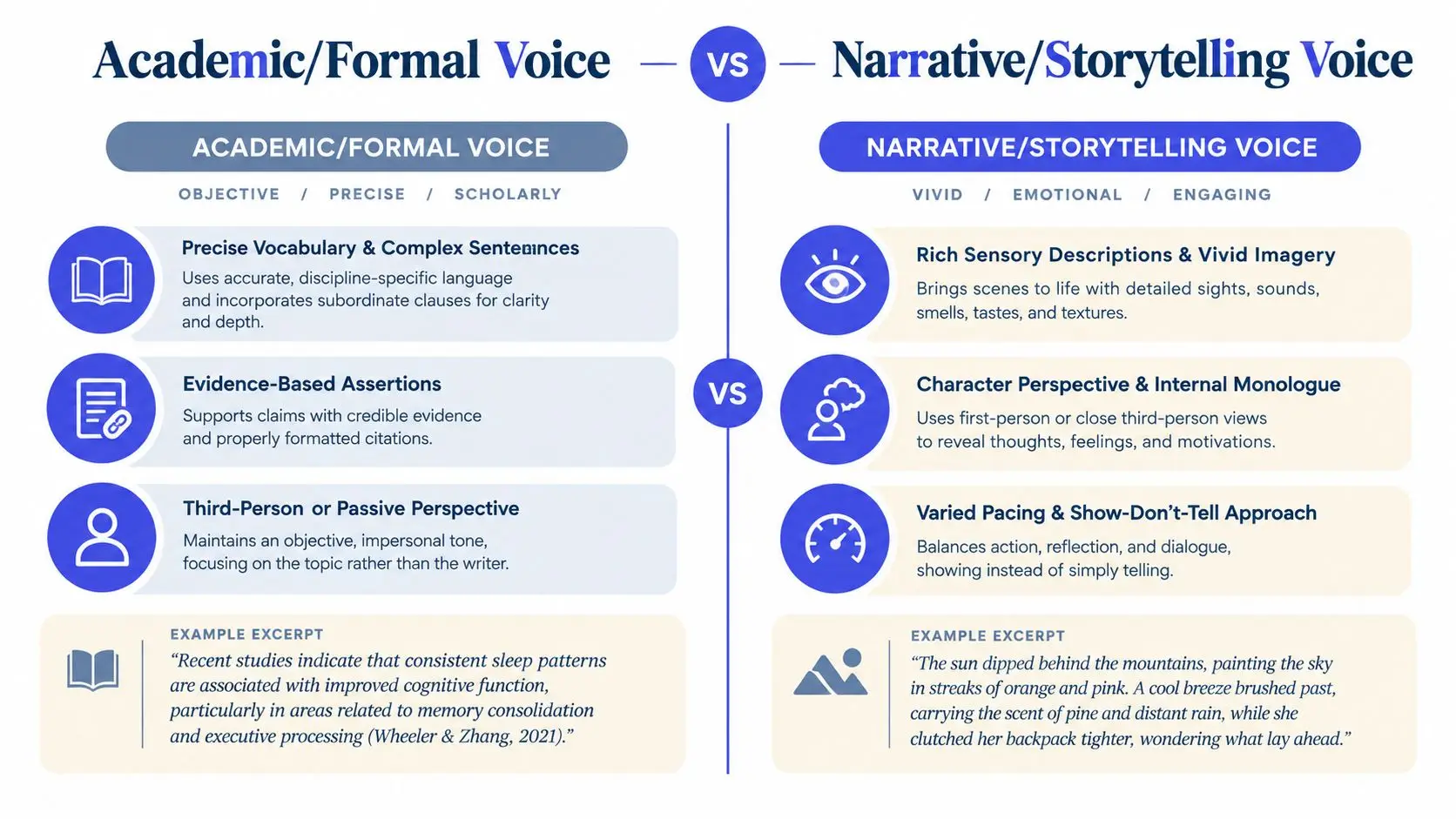
Academic and formal voice aims for precision, not warmth. It tends to use structured arguments, measured transitions, and vocabulary that signals analysis rather than performance. The tone feels controlled because the writer is trying to be exact, visible enough to be credible, but restrained enough to keep the evidence in the foreground.
That pattern shows up in research articles, professional reports, and many nonfiction books that need trust more than flair. A sentence such as, “The argument depends on how the evidence is selected and connected,” carries formal voice because it names the logic of the claim instead of dramatizing it. In academic writing, that visible logic matters, since scholarship on voice treats authorial presence as a mix of discursive and non-discursive features, including stance, self-mention, reporting verbs, and source integration voice in academic writing review.
The strongest formal writing usually sounds consistent across a long passage. It doesn't lurch between casual asides and dense abstraction. In books like Malcolm Gladwell's Outliers or in business writing such as Jim Collins's Good to Great, the voice stays orderly because the reader is being asked to track reasoning, not mood.
How formal voice works on the page
A formal passage often does three things well. It defines terms, it separates claims from examples, and it uses source material to build authority rather than decoration. That's why citations matter so much, since citation choices can shape how visible the writer feels on the page, whether through integral citations, non-integral citations, or direct quotation same academic voice study.
Practical rule: Formal voice gets weaker when a paragraph tries to sound impressive instead of clear.
If you're revising this voice, check that every paragraph earns its place by advancing the argument. Storyloft's formatting and planning workflow for academic and philosophy books fits this kind of drafting because it keeps research, structure, and manuscript text close together. That helps the writer maintain a steady, evidence-led voice across a long project.
3. Narrative and Storytelling Voice
Narrative voice pulls readers into a scene and asks them to feel the motion of events. It leans on sensory detail, pacing, emotional shading, and a stronger sense of perspective than formal prose usually allows. In fiction and memoir, this voice gives the prose a pulse because the reader experiences the world through a human consciousness, not just through information.
A storytelling passage might begin with a concrete image, then widen into memory or reaction. “The kitchen light hummed above the sink, and she stood still long enough to hear the house settle” works because the verbs are active, the imagery is specific, and the sentence movement slows the reader down at the right moment. That kind of voice is central to Cheryl Strayed's Wild, Colleen Hoover's contemporary fiction, and lyrical writing associated with Toni Morrison or Gabriel García Márquez.
Signals that make storytelling feel alive
Narrative voice usually relies on details that feel selected, not dumped onto the page. The writer chooses the one object, gesture, or line of dialogue that reveals something larger. That selectivity creates emotional effect, because readers fill in what the passage leaves out.
The risk is over-description. If every sentence tries to sparkle, the scene can lose forward motion. Strong narrative voice still needs shape, and that means the writer has to decide when to slow down and when to move.
Storyloft's narrative voice guidance aligns with this approach because it treats story voice as something built through scene choices, not just decorative language. For revision, look at whether your verbs, sensory details, and paragraph breaks support the scene's emotional turn. If they don't, the passage may be vivid but not yet shaped.
4. Humorous and Comedic Voice
Humorous voice depends on timing as much as word choice. It creates surprise through contrast, irony, exaggeration, or an unexpected turn at the end of a sentence. David Sedaris, Tina Fey in Bossypants, and Douglas Adams in The Hitchhiker's Guide to the Galaxy all show that comedic voice can still carry serious ideas, as long as the writer controls rhythm and knows when to stop.
A comedic passage often sounds light, but it's usually doing heavy structural work. It sets up an expectation, then redirects it. “I made a detailed plan, which was useful for five minutes and then immediately became a reminder of how much I don't control” works because the first clause creates order and the second punctures it. The humor comes from the gap between confidence and reality.
Where comedy succeeds and where it slips
Humorous voice thrives on precision. If the diction is too broad, the joke feels generic. If the sentence gets too busy, the punchline loses timing. Readers also expect consistency, so a witty chapter that suddenly turns solemn without transition can feel like two different writers are sharing the page.
The best comedic writing often uses small, controlled moves rather than nonstop jokes. That leaves room for sincerity, which is what gives the humor weight. A memoir paragraph can be funny and honest at the same time, and that combination is usually stronger than pure cleverness.
Read the passage aloud. If the joke lands only on the page and not in the ear, the rhythm probably needs work. Storyloft's how to rewrite scenes without losing voice is relevant here because comedic prose often breaks when a rewrite smooths out the author's timing. Preserve the beat first, then tighten the wording.
5. Inspirational and Motivational Voice
Inspirational voice tries to move the reader toward action, confidence, or change. It often combines encouragement with vulnerability, which keeps the prose from sounding like a poster on a wall. In leadership books, self-help, and transformation memoirs, the writer usually speaks as a guide who has seen struggle and wants the reader to keep going.
Oprah Winfrey, Michelle Obama in Becoming, Brené Brown, and Tony Robbins all use versions of this voice, though their styles differ widely. The common thread is forward motion. A motivating sentence doesn't just describe a feeling, it points toward a choice. “You can start from where you are, not where you wish you were” works because it acknowledges reality while still opening a door.
This voice can fail when it becomes abstract. Words like hope, growth, and purpose matter, but they need something concrete underneath them. A personal story, a specific decision, or a visible turning point gives the message traction.
Keeping encouragement grounded
The strongest motivational writing does three things at once. It names the obstacle, it respects the reader's difficulty, and it offers a next step. That balance keeps the voice from sounding inflated. Readers trust the writer more when the encouragement sounds earned.
Practical rule: Motivation lands best when it sounds specific enough to act on.
If you're revising this kind of prose, check whether every uplifting line has a real anchor in experience or evidence. Tools that keep notes, goals, and manuscript context together help here because motivational writing often depends on repetition without sameness. The voice should feel steady, not preachy.
6. Stream of Consciousness Voice
Stream of consciousness tries to mimic thought as it moves, including detours, contradictions, and sudden associations. It can feel raw, intimate, and unstable in the best way. Virginia Woolf's Mrs. Dalloway, James Joyce's Ulysses, and interior passages in Kazuo Ishiguro all show how this voice puts a reader inside a mind rather than outside a plot.
The diction can be ordinary, but the syntax often bends or stretches to follow thought. A line may begin with one concern and end somewhere else entirely because that's how mental movement works. “I came in for the keys, no, the bag, and now I'm thinking of the train, the rain, the phone call I didn't return” sounds like this voice because it reproduces mental drift instead of polishing it away.
That freedom creates emotional closeness, but it also creates risk. Readers need enough orientation to keep moving, even when the thought pattern wanders. If every sentence breaks off or doubles back, the text can become exhausting instead of immersive.
Revision without flattening the mind
The challenge is not to remove the mess entirely. It's to shape the mess so readers can follow it. A writer can preserve the feel of thought by keeping images, recurring words, or emotional pressure points consistent even when the syntax loosens.
The draft doesn't need to sound tidy. It needs to sound like a mind the reader can follow.
For editing, mark the passages that must stay loose and the passages that need a cleaner bridge. That distinction is useful because stream-of-consciousness voice often loses force when revision turns it into ordinary narration. The goal is controlled irregularity, not accidental confusion.
7. Minimalist Voice
Minimalist voice says more by saying less. It strips away qualifiers, decoration, and explanation so the remaining words carry extra weight. Hemingway, Lydia Davis, Cormac McCarthy in later work, and Kazuo Ishiguro's more restrained prose all show that restraint can be as expressive as lyrical abundance.
A minimalist sentence often feels almost plain at first glance. “He opened the door. The room was empty” does more than report facts. The short clauses create silence, and the silence carries meaning. That's why minimalist writing often depends on subtext, where the reader feels what the narrator refuses to spell out.

Cutting without damaging meaning
Minimalist voice is hard because every word has to justify itself. Weak adjectives, repetitive phrasing, and explanatory filler quickly dull the effect. The writer has to trust the sentence, then trust the reader to do some of the work.
A good revision question is simple. If you removed this word, would the line lose force or just lose clutter? If the answer is clutter, cut it. That's how minimalist prose keeps its quiet authority.
Tone analysis can help writers spot the usual problems, especially overqualified descriptions and unnecessary repetition. A clean style guide in your notes can also keep the voice consistent across chapters, so restraint doesn't turn into emptiness. Minimalism works when the omissions are deliberate.
8. Expert and Authority Voice
Expert voice tells the reader, calmly and clearly, “I know this terrain.” It builds confidence through accuracy, structure, and useful explanation rather than through personality alone. In books like Cal Newport's Deep Work, Daniel Kahneman's Thinking, Fast and Slow, and Seth Godin's marketing writing, authority comes from the way the writer organizes knowledge for practical use.
This voice usually combines technical vocabulary with plain explanation. That balance matters because an expert who sounds obscure loses the reader, and an expert who sounds casual may lose trust. The most effective passages often define terms, connect concepts, and move from principle to application without overexplaining every step.
A strong authority passage might say, “The framework works because it reduces decision fatigue before the draft begins.” That sentence is confident, specific, and readable. It doesn't perform expertise, it demonstrates it.
What authority should feel like
Readers should feel guided, not dominated. The writer can be decisive while still sounding approachable, especially in how-to books or thought leadership pieces. The tone is often most persuasive when it stays calm under pressure and keeps the explanation moving.
Practical rule: Authority voice breaks the moment it starts sounding defensive.
That's why source management, note organization, and manuscript-level editing matter so much in nonfiction. Storyloft's AI rewriting without losing voice is relevant here because expert writing often needs revision that preserves the author's judgments, cadence, and terminology. A strong authority voice is not just informed, it's stable across the whole text.
Comparison of 8 Writing Voices
| Voice | 🔄 Complexity | 💡 Resource requirements | ⚡ Efficiency | 📊 Expected outcomes & Ideal use cases | ⭐ Key advantages |
|---|---|---|---|---|---|
| Conversational Voice | Low–Medium, straightforward phrasing but needs consistent tone | Minimal research; editing for voice; reader testing for relatability | ⚡ High, fast to draft and iterate | Accessible, engaging prose; ideal for memoirs, self-help, blogs, YA fiction | Builds rapport and retention; makes complex ideas digestible |
| Academic/Formal Voice | High, structured arguments and precise language | Extensive research, citation management, peer review | ⚡ Low, slow drafting and revision cycles | Credibility and rigor; ideal for academic papers, research-based nonfiction, professional reports | Establishes authority; supports nuanced, evidence-based analysis |
| Narrative/Storytelling Voice | Medium–High, requires control of imagery, pacing, perspective | Time for scene development, character work, multiple revisions | ⚡ Medium, immersive drafting with revision-heavy polishing | Deep emotional engagement; best for fiction, memoir, creative nonfiction | Creates vivid immersion and long-term reader resonance |
| Humorous/Comedic Voice | Medium, requires timing, cultural sensitivity, and consistency | Iterative testing, beta readers for joke feedback, tone edits | ⚡ Medium, jokes may need repeated rewriting/testing | High engagement and memorability; suited for satire, comedic memoirs, light fiction | Distinctive personality; makes difficult topics approachable |
| Inspirational/Motivational Voice | Medium, balance optimism with authenticity | Personal testimony, curated examples, editing for sincerity | ⚡ Medium, steady drafting with emphasis on refining voice | Drives action and behavior change; ideal for self-help, leadership, motivational memoirs | Strong emotional resonance; prompts reader action and sharing |
| Stream of Consciousness Voice | High, demands readable yet raw internal flow | Skilled revision, structural editing, careful pacing | ⚡ Low, time-intensive to craft and clarify | Deep psychological realism; suited to literary fiction and experimental work | Intense immersion into consciousness; highly distinctive voice |
| Minimalist Voice | Medium, requires precise word choice and disciplined cuts | Rigorous line-level editing, strong sense of subtext | ⚡ Medium, drafting concise prose can be quick; edits are meticulous | Sophisticated, interpretive works; contemporary literary fiction and short forms | Memorable precision; engages reader interpretation and implication |
| Expert/Authority Voice | High, needs factual accuracy and clear frameworks | Deep subject expertise, data/case studies, fact-checking, peer review | ⚡ Low–Medium, research-heavy prep slows initial drafting | Trusted guidance and practical application; ideal for how-to, business, thought leadership | Establishes credibility and practical utility; builds reader trust |
Turn Voice Recognition Into a Revision Method
The fastest way to understand voice is to compare contrasts. Conversational voice stays close to the reader, while academic voice keeps more distance. Narrative and stream-of-consciousness voices can feel expansive or inward, while minimalist writing compresses meaning into fewer words. Expert voice sits somewhere between intimacy and authority, and humorous or motivational voice depends on timing and relationship as much as content.
That means voice isn't a single feature you either have or don't have. It's a pattern of choices. If you want your manuscript to feel consistent, start by picking one dominant voice for the piece, then identify the signals that create it in a short sample. Look at diction, sentence length, imagery, perspective, and the emotional temperature of the paragraph.
Next, check for accidental shifts. A memoir chapter can drift from conversational into academic when the writer starts explaining a concept too formally. A business book can slip from authority into self-help language if the prose becomes too inspirational. A novel can lose narrative momentum if every scene gets the same reflective treatment. These changes are often subtle, which is why readers feel them before they can name them.
A practical revision pass helps here. Read one page aloud, then mark where the voice feels strongest and where it loosens. Ask whether each sentence supports the intended relationship with the reader. If the answer is no, revise the sentence, not just the word choice. Sometimes the fix is a sharper verb. Sometimes it's a shorter clause. Sometimes it's cutting a paragraph that explains what the scene already shows.
Storyloft can fit into that workflow if you want a single place to test changes. Tone analysis helps you spot drift, notes help you flag sections that need a different treatment, focus mode helps you hear the prose without distraction, and Eddy's voice-aware revisions can suggest changes while keeping manuscript context intact. Used together, those tools support the same goal as any strong edit, preserving the voice you intended while cleaning up the parts that pull against it.
If you're working on a manuscript, visit Storyloft to draft, revise, and test voice-aware changes in one place. You can use tone analysis, notes, focus mode, and Eddy to compare passages, protect your manuscript's voice, and keep your revisions tied to the full context of the draft.