
How to Write a Book Synopsis That Sells Your Story
You've finished the manuscript, polished the query, and then the submission guidelines ask for a synopsis. Suddenly, the book you spent months building has to fit into a few hundred words without losing its plot, emotional logic, or commercial shape. Many writers respond by producing either a teaser that hides the ending or a chapter-by-chapter inventory that leaves the central story buried.
A strong synopsis takes a different approach. It compresses the manuscript's main character, central conflict, major choices, escalating consequences, climax, and resolution into a document an agent or publisher can evaluate quickly. The skill isn't summarizing everything. It's identifying what the book cannot function without.
Table of Contents
- What a Book Synopsis Really Does for Agents and Readers
- How Long Should a Synopsis Be and What Voice to Use
- Building Your Core Story Arc From Hook to Ending
- Adapting the Synopsis for Nonfiction and Hybrid Books
- Common Mistakes That Weaken Your Synopsis and How to Fix Them
- Final Polish Checklist and Next Steps for Submission
What a Book Synopsis Really Does for Agents and Readers
An agent opens a submission package with limited time and practical questions. Who drives the story? What does that character want? What interrupts the opening situation? Do the complications follow from earlier choices? Does the ending resolve the central conflict, and does the manuscript deliver on its premise?
A synopsis gives direct answers. It is a business-facing evaluation document, not back-cover copy. Jane Friedman on writing a novel synopsis describes it as a compressed account of the complete narrative, including the ending. Writers & Artists synopsis guidance also emphasizes an orderly account of the arc, relevant competition, and the book's distinct market position.
Synopsis, query, and blurb serve different jobs
A blurb creates curiosity. It can present a dilemma and stop before the decisive revelation. A query letter combines a short pitch with information about the manuscript and author. The synopsis gives the evaluator the complete story, allowing a judgment of structure, execution, and fit.
That distinction changes the wording. “Secrets emerge and Margot must make an impossible choice” might suit promotional copy, but it is weak synopsis language because it hides both the secret and the choice. State what Margot discovers, what she does with that knowledge, and what she risks, loses, or protects as a result.
Practical rule: Suspense belongs in the novel and the pitch. The synopsis earns trust by explaining the entire arc.
Agents do not need a synopsis to experience the twists. They need to see whether those twists are supported, whether the protagonist makes consequential choices, and whether the ending follows from what came before. Revealing the ending also exposes structural problems a teaser can conceal, including a climax disconnected from the opening conflict or a resolution that arrives without a meaningful decision.
Fiction generally organizes the synopsis around plot and character transformation. Nonfiction organizes it around the book's promise, argument, audience, authority, and chapter logic. Hybrid books require both forms of accountability. The personal or narrative journey must connect to the practical or intellectual promise.
Draft the synopsis beside the manuscript, not from memory alone. Writers often create a separate document, then revise the book and forget to update its details. Storyloft can keep drafting, notes, research, goals, and revision history close together, making it easier to compare the synopsis with the current manuscript.
Supporting materials should make the same promise as the book. Promotional imagery, like any other asset, needs to match the story described in the synopsis. The MyImageUpscaler creator software guide offers a practical reference for fitting visual content into a wider publishing workflow, while the synopsis remains anchored to the manuscript's actual content.
Identify the document's destination before drafting. A query package may request a tight synopsis, while a proposal may require an overview that includes audience and market information. Understanding what a literary agent does clarifies why the synopsis must help assess fit, readiness, and commercial shape, rather than merely present an appealing premise.
How Long Should a Synopsis Be and What Voice to Use
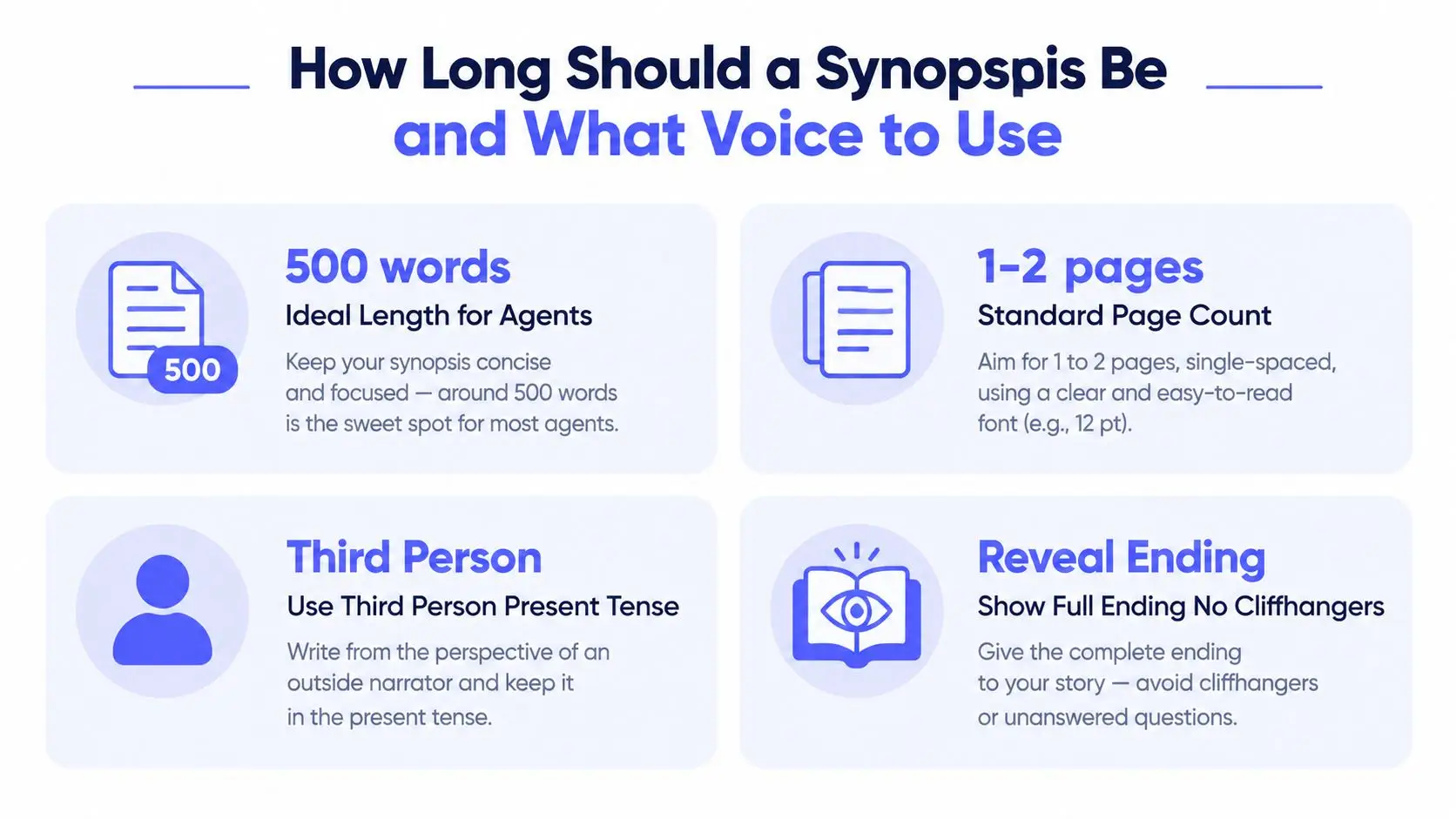
Length is a submission requirement before it becomes a creative choice. A widely used norm is 500 to 1,000 words, usually formatted as one to two single-spaced pages, according to Jane Friedman's synopsis guidance. Some agents request no more than one side of A4, and a one-page request is often understood as roughly 500 words, as noted in Writers & Artists submission advice.
Treat the stated limit as part of the assignment. Sending several pages when the guidelines ask for one does not show that the story needs more room. It shows that the writer has not made the required editorial choices.
Choose a drafting length, then cut deliberately
Write a short first pass of around 300 words, then expand or refine it into the requested version. Some writers prefer a working draft of 600 to 800 words before cutting. These are useful drafting ranges, not universal rules. The final document must follow the recipient's instructions.
Use this workflow:
- Short first pass: Capture the protagonist, disruption, central complications, climax, and ending without ornament.
- Working draft: Add the causal links that explain why each major turn happens.
- Final submission: Remove secondary characters, repeated explanations, atmospheric detail, and any beat that does not alter the protagonist's path.
- Agent-specific version: Adjust the document to the requested length instead of sending one version everywhere.
Draft beside the current manuscript. Check names, chronology, reveals, and the ending against the pages as you revise. A separate synopsis can fall out of date after structural changes, so Storyloft's drafting space can keep notes, research, goals, and revision history near the manuscript for comparison.
Single-space the document unless the guidelines say otherwise. Leave clear space between paragraphs, use a readable font, and place the title and your name where the instructions specify. Some writers put named characters in caps on first mention to make scanning easier. Follow the recipient's preference first.
Use a controlled voice, not a flat one
The safest default is third person, present tense, even when the novel uses first person or past tense. Write “Mara discovers the ledger,” not “I discovered the ledger” or “Mara discovered the ledger.” Third-person present creates immediacy while keeping attention on the story rather than the person summarizing it.
Voice still matters. A comic novel should not become solemn corporate prose, and a literary mystery should not read like a police report. Match the manuscript's dominant energy through sentence rhythm, precise details, and occasional tonal cues, without reproducing the novel's full style. The synopsis must remain quick to scan.
Separate voice from decoration. A vivid verb can preserve tone. A paragraph of setting history usually cannot. For a practical explanation of perspective and tone, see what narrative voice means.
A synopsis should feel compressed, not generic. If a sentence could describe hundreds of unrelated novels, replace it with an action, discovery, or consequence that belongs only to yours.
Building Your Core Story Arc From Hook to Ending
The most reliable way to learn how to write a book synopsis is to stop thinking in chapters and start thinking in causal turns. Your job is to show how one event creates pressure for the next, while keeping the protagonist's choices visible.
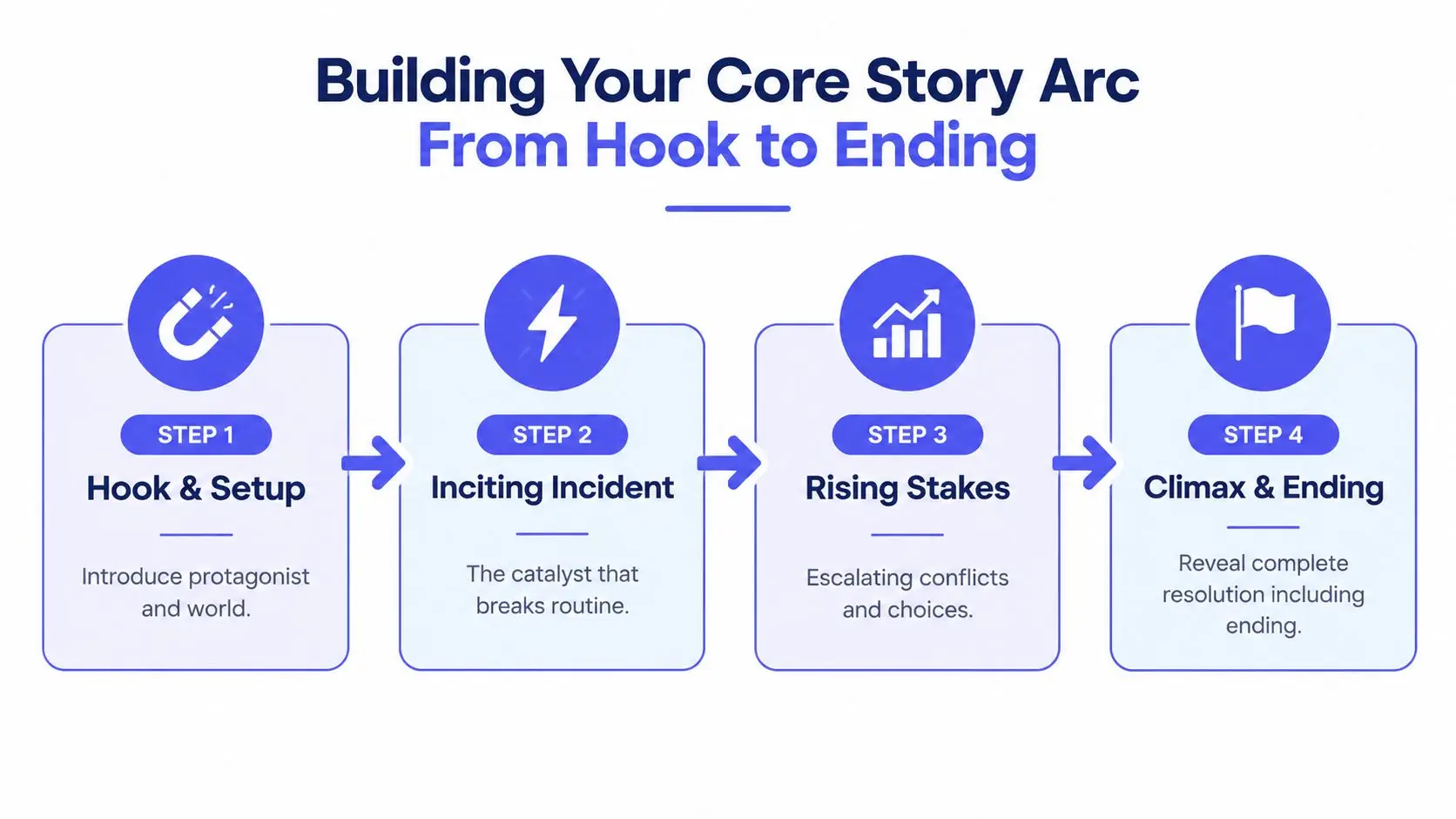
For a query package, a reusable structure is two to four paragraphs. A compact version can use three paragraphs: setup and inciting incident, escalating complications, then climax and ending. This format aligns with query-package guidance that recommends compressing the arc rather than reproducing the novel's atmosphere (Hali Hyland's query-letter checklist).
Start with the person before the machinery
Open with the protagonist in a specific situation. Give the reader the character's position, immediate desire, and the condition that makes the story vulnerable to disruption.
A useful sentence frame is:
When [inciting event] happens, [protagonist] must [goal], but [opposing force] makes failure mean [specific consequence].
For example:
When her estranged mother dies, MARGOT REYES inherits half of a crumbling lake house, but she can't sell it until she spends a month there with the sister she blames for a childhood drowning.
This opening does more than name a premise. It establishes a character, a conflict, an obstacle, and a pressure system. Keep background to one or two sentences unless the history directly determines the plot.
Select turns that change the available choices
A synopsis doesn't need every event. It needs the events that change what the protagonist can do next.
For each major beat, ask:
- What does the protagonist want at this point?
- What happens that makes the goal harder or changes it?
- What choice does the protagonist make?
- What consequence follows?
- How does that consequence create the next turn?
This test separates plot from texture. A side character's amusing habit may enrich the novel but belong nowhere in the synopsis if removing it doesn't affect the ending. A discovered letter belongs if it changes the protagonist's understanding and sends the investigation in a new direction.
Use concrete actions instead of abstractions. “Mara is devastated by betrayal” tells the reader how to feel, but not what happens. “After finding her partner's second lease, Mara sends the evidence to his employer and loses access to their shared account” gives the emotion a visible cause and consequence.
Escalate through decisions and consequences
The middle of the synopsis should move. Don't list complications as disconnected incidents. Connect them with words such as because, therefore, but, and so during drafting, then keep the strongest causal relationships in the final prose.
A useful paragraph pattern looks like this:
- The protagonist pursues an initial solution.
- That solution exposes a deeper problem.
- The protagonist chooses a riskier plan.
- The plan produces a consequence that forces the climax.
If the protagonist only reacts while other characters create every turning point, the synopsis will reveal a potential agency problem in the manuscript. Events may be dramatic, but the central character's decisions should shape the direction of the story.
For additional planning support before drafting, this practical guide on how to outline a novel effectively can help you identify the beats that deserve space. Storyloft's story-structure guide offers another way to map the manuscript's movement before compressing it.
Place the climax near the end of the synopsis and explain the decisive action. Don't write “the final confrontation changes everything.” Name the confrontation, the choice, and the result.
Then reveal the ending plainly. State who survives, what the protagonist accepts or rejects, what happens to the central relationship, and what new condition remains. A resolution can be tragic, ambiguous, or unsettling, but it must be understandable. The reader should see how the ending answers the central question raised at the beginning.
You can use the following paragraph blueprint:
Paragraph one: protagonist, setting, initial desire, inciting incident.
Paragraph two: central pursuit, major reversal, escalating choices, worsening stakes.
Paragraph three: final plan, climax, decisive consequence, resolution.
Optional paragraph four: one additional arc or thematic consequence that the requested length allows.
If your novel has multiple timelines or points of view, don't explain the architecture at length. Present the events in the clearest order for understanding the central arc, and identify a timeline shift only when the reader needs it to follow causality.
Storyloft can support this compression process through binders, tags, side-by-side manuscript work, and Eddy's manuscript-aware suggestions. Instead of copying passages into a separate tool, you can compare the synopsis with the relevant draft material, revise in context, and retain an edit history as the story changes.
Adapting the Synopsis for Nonfiction and Hybrid Books
A nonfiction synopsis needs a different organizing question from a novel synopsis. Instead of tracking a protagonist through escalating events, build the document around the book's promise, reader problem, authority, argument, and chapter progression. The manuscript still needs a clear movement, but that movement may be intellectual, practical, investigative, or personal.
Begin with the reader's situation. What do they struggle to understand, decide, or accomplish? State the book's answer, then explain why this author can deliver it. A proposal synopsis should show the book's usefulness, distinctiveness, and internal logic without turning into a general description of the subject.
For a proposal, include the book's progress and delivery timing when relevant, along with its word count if the manuscript is finished. Identify competing books and explain how the proposed book differs. These details place the overview within the project's publishing case, rather than leaving it as a description of contents.
Use chapter logic instead of chapter inventory
A chapter-by-chapter recap usually produces a long contents page with no argument. Group chapters by the work they perform and show how each group changes the reader's understanding or ability.
A practical book might move from diagnosing a problem, to establishing a method, to applying that method, then addressing objections and edge cases. A memoir with an expert framework may combine the author's personal transformation with the ideas readers will learn from it. The synopsis should make that relationship visible, especially when the personal material provides evidence for the framework.
A strong nonfiction paragraph answers three questions:
- What does the reader understand or gain here?
- How does this material build on what came before?
- Why does this material belong in this book rather than a generic article?
Draft a 30 to 75 word back-cover-style summary first and use it as the promise. Expand from that statement into the argument, authority, audience, competition, and chapter logic. Do not repeat the pitch in each paragraph. Use it as a test for relevance: if a planned detail does not support the promise or the book's progression, cut it.
Fiction and nonfiction require different evidence
| Element | Fiction Synopsis | Nonfiction Synopsis |
|---|---|---|
| Central engine | Protagonist pursuing a goal under pressure | Reader seeking an answer, method, or new understanding |
| Essential movement | Inciting incident, complications, choices, climax, resolution | Problem, promise, argument, framework, applications, conclusion |
| Character information | Main character's desire, opposition, agency, transformation | Author credibility and relevant experience |
| Ending | Reveal the full resolution and new normal | State the conclusion, practical outcome, or final argument |
| Market information | Genre, audience, and distinctive premise when relevant | Audience, competition, differentiation, and need |
| Chapter treatment | Major plot turns only | Grouped chapter logic, not a chapter-by-chapter recap |
Hybrid books need an explicit connection between both forms. A narrative nonfiction book may follow an investigation, but the synopsis must also explain what the reader learns and how the investigation supports the larger claim. A memoir with a practical promise should show the emotional arc while identifying the framework or change offered to readers. If the narrative and instructional strands separate, state where they meet and what each contributes.
Keep research organized while drafting. Storyloft's planning workspace supports binders, tags, source management, and side-by-side reference, which can help nonfiction writers connect claims, chapter plans, and supporting material without losing the book's throughline. The synopsis itself should stay selective. Mention evidence when it proves the premise or establishes authority, not because every source deserves space in the overview.
Common Mistakes That Weaken Your Synopsis and How to Fix Them
A weak synopsis often exposes a strong manuscript badly. The writer knows every character and subplot, so the document gives equal weight to everything. The reader then has to reconstruct the story's hierarchy.
Worldbuilding arrives before story
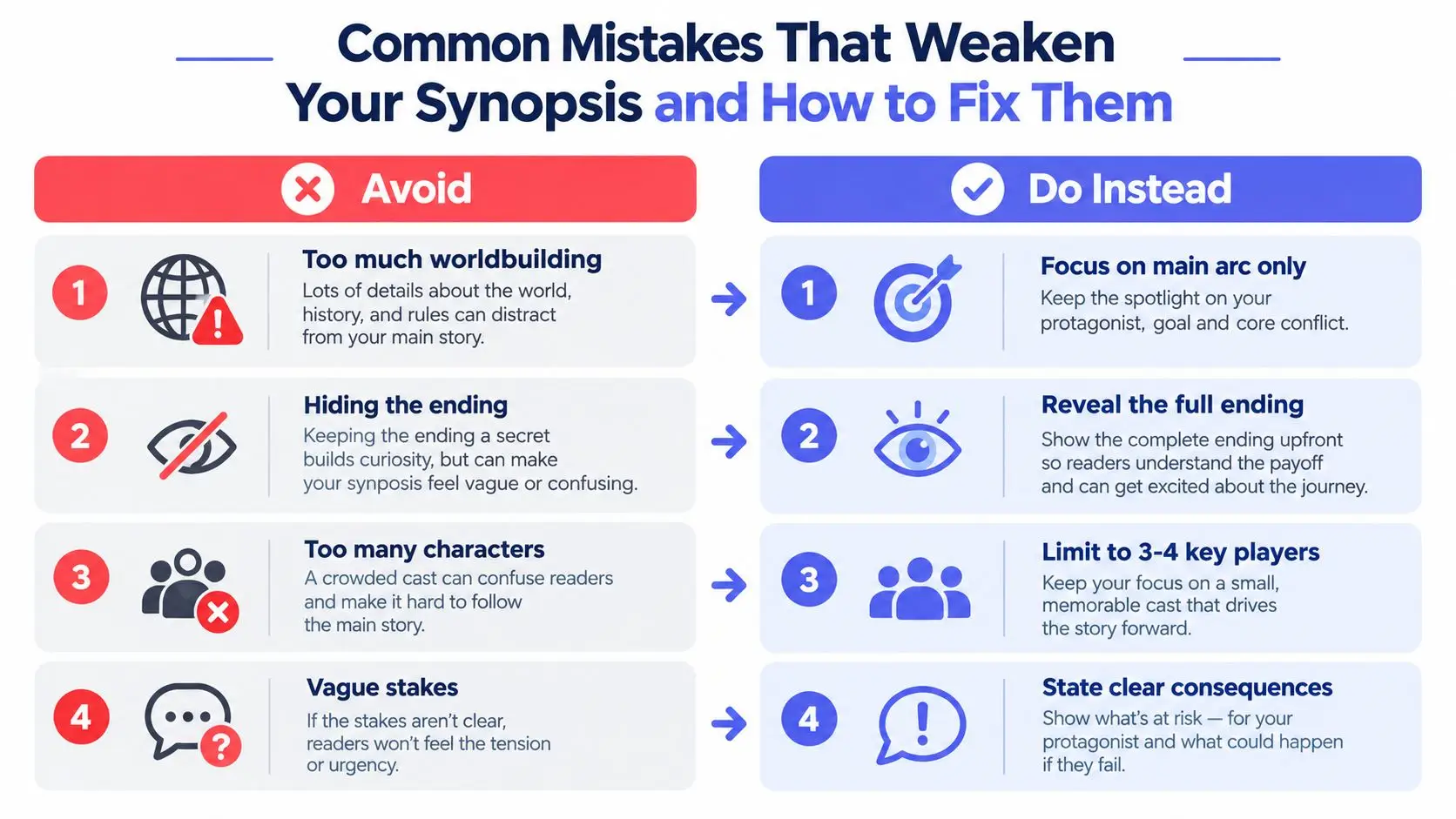
Before: “For centuries, the kingdoms of Avarra, Kel, and Dren have competed for control of the silver rivers, whose ancient magic determines the balance of power.”
After: “When the silver river beneath Lio's village runs dry, he breaks the law to find its source and discovers that the ruling kingdom has been diverting the water.”
The first sentence may be useful in the novel. The second gives the synopsis a protagonist and a problem. Keep only the worldbuilding needed to understand the central conflict.
The ending stays hidden
Before: “As the final battle approaches, Lio faces a revelation that will change the kingdom forever.”
After: “Lio learns that the king has sealed the river to prevent an uprising. He opens the gate, flooding the capital and ending the drought, but the release destroys the palace and leaves him responsible for rebuilding the kingdom he opposed.”
A synopsis that protects the twist fails its evaluative purpose. The resolution should show the cost of the protagonist's choice.
Too many names compete for attention
Name the people who create the central conflict, enable the protagonist's plan, or determine the ending. Everyone else can usually become a role.
Before: “Lio meets Arin, Vessa, Tor, Mikel, Sera, and the old cartographer Jovan, who each reveal part of the river's history.”
After: “With help from a disgraced cartographer, Lio traces the missing water to the king's underground reservoir.”
The change doesn't erase useful information. It gives the information a function.
Stakes remain abstract
Before: “The kingdom's future hangs in the balance.”
After: “If Lio fails to reopen the river before the harvest, the villages will lose their food supply and the king's soldiers will arrest the families who helped him.”
Specific consequences make pressure legible. They also help an agent understand what the protagonist stands to lose.
Backstory interrupts the present action
A synopsis can't carry every explanation that makes the manuscript emotionally rich. Put history in the document only when it changes a current decision.
Revision test: If a detail doesn't alter a character's goal, obstacle, choice, or consequence, cut it from the synopsis.
Abstract emotional language causes a similar problem. Replace “she is haunted by her past” with the past event that shapes her behavior now. Replace “he seeks redemption” with the action he takes to repair the damage and the person who may refuse him.
Storyloft's tone analysis, edit history, and voice-aware rewriting can help you test shorter phrasing against the manuscript rather than polishing the synopsis into a voice the book doesn't have. Whether you work in Storyloft, Word, or a simple text editor, revise in passes. First cut information. Then repair causality. Then restore the few details that carry the manuscript's particular tone.
Final Polish Checklist and Next Steps for Submission
A submission-ready synopsis stands on its own while making the manuscript's shape easy to follow. Close the manuscript and read the synopsis alone. You should be able to identify the protagonist's goal, the opposing force, the decisive choices, and the ending. If one is missing, revise the structure before polishing sentences.
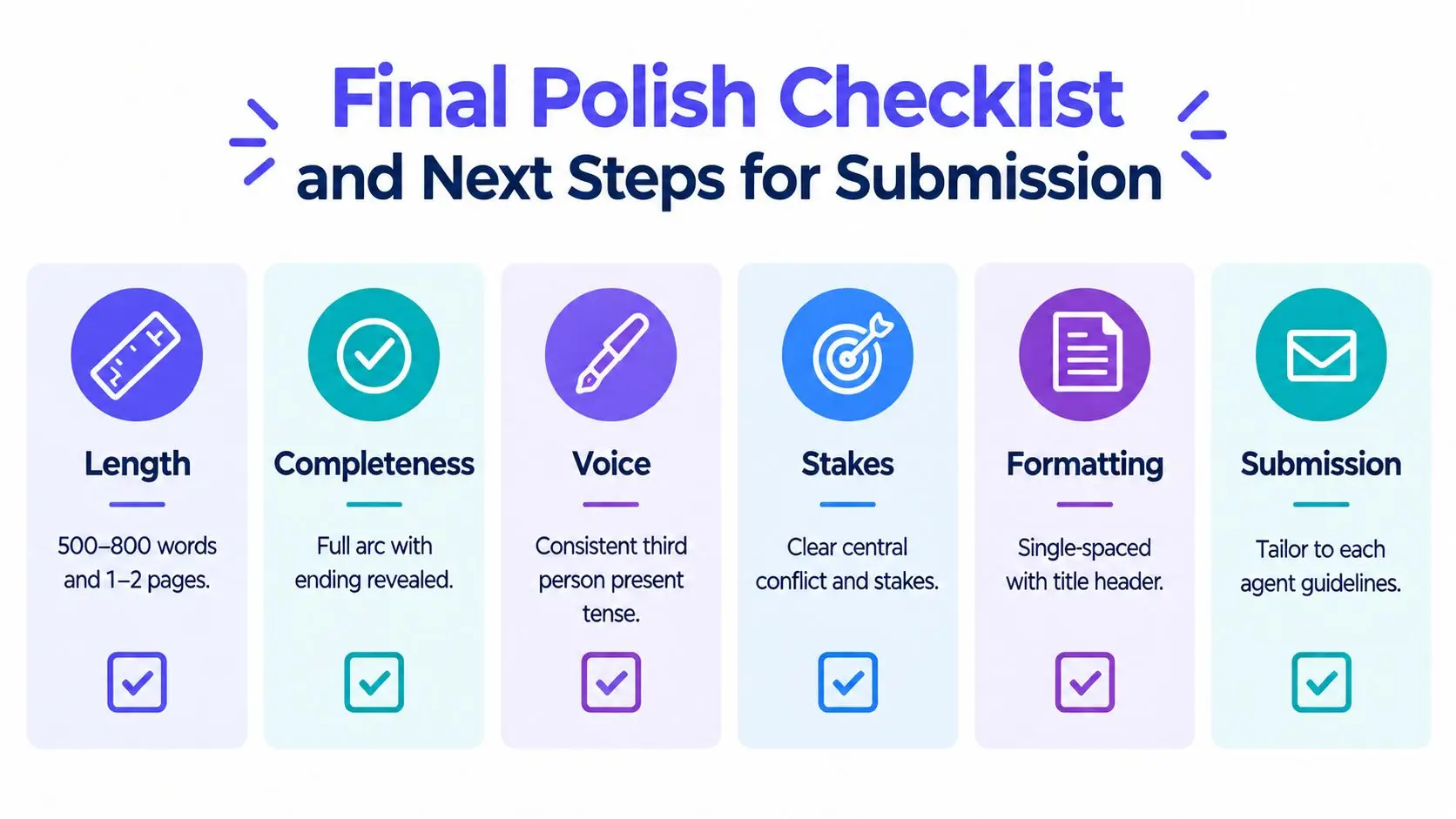
Run the manuscript-aware checks
Use a final pass that tests both compliance and story logic:
- Length: Match the specific agent's stated word and page limit, not a generic industry norm. Apply the length guidance discussed earlier only when no more precise instruction is provided.
- Completeness: Cover the full arc, including the ending. Do not stop at the final twist.
- Centrality: Keep the protagonist, primary conflict, major opposing force, and supporting characters who affect the resolution.
- Causality: Show why each major turn follows from a choice, discovery, or consequence.
- Voice: Use third person and present tense by default, while preserving the manuscript's tonal identity.
- Formatting: Check typography, paragraph spacing, file type, and any requested title or name header. Use this manuscript formatting guide for agents to review the surrounding submission package.
- Nonfiction fit: For a proposal, state the promise, audience, authority, argument, chapter logic, and distinction from competing books.
- Consistency: Compare names, ages, locations, chronology, terminology, and the ending with the latest manuscript.
A tool can handle mechanical checks, but it cannot decide which subplot represents the book's identity. Compare the synopsis with the opening, midpoint, climax, and final pages. Delete any sentence that sounds polished but does not describe an actual event, argument, or consequence.
Save versions for individual agent requirements. For proposals, make sure the synopsis agrees with the audience and competition sections. For self-publishing metadata, keep it accurate and aligned with the final cover, description, and positioning. Storyloft's manuscript editor, goal tracking, binders, Eddy, and formatting workflow can keep these materials in one project while you revise.
Read the final version once without editing. Ask: Can a stranger explain what this book does, how it gets there, and what it costs without asking me to fill in the gaps? If yes, the synopsis has done its job.
Storyloft provides one workspace for drafting, organizing research, revising with manuscript-aware assistance, and preparing publishing files. Use it to compare the synopsis with the manuscript, track focused revision goals, and keep submission materials consistent, then visit Storyloft to start shaping your book project.