What Is Narrative Voice and How to Find Yours
Narrative voice is the sum of choices a writer makes about who speaks, how they speak, and where they stand relative to events. In modern narratology, that question became a formal one in the early 1970s, which is why readers still get tangled when they try to separate voice from style, tone, and point of view.
What does that confusion usually hide? It hides the fact that voice is not one thing at all. It's a bundle of decisions, some conscious and some habitual, that shape how a story feels in the reader's mind.
Table of Contents
- A Working Definition of Narrative Voice
- The Four Building Blocks of Voice
- Narrative Voice vs Style vs Tone
- How Voice Changes the Same Scene
- When Voice Becomes Unreliable
- Finding and Keeping a Consistent Voice
- Quick Checklist for Voice Consistency
A Working Definition of Narrative Voice
Narrative voice is the combined effect of who speaks, how the narration sounds, and how close or far the narrator stands from the events. That is why readers feel voice in the grain of a sentence, not just in whether a story uses first person or third person. It includes sentence rhythm, vocabulary, emotional stance, and the narrator's habit of interpreting what happened.
A useful comparison comes from Gérard Genette's Narrative Discourse. His framework separates voice from mood and treats voice as the answer to “who speaks?” rather than “who sees?”. That distinction gives scholars a language for narrator types such as extra-diegetic, intra-diegetic, homo-diegetic, hetero-diegetic, and auto-diegetic, instead of folding narrator, author, and character speech into one undivided sound (academic overview of Genette's framework).
Voice is not the same as style, tone, or point of view
Writers often hear those terms together, which is part of the confusion. Point of view selects the lens; style is the writer's habitual fingerprint; tone captures the emotional register of a passage. For a clearer guide to that last term, see what is tone in writing. Voice is the larger identity the narrator projects, and it can draw on all three without becoming identical to any one of them.
A simple way to frame it is this. Voice is the narrator's presence on the page, even when that presence is quiet. It may feel intimate, distant, playful, severe, reflective, or unstable. A story can keep the same voice while changing tone from paragraph to paragraph, and it can keep the same point of view while shifting from lyrical to blunt prose.
Practical rule: if you can move the narrator's sentences into another scene and they still sound like the same speaking mind, you are probably hearing voice, not just plot.
That is why voice works best as a pattern rather than a single trait. In the sections below, the framework breaks into four parts, then becomes a practical way to check whether a long manuscript still sounds like itself.
The Four Building Blocks of Voice
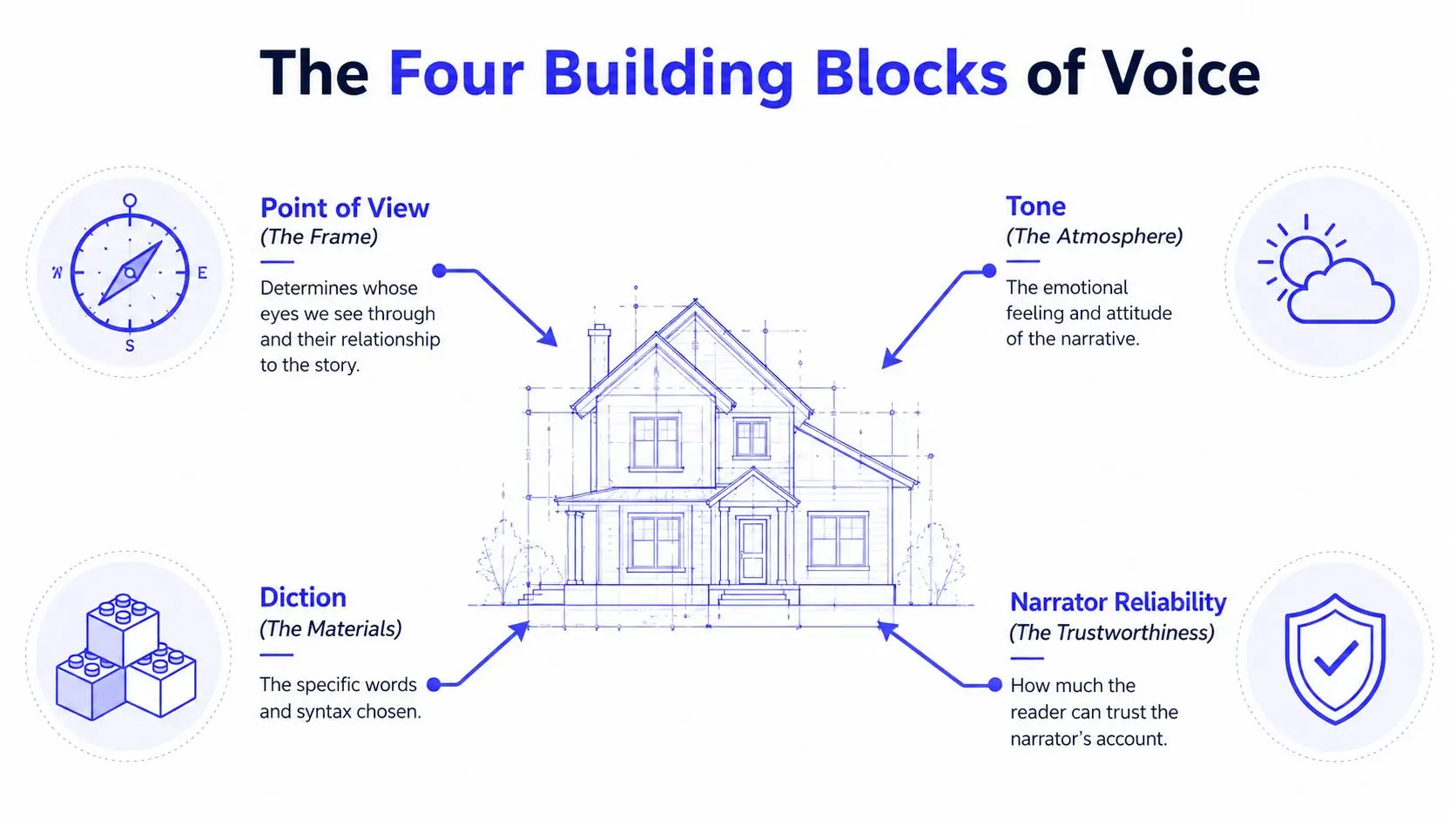
Narrative voice works like a house built from four parts. Point of view sets the frame, tone shapes the atmosphere, diction provides the building material, and narrator reliability determines how much weight the structure can carry. Change one of them, and the same story starts to feel different.
Point of view gives the frame
Point of view determines whose eyes the reader stays close to. First person places the reader inside a character's telling, second person addresses the reader directly, and third person can stay tightly limited or move outward toward a broader view. A modern discussion of the split between voice and focalization helps here, because the speaker's position and the source of perception are not always the same (modern distinction between voice and focalization).
A simple comparison makes the difference clear. “I locked the door, then heard the floorboard groan behind me.” becomes “Maya locked the door, then heard the floorboard groan behind her.” The event stays the same, but the distance changes, and so does the reader's sense of being inside or outside the moment.
Tone sets the atmosphere
Tone is the emotional weather of the narration. It can feel wry, mournful, reverent, tense, or detached. The same factual event may read like a joke, a confession, or a warning depending on that stance.
A line such as “He entered the room like a man expecting applause” carries a very different attitude from “He entered the room and waited.” The action is similar. The narrator's attitude is not.
Diction builds the walls and furniture
Diction is word choice, but in narrative voice it also includes syntax, sentence length, vocabulary register, dialect, and repetition habits. A narrator who relies on short, clipped sentences creates a different presence from one who uses long clauses and layered observation.
Compare “She left” with “She drifted out, still holding her anger like a hot coin in her palm.” Both lines move the scene forward, but each one sounds like a different mind speaking. The first is spare. The second is figurative and close to the character's inner life.
Metaphor often reveals what a narrator notices first, so a guide to using metaphor can help you see how diction shapes voice at the sentence level.
Reliability controls trust
Narrator reliability is the gap between what the narrator reports and what the text asks the reader to question. A reliable narrator and an unreliable narrator can share the same point of view, tone, and diction, yet still create very different levels of trust.
A line like “Nothing unusual happened that night” may be plain truth, or it may hide what the narrator cannot face. That uncertainty matters because readers keep asking, even without naming it, how much of the account they can believe.
If you want a quick reference for how emotional color differs from narrator identity, the discussion of tone vs voice in writing is useful.
Narrative Voice vs Style vs Tone
這三個詞常被混在一起,因為它們確實有重疊,但各自負責的工作不同。先把它們拆開,閱讀和修稿時會清楚很多。
| Term | What It Controls | How Stable It Is |
|---|---|---|
| Narrative Voice | The narrator's presence, stance, distance, and way of speaking | Usually consistent within a scene or manuscript, though it can evolve |
| Style | Sentence habits, punctuation, rhythm, imagery, and the writer's habitual language | Often stable across an author's work |
| Tone | The emotional register of a passage, such as irony, warmth, dread, or tenderness | Can shift from scene to scene |
Narrative voice 回答的是,這段文字讓讀者聽見的是什麼樣的說話者。Style 看的則是作者習慣怎麼組織語言,像句子節奏、標點和意象。Tone 問的是,這一段此刻帶著什麼情緒。若想更細地分辨 tone vs voice in writing,可以看我們對 tone vs voice in writing 的說明,也可對照 tone vs voice in writing 的整理。
這三者像同一首歌裡的不同層次。聲音的辨識度屬於 voice,演奏方式屬於 style,當下是明亮、緊繃,還是帶點諷刺,則屬於 tone。寫作時最容易混淆的地方,是一段文字可以保留相同的 voice,卻改變 tone;也可以維持相近的 style,卻因敘述者的距離不同而讓 voice 變了樣。
作者的 style 往往在多本作品裡都能看出來,但頁面上的 voice 會隨人物、場景和寫作目的改變。這也是為什麼,同一位作者寫回憶錄章節、中童小說片段、推理小說時,讀感可能差很多,卻仍然帶著相似的語言習慣。讀者感受到的,不只是字句本身,還有說話的位置與態度。
A passage can keep style while shifting tone
Read these three lines as one small sequence:
“The kettle screamed. She reached for it with the patience of someone handling a rude dog. By the time it stopped, the kitchen had gone quiet in a way that felt personal.”
這裡的 style 很連貫,因為句法和比喻習慣保持一致。Tone 則從緊張轉向帶點乾幽默,再滑向不安。Voice 仍然像同一個敘述者在說話,因為同樣的觀察角度和解讀姿態把三句連在一起。
判斷方式很簡單,若語言變了,但說話的存在感還認得出來,多半是 tone 在變,不是 voice 整體失控。
修稿時,這個區分很有用。作者有時以為自己需要修 voice,其實只是 tone 太單一。也有人以為 tone 出問題,真正的問題卻是敘述距離一直忽遠忽近,讓讀者抓不到同一個說話位置。把這些層次分開,後面的修訂會更準。
How Voice Changes the Same Scene
A single event can sound completely different depending on who tells it, how close the telling is, and how much the narrator knows. That's the easiest way to feel the difference instead of just naming it.
A woman returns home, finds the front door ajar, and notices a muddy print on the hall tile.
Detached third person
When Lena came home, the front door stood open by several inches. A wet footprint marked the tile just inside the hall. She stopped, set her bag down slowly, and looked toward the stairs without moving her feet. The hallway was still, and the apartment gave no immediate sign of what had happened. She took out her phone and held it at her side.
This version keeps the narration cool and observational. The reader sees only what a nearby camera might capture, plus a little interior action through body language. The diction stays plain and controlled, which creates distance.
Close first person
I knew something was wrong the second I saw the door. It wasn't wide open, just enough to make my stomach drop. The muddy print on the tile looked fresh, like someone had stepped inside and decided to leave a signature. I stood there with my keys jammed into my palm and listened, stupidly, for a sound upstairs. Nothing. That silence felt worse than noise.
Here the scene tightens around panic and perception. The narrator's language carries fear, judgment, and internal reaction. The reader knows less about the apartment as a whole, but more about what the moment feels like from inside the body.
Distant omniscient voice
Lena had come home to the sort of silence that changes a room before anyone names it. The door was open, the footprint visible, and the danger still invisible to her. She would remember the pause on the threshold later, because people often remember the moment before fear more clearly than fear itself. At that instant, she believed the apartment was waiting to explain itself.
This version steps back and comments with a wider, more reflective intelligence. The narrator knows more than Lena does, and that knowledge creates a different kind of authority. It's less immediate, more interpretive.
The plot never changed. The same door, the same print, the same silence remained in place. What changed was the voice's distance, its knowledge, and its wording. Even within one point of view, diction can move a scene from tense to wry to ominous without altering the facts at all.
When Voice Becomes Unreliable
Can a narrator sound honest and still mislead the reader? Yes. Unreliable narration is a controlled mismatch between what the narrator says and what the text suggests. Readers usually do not need a label on it. They notice the account starting to wobble.
A stressed narrator might write, “I told the whole truth from the start.” A few lines later, that same voice may skip the shattered glass by the sink, or describe a slammed chair as if the argument stayed calm. The issue is not one isolated lie. It is the pattern of choice.
The most common signals are easy to miss at first
Contradictions appear when the narrator gives details that do not fit together. Omissions appear when an obvious detail never gets named, even though another character would notice it. Rhetorical tells include over-explaining, emotional flatness during charged events, or a strong need to prove innocence.
Those signals live inside voice. Diction can sound defensive, blank, or evasive. Sentence rhythm can turn repetitive when a speaker is trying to control the story. Distance can also widen as a defense, because some narrators step back from their own experience to avoid naming it.
A useful way to study that effect is to separate point of view from reliability. A third-person POV explanation helps readers see how a narrator can stay close to a character's thoughts while still keeping some distance. That distance often gives the writer room to hide, reveal, or soften information without changing the scene itself.
Useful test: if the narrator's words protect them from the facts of the scene, the voice may be carrying unreliability even before the plot confirms it.
Reliability is part of the narrator's stance. A reliable voice, an evasive voice, and a self-deceiving voice can all sound polished, but they make different promises to the reader. Once that promise becomes clear, the passage reads differently, because the reader starts listening for what the voice avoids as much as what it says.
Finding and Keeping a Consistent Voice
How do you keep a narrative voice steady across a long manuscript without flattening it?
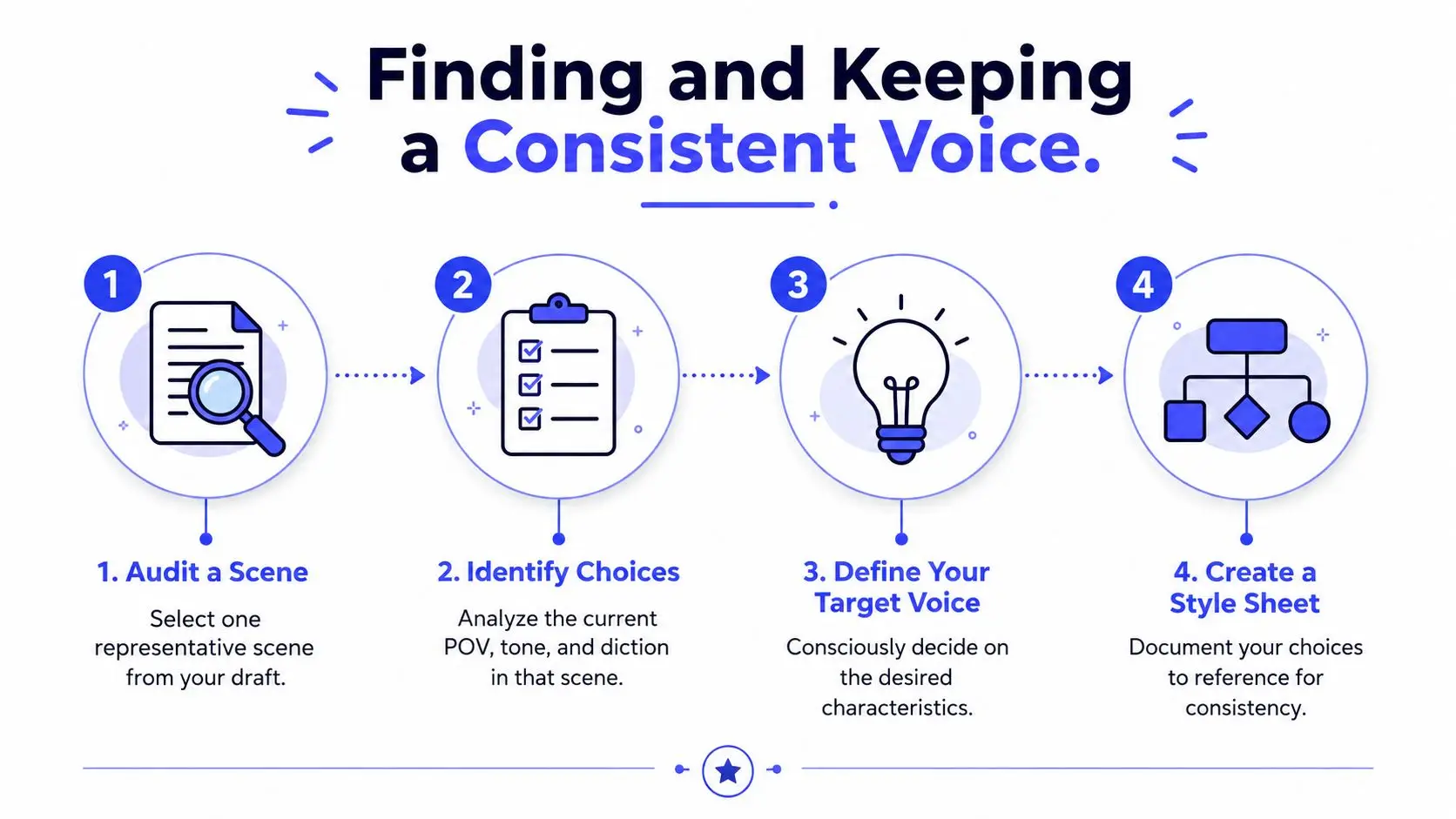
The answer starts with a reference point. If you draft chapter by chapter without one, the book can wander toward whatever phrasing feels easiest in the moment. Voice is not only who speaks. It is a bundle of choices, including time, distance, diction, reliability, and rhetorical purpose. A writer who keeps those choices visible has a better chance of making the whole manuscript sound like one mind, not a series of good pages that do not quite belong to each other.
Start with one voice anchor
Choose one scene that already sounds close to the book you want, then write it with care. A short paragraph, a monologue, or a private letter can serve as a voice anchor. Like a tuning note before a performance, it gives your ear something stable to return to.
That anchor should answer a few questions at once. Who is speaking? How close are they to the action? Is the language formal or plain? Do they sound certain, wary, amused, wounded, or detached? You do not need perfection here. You need a sample that captures the narrator's stance clearly enough to compare against later pages.
Test new chapters against the anchor
Later scenes should be checked against that sample, not for exact repetition, but for the same underlying decisions. A useful habit is to compare the opening 250 words of each chapter with the anchor and ask where the voice has shifted.
- Distance: Is the narrator closer to the events here, or farther away?
- Vocabulary: Does the language still fit the narrator's usual register?
- Emotional stance: Does the narrator sound like the same person under pressure?
- Knowledge: Does the narration stay within the voice's normal limits, or does it suddenly sound wiser, colder, or more omniscient?
These checks catch drift that can hide inside an otherwise strong chapter. A page can work on its own and still feel off if it borrows the wrong level of intimacy or commentary.
If you work with software, keep the anchor inside your drafting environment. Storyloft includes voice-aware rewrites, and this guide to using AI without losing your voice offers additional strategies for preserving narrator identity.
Use a style sheet for voice choices
A style sheet should track more than spelling. It can also record narrator stance, preferred sentence shape, recurring metaphors, and the situations where the voice should tighten or open up. That makes revision less like guesswork and more like comparison against a defined standard.
A manuscript keeps its shape when the writer checks the same choices over time. The goal is not to make every line identical. The goal is to keep the narrator believable as one continuous presence across a long book.
Quick Checklist for Voice Consistency
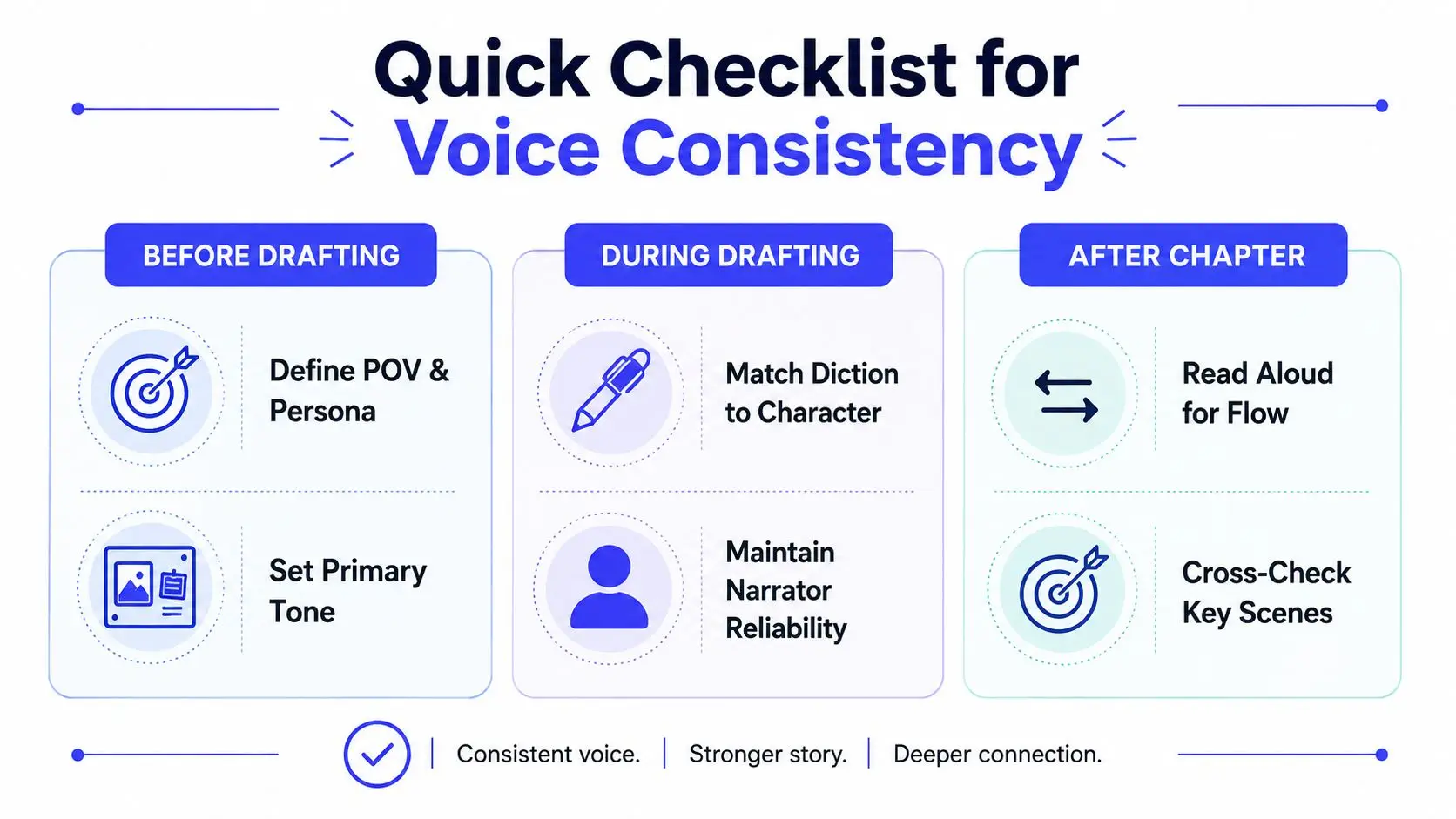
Before you draft, write one sentence that names the narrator's stance in plain language. Keep that line visible. If you can't describe the voice in one sentence, it'll be easy to lose it in chapter seven.
Before drafting
- Define POV and persona: Decide who is speaking and how much of the story they can know.
- Set the primary tone: Choose the narrator's default emotional register, then note where it can bend.
- Mark the distance: Decide whether the voice stays close, observant, reflective, or detached.
During drafting
- Match diction to character: Flag sentences that use vocabulary the narrator wouldn't naturally choose.
- Watch reliability: Check whether the narrator is hiding, correcting, or over-explaining.
- Read the last page before starting again: That keeps the current scene in the same acoustic room as the one before it.
After each chapter
- Read aloud for flow: If the sentences sound like a different speaker, mark the drift.
- Cross-check key scenes: Compare emotional intensity, knowledge level, and time markers across chapters.
- Track repeated habits: Notice recurring metaphors, sentence length, and interruptions, because those often reveal the voice more clearly than plot does.
A good voice checklist is simple enough to use on a tired day. It doesn't ask you to become a different writer, it asks you to stay in conversation with the narrator you've already begun to build.
Storyloft gives writers a place to draft, revise, and compare voice-aware text inside the manuscript itself. If you're working on a long project and want a tool that helps you hold onto narrator stance, tone, and consistency while you revise, visit Storyloft and explore how its drafting and editing features fit your workflow.