10 Writing Goals Examples for Authors in 2026
A larger daily word count isn't automatically a better writing goal. It can produce pages, but pages aren't the same as progress when the project needs research, structural revision, feedback, illustrations, or publishing decisions. The most useful writing goals examples connect a deadline, a measurable action, and a quality check. They tell you what to do, when to do it, and how to recognize meaningful progress.
The right target also depends on the work. A first-time novelist needs a drafting rhythm. A nonfiction author may need source milestones. A revising writer needs section-level outcomes, while a self-publishing author must coordinate editing, design, formatting, and release preparation. The examples below cover drafting, manuscript completion, genre development, revision, feedback, research, visuals, publishing, and multiple projects.
Storyloft can serve as an optional workspace for these workflows, with daily targets, streaks, planning, research organization, editing, collaboration, illustration, cover design, formatting, and publishing tools in one application. Use it if consolidating those tasks helps you spend less time moving between systems and more time making decisions that improve the manuscript.
Table of Contents
- 1. Daily Word Count Goals
- 2. Manuscript Completion Goals
- 3. Genre or Format Mastery Goals
- 4. Editing and Revision Goals
- 5. Publishing Timeline Goals
- 6. Manuscript Polish and Beta Reader Feedback Goals
- 7. Research and Source Documentation Goals
- 8. Illustration and Visual Content Goals
- 9. Book Cover Design and Testing Goals
- 10. Multi-Project Management and Writing Portfolio Goals
- 10-Point Writing Goals Comparison
- Turn One Example Into a Working Writing System
1. Daily Word Count Goals
A daily word target works best during new drafting, when the main job is generating material rather than evaluating every sentence. It gives an abstract ambition, such as “write my novel,” a visible action you can complete today. The danger is treating the number as the entire definition of success. A high count can hide scenes that don't advance the story, while a smaller session can solve a significant narrative problem.
NaNoWriMo helped make this model familiar. The event began in July 1999, when Chris Baty invited 20 friends to attempt a 50,000-word novel in one month, then moved to November in 2000 and became a nonprofit in 2005. Its target averages 1,667 words per day across 30 days, according to The Writer's history of NaNoWriMo. That structure is useful because it converts a large project into repeatable sessions, not because every author should adopt the same pace.
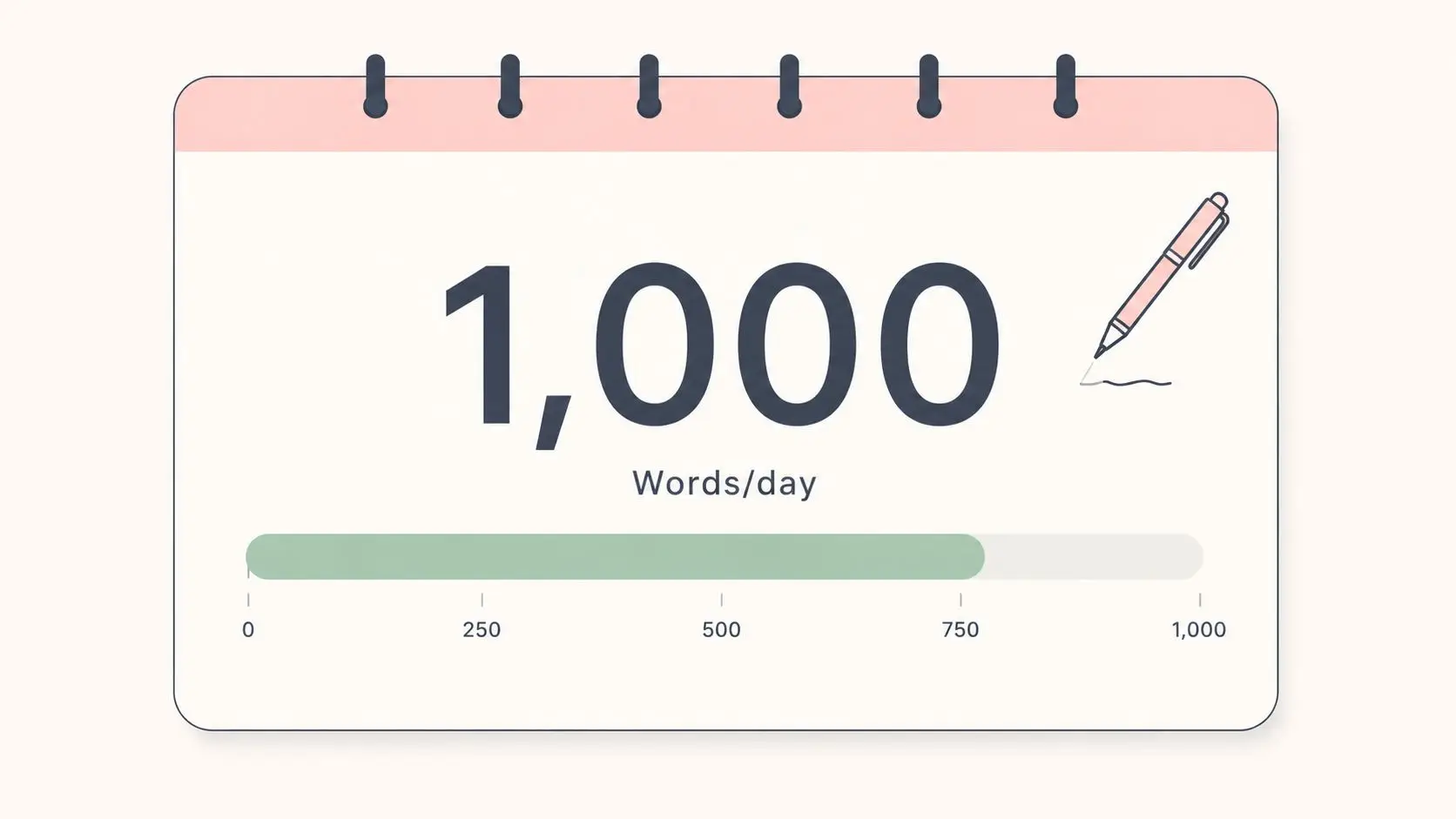
A reusable drafting template
- Action: Draft a defined word-count floor on scheduled writing days.
- Quality check: End with a scene, argument, or section that has a clear purpose.
- Tracking method: Record words written, minutes spent, and whether the session moved the outline forward.
- Adjustment rule: Lower the floor after repeated misses, or raise it only after the current target feels sustainable.
Set the target from your actual schedule, not from another writer's reported routine. For help converting a manuscript deadline into a workable target, use this writing goal calculator. A focus mode and streak record can make the habit visible, but the streak should support the manuscript, not pressure you into meaningless filler. These habits complement building a daily writing habit consistently, especially when each session has a defined stopping point.
2. Manuscript Completion Goals
A manuscript completion goal gives a long project an endpoint. “Finish the book” is emotionally clear but operationally weak. A usable version names the deliverable, the deadline, and the conditions for calling it complete. For a first draft, completion may mean every chapter exists in rough form. For a final manuscript, it may mean the planned revision passes are done and unresolved notes have been triaged.
Separate draft completion from publication readiness. If you combine them, you may polish the opening repeatedly while later chapters remain unwritten. A completion goal should protect forward motion first, then make room for quality work after the full structure is visible.
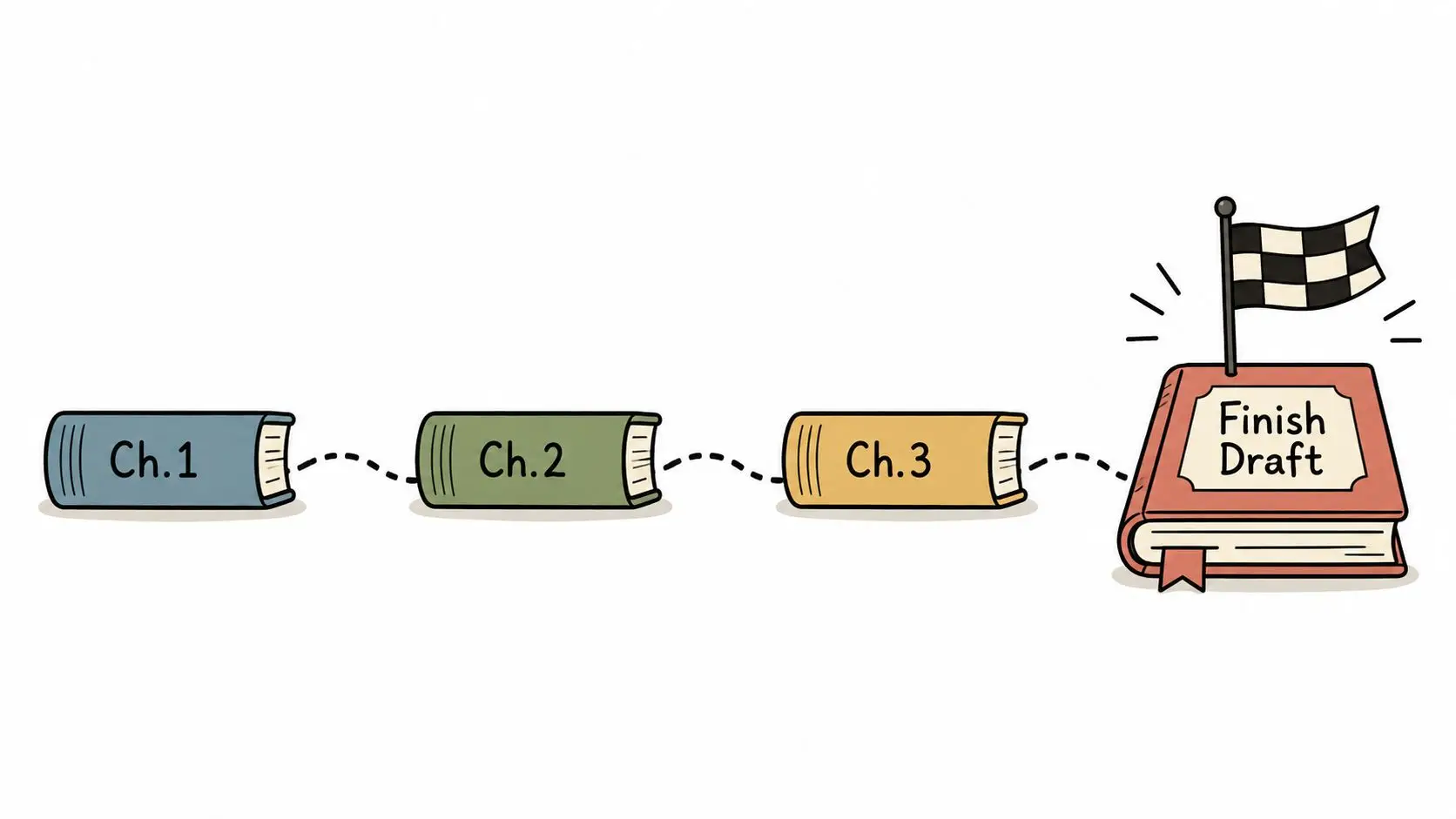
Build the finish line backward
Write the outcome in a form you can verify:
Practical rule: A manuscript isn't finished because the calendar says so. It's finished when the agreed deliverable exists and the next review can begin.
Break the project into chapters, sections, or research units. Mark intermediate checkpoints such as an opening portion, a midpoint review, and a complete draft, but don't treat those checkpoints as proof of quality. They show whether the project is moving at the expected velocity.
A practical template looks like this:
- Outcome: Complete a full draft of the current manuscript.
- Deadline: Choose a date that leaves room for interruptions and review.
- Weekly action: Finish the next scheduled chapters or sections.
- Success metric: All planned sections exist, each has a purpose note, and open research questions are logged.
- Tracking method: Use a binder or project outline to mark drafted, incomplete, and needs-research sections.
- Adjustment rule: If progress falls behind, reduce scope, reschedule the deadline, or change the weekly workload. Don't carry an impossible plan.
Storyloft's manuscript completion workspace can help keep chapters, planning notes, and progress records together. The important decision remains yours: define what “complete” means before the deadline arrives.
3. Genre or Format Mastery Goals
“Get better at fiction” gives you no practice target. A useful genre or format goal names the convention to study, the exercise that will test it, and the evidence that your draft improved. This applies to romance, mystery, science fiction, memoir, screenwriting, and technical documentation.
Genre study also changes the output trade-off. A week spent comparing published examples or rebuilding a scene may produce fewer words than a drafting sprint. That time earns its place when it answers a defined craft question and changes your own work. Research becomes avoidance when you keep collecting examples without testing a technique in a draft.
Set the target by author type:
- Romance writer: Over one week, examine relationship-conflict escalation in selected examples, then draft scenes that make the emotional turn clear. Track the passages reviewed, escalation pattern identified, scenes drafted, and the revision that strengthened the turn.
- Mystery writer: Map clue placement and reader discovery, then revise one chapter so evidence and misdirection work together. Track each clue, its reveal point, the chapter revised, and whether a test reader understood the intended trail.
- Science fiction writer: Define the consequences of the speculative premise, then write or revise scenes where setting rules affect character decisions. Track each rule, its consequence, the scenes tested, and any inconsistency found.
- Memoir writer: Study voice, scene selection, and reflection, then revise one personal episode for narrative movement and meaning. Track the source passage, the reflection added or removed, and the revised episode.
- Screenwriter: Study scene economy and visual action, then convert one prose sequence into a screenplay scene. Track the original sequence, the screenplay pages, actions that replaced explanation, and the scene's purpose.
Use this reusable weekly template: one craft principle, one study record, and one completed application. Storyloft's notes, comments, binders, and character tools can keep examples and experiments near the manuscript. AI-assisted tone analysis may help inspect consistency, but the writer must decide whether the result fits the intended audience.
Judge progress by transfer. A folder of notes shows collection. A revised scene, story, chapter, or script shows control.
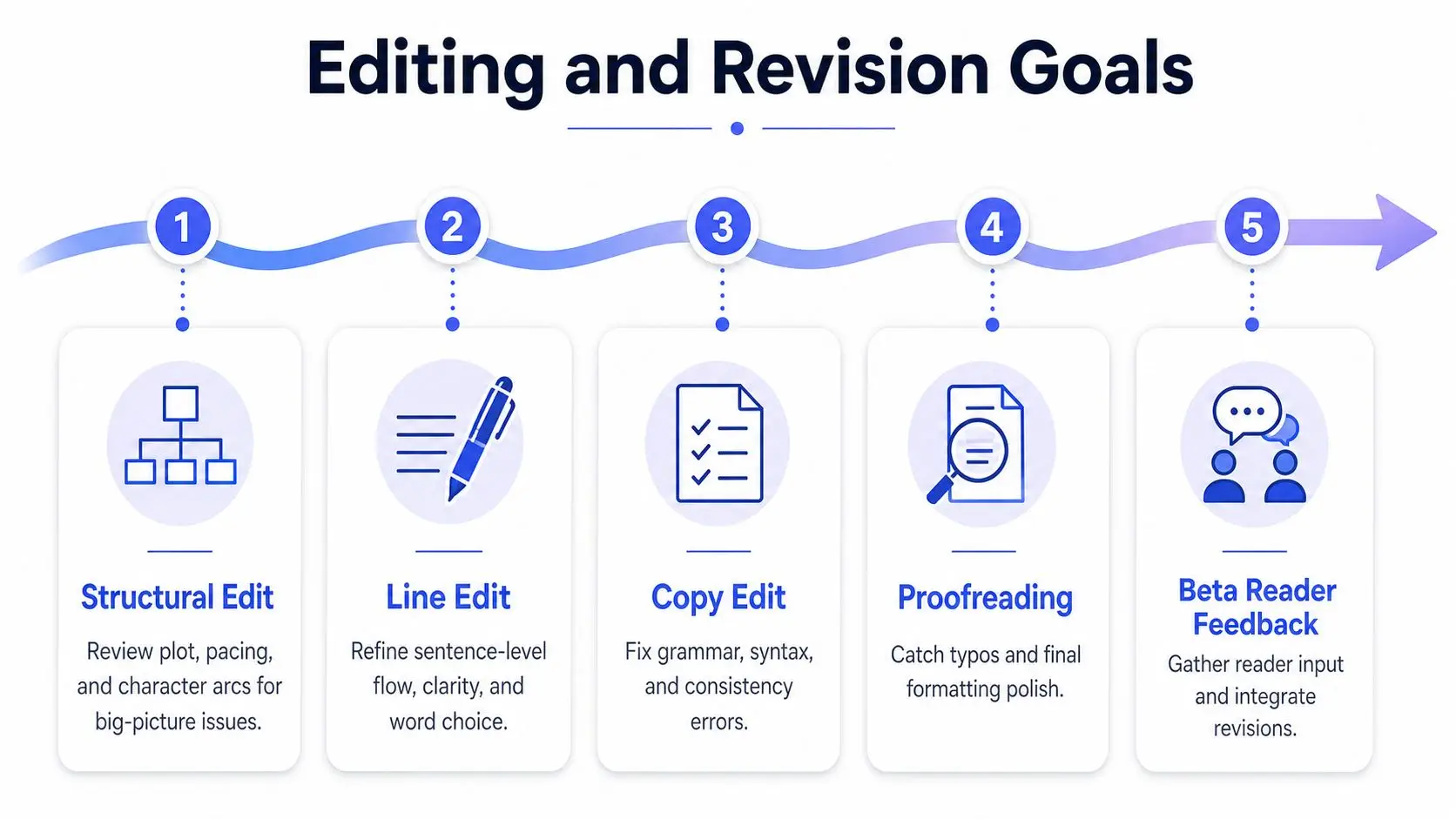
4. Editing and Revision Goals
Revision needs its own goals because word production is a poor measure of editing progress. A writer can spend a full session changing sentences without resolving the central problem, or delete words while weakening clarity. Effective revision goals define the layer of work and the evidence that the layer has improved.
Start with the largest problems. A structural pass might examine premise, sequence, stakes, argument, or chapter logic. A line pass can address clarity, rhythm, repetition, and voice. Proofreading should come after substantive changes, not before them.
Use passes instead of one giant edit
- Structural pass: Review the manuscript outline and write a purpose statement for every chapter or section.
- Scene or argument pass: Identify sections that lack conflict, evidence, transitions, or a clear reader takeaway.
- Line pass: Revise a defined group of pages for precision, rhythm, and unnecessary repetition.
- Proofreading pass: Check the final text after layout or export, not while the structure is still changing.
Set a session goal such as “evaluate the next chapter against the outline” rather than “edit for two hours.” Your quality metric might be a resolved structural question, a clarified character motivation, or a documented decision about a weak section. Track the passage reviewed, the issue found, the change made, and any item deferred.
Storyloft's Eddy assistant can support targeted revisions and voice-aware rewrites, while edit history lets you compare versions. Comments and tags can separate plot, pacing, character, continuity, and copy issues. Those features are most useful when the writer has already decided what the pass is meant to accomplish. The same principle applies when comparing writer portfolio apps: choose tools around the revision problem, not around a larger activity count.
5. Publishing Timeline Goals
A launch date is useful only when it is tied to work that can be checked. Publication depends on connected decisions: editing changes formatting, formatting reveals proofing issues, and cover choices affect metadata and production files. Self-publishing authors also need to assign each task to themselves or a collaborator, while traditional publishing plans must account for external approvals.
Set the release date after listing the deliverables behind it. “Manuscript complete” may still leave a final proof, cover files, product description, distribution setup, or corrections from a test export. Build the schedule around the path you control, then mark outside decisions as dependencies rather than assuming they will arrive on time.
Use readiness gates, not a single deadline
Organize the plan around five gates:
- Editorial readiness: Finish the planned revision and record the final decisions.
- Design readiness: Approve the cover direction and prepare its required format variations.
- Interior readiness: Export, inspect, and correct ebook and print layouts.
- Metadata readiness: Finalize the title information, description, categories, and contributor details.
- Launch readiness: Complete uploads, review proofs, and confirm the release plan.
Give every gate an owner, dependency, review date, and definition of done. Leave buffer between dependent tasks. If a cover revision delays formatting, update the launch date and downstream reviews immediately. A reliable publishing goal measures completed gates and unresolved blockers, not days spent preparing files.
A reusable template is: “Reach launch readiness by the release date, with all five gates signed off and no unresolved production blocker.” Track each gate in a simple table with status, next action, owner, and revised date. For an independent author, review it weekly. For a traditionally published author, track the approvals you can influence and the handoffs you are waiting on.
Storyloft includes cover design, ISBN barcode generation, export, and publishing tools. Its themes and typography options support ebook and paperback outputs, but exported files still require human inspection. Software can reduce formatting work without replacing a final proof.
6. Manuscript Polish and Beta Reader Feedback Goals
A manuscript can collect plenty of comments and still remain unfocused. Useful feedback starts with a revision decision: which reader experience needs testing, what evidence would confirm the problem, and what change the author is prepared to make. Readers may disagree about pacing, backstory, or voice. That disagreement is information, not an instruction to satisfy everyone.
Match the process to the project. A novelist may test whether readers understand a character's motivation before the climax. A nonfiction writer may check whether the argument remains clear across sections. A co-written manuscript may need continuity and voice checks alongside reader reactions.
Turn comments into revision decisions
Run the cycle in five stages:
- Prepare: Send a dated version with a brief and focused questions.
- Collect: Set one response deadline and ask readers to identify scenes, chapters, or sections.
- Group: Sort comments into plot, character, pacing, clarity, argument, voice, and continuity.
- Decide: Label each issue accept, adapt, investigate, or decline, with a reason.
- Revise: Complete the selected changes in one controlled pass, then reread nearby material for unintended effects.
Use a time-bound goal such as: “Complete one beta feedback cycle by the review date, identify recurring issues, and revise the affected sections before the next proof.” Track readers invited, responses received, repeated issues, decisions made, and changes completed. For an independent author, reserve time for a second pass after synthesis. For an editor or co-writer, record who owns each decision. The output count shows activity. The decision log and revised pages show progress.
Storyloft supports role-based access for editors, co-writers, and beta readers. Comments, tags, and edit history can connect an observation to the revision that followed. Keep the earlier version available for comparison instead of relying on memory.
7. Research and Source Documentation Goals
Research should answer a manuscript's real needs, then stop. Starting too early can leave key claims unsupported. Continuing too long can postpone drafting and difficult choices. Set a question, define usable evidence, and choose a stopping point before collecting more material.
A historical novelist might document the setting, timeline, social conditions, and material details that shape the characters. A nonfiction writer needs a traceable source for each major claim. Academic writers must also keep notes compatible with a consistent citation system.
Build the goal around the next section you will write:
- Question list: Record the factual or conceptual questions each chapter must answer.
- Source record: Note the source, relevant passage, topic, chapter connection, and any limitation.
- Coverage check: Test whether every major claim has adequate support before drafting or revising.
- Stop rule: Start writing once remaining questions are nonessential, and mark them for later verification.
Use a time-bound template: “By the review date, complete the source records for the next research-dependent section, connect each major claim to documented evidence, and flag unresolved points.” Track records completed, claims supported, questions unresolved, citations checked, and sections cleared for drafting. These measures separate research activity from manuscript progress. A large pile of weak notes can create more risk than a smaller set that you can verify quickly.
Storyloft's research notes organization guide describes a workflow using binders, tags, and side-by-side reference. Choose APA, MLA, Chicago, or the required house style early, then apply it consistently. Keep interpretation separate from quotations and factual notes, so your summary is not later mistaken for the source's wording. For historical fiction, add a continuity check for details that recur across scenes. For nonfiction and academic work, retain the citation beside the claim rather than reconstructing it during revision.
8. Illustration and Visual Content Goals
Illustrated books add a second production track. The writing may be complete while the visual system remains undefined, or the artwork may introduce continuity problems that require changes to the text. Children's books, graphic novels, illustrated cookbooks, and visual nonfiction each need goals that connect narrative progress with visual decisions.
Don't treat illustration as decoration added at the end. Define the visual requirements early enough to test whether the manuscript and images support one another. A character's appearance, setting, object, or sequence may need to remain consistent across many scenes.
Pair visual milestones with narrative milestones
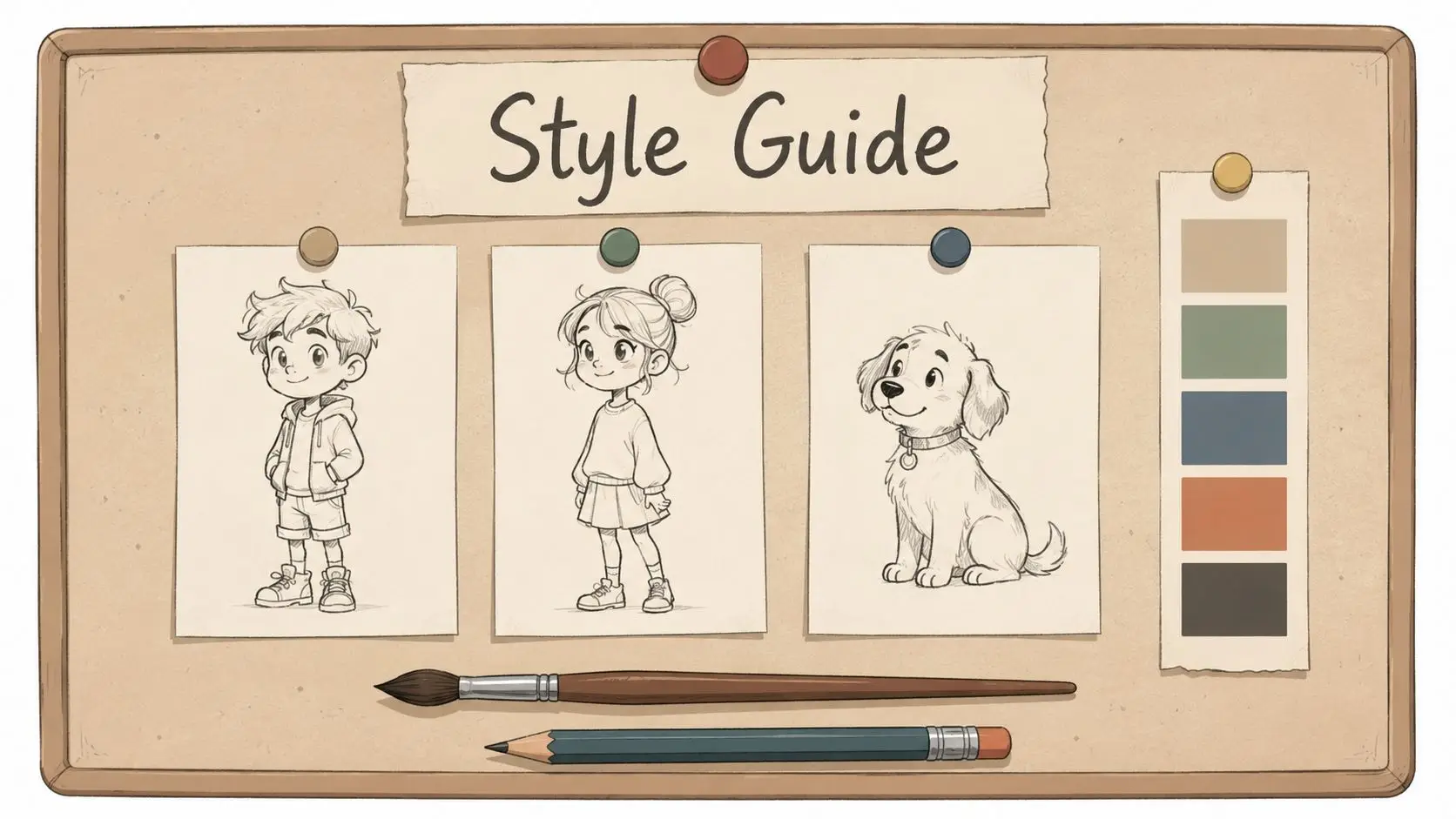
- Style guide: Record palette, line treatment, rendering approach, character attributes, and recurring visual rules.
- Scene plan: Identify which passages require an illustration, panel sequence, diagram, or photograph.
- Continuity review: Compare character, setting, clothing, object, and spatial details across the planned visuals.
- Approval stage: Review the artwork beside the relevant manuscript section before moving to final production.
A reusable goal could be: “Complete the visual plan for the next group of chapters, approve the style guide, and review every image against its related passage by the stated date.” Track assets planned, assets drafted, assets approved, and continuity issues resolved. For commissioned work, also record feedback deadlines and approval ownership so revisions don't drift.
Storyloft's illustration suite can generate scene visuals from selected passages, while its character creator can store persona and appearance details for consistency. Treat generated images as working material that still requires editorial review, especially when visual accuracy, representation, or continuity matters.
9. Book Cover Design and Testing Goals
A cover goal must measure communication, not only visual appeal. Set a deadline, define the intended genre signal, and decide which formats require approval. The cover should remain readable as a thumbnail, match the book's category, and avoid suggesting the wrong kind of story.
Start with the decision the design must support. For a fiction release, that might mean confirming that target readers identify the expected genre and can read the title at small size. For nonfiction, it may mean checking that the promise and audience are clear before production begins. Compare alternatives, but limit the test to questions that can change the final choice.
Use a time-bound cover testing plan
A reusable goal for an independent author is: “By the stated date, create several cover directions, test each at thumbnail size with target readers, complete format checks, and approve the final production file.” Track the work in a simple decision log:
- Concepts: Record each direction, its intended audience, and the question it tests.
- Quality checks: Review title and author-name readability, contrast, imagery, typography, trim, margins, barcode placement, and export quality.
- Reader signal: Note the genre, tone, and story expectations readers report, including repeated misunderstandings.
- Milestones: Mark concepts drafted, feedback collected, technical corrections completed, and the final file approved.
Reader preference alone is weak evidence. Comments become useful when several people identify the same strength or confusion. The author still makes the editorial choice, balancing audience clarity, production requirements, and personal judgment.
Storyloft's book cover creation guide describes cover-studio features for layout variations, print and ebook presets, custom imagery, synchronization, and ISBN barcode generation. Use those tools to test options efficiently, then inspect the approved files in every format planned for release.
10. Multi-Project Management and Writing Portfolio Goals
A full writing portfolio does not advance when every project receives equal attention. A novelist may draft one book while revising another. A freelance writer may handle client work, submissions, and a personal project in the same week. Assign each project a role, stage, priority, and next action so available time produces visible progress.
Use a portfolio map rather than one undifferentiated task list. Give each project a current capacity, then protect the work with the nearest external consequence. Research can continue at a smaller weekly pace while a manuscript approaches a fixed submission date. Group similar tasks, such as editing several pieces together or processing submissions in one block, to reduce context switching.
Set a measurable target for every project:
- Stage: Research, drafting, revision, feedback, submission, or production.
- Deliverable: The next chapter, revision set, pitch, or file, rather than the entire project.
- Priority: Deadline, contract, publication opportunity, or personal importance.
- Weekly output: A defined amount of drafting, research, editing, or outreach.
- Quality check: A criterion such as resolved comments, verified sources, or a completed read-through.
- Milestone date: The point when the deliverable must be finished or reviewed.
A novelist might set this goal: “By the end of the week, complete the next manuscript milestone, revise the assigned scene set, and give the secondary project one scheduled drafting session.” A freelance writer could set a parallel target: “Submit the contracted piece by its due date, complete one pitch, and reserve a recurring block for the personal project.” Track output, quality evidence, and milestone status separately. Review the portfolio weekly for missed commitments and stalled projects. If one project receives no meaningful work repeatedly, pause it explicitly instead of allowing it to create ongoing guilt.
Storyloft's separate workspaces, binders, tags, and progress records can keep projects distinct while preserving reusable research and character details. Keep one master calendar as the deadline record. Meet external commitments first, then allocate remaining capacity to personal goals without promising every project the same pace.
10-Point Writing Goals Comparison
| Goal | Implementation Complexity 🔄 | Resource Requirements ⚡ | Expected Outcomes 📊 | Ideal Use Cases 💡 | Key Advantages ⭐ |
|---|---|---|---|---|---|
| Daily Word Count Goals | Low, set daily targets and track automatically | Low, time and a tracking tool (e.g., Storyloft) | Consistent daily progress; habit formation | Drafting phases, habit-building (NaNoWriMo) | ⭐ Builds routine and measurable momentum |
| Manuscript Completion Goals | Medium, milestone planning and timeline management | Moderate, planning tools, time allocation, possible editors | Finished draft by a target date; clearer scope | Long-form projects, publisher deadlines | ⭐ Provides a clear endpoint and reduces overwhelm |
| Genre or Format Mastery Goals | Medium–High, sustained study and practice cycles | High, reading, research, targeted feedback/community | Specialized craft skills and niche positioning | Writers seeking market specialization or series work | ⭐ Creates marketable expertise and differentiation |
| Editing and Revision Goals | Medium, multi-pass workflows and version control | High, editors, beta readers, time for multiple passes | Significantly improved manuscript quality and polish | Pre-publication polishing, agent submissions | ⭐ Ensures professional standards and error reduction |
| Publishing Timeline Goals | High, coordinate sequential publishing tasks and vendors | High, vendors, budget, marketing and scheduling | Smooth launch and distribution; fewer last-minute issues | Self-publishing launches, traditional publishing schedules | ⭐ Ensures coordinated launch and reduces missed steps |
| Manuscript Polish & Beta Reader Feedback Goals | Medium, manage recruitment, rounds, and synthesis | Moderate, beta readers, collaboration tools, time | Identifies blind spots; improves readability and appeal | Final pre-launch validation and audience testing | ⭐ Improves plot/character clarity and builds early advocates |
| Research & Source Documentation Goals | Medium–High, organized citation and fact-checking | Moderate–High, access to sources, reference managers | Enhanced credibility and accurate references | Nonfiction, historical fiction, academic projects | ⭐ Strengthens authority and reduces factual errors |
| Illustration & Visual Content Goals | High, art direction, style guide, iteration cycles | High, illustrators, software, higher production costs | Visual consistency and stronger reader engagement | Children's books, graphic novels, illustrated editions | ⭐ Elevates product value and reader immersion |
| Book Cover Design & Testing Goals | Medium, multiple mockups, A/B testing, proofs | Moderate, designers, testing audience, proofs | Better discoverability and conversion rates | Pre-launch marketing and sales optimization | ⭐ Directly impacts sales and perceived professionalism |
| Multi-Project Management & Portfolio Goals | High, sequencing multiple timelines and priorities | Moderate, organizational tools, strong time management | Sustained publication velocity and diversified income | Prolific authors, series writers, portfolio builders | ⭐ Maintains steady output and backlist growth |
Turn One Example Into a Working Writing System
The best writing goals examples aren't isolated resolutions. They form a system in which one outcome goal creates the next layer of actions. Start with the result that matters most right now, such as completing a first draft, finishing a revision pass, verifying research, preparing a cover, or submitting a manuscript. Don't choose a daily word target merely because it looks measurable. Choose the measure that matches the work.
Then translate the outcome into a weekly action. A drafting project may need scheduled writing sessions and a word-count floor. A research project may need source records linked to chapter questions. A revision project may need a defined pass across selected sections. A feedback project needs a response deadline, synthesis process, and decision log. Visual and publishing projects need approvals, dependencies, and file checks. Portfolio management needs priority rules that prevent every project from becoming urgent.
Research on writing interventions supports this emphasis on specific goals. A published summary reported that goal setting produced a large-to-moderate increase in writing productivity for students in Grades 2–5 and 8–12, while another goal-setting study found that students writing toward goals produced longer papers, more supporting reasons, and higher-quality writing than control groups, as summarized in the published writing intervention research. The practical lesson is not that every author needs a particular number. It is that a visible, concrete target gives effort a direction and makes review possible.
Write the plan down and add accountability where it helps. The Dominican University study summarized by Michigan State University reported a 76% success rate for participants who wrote goals, committed to action steps, and sent weekly progress updates, compared with 43% for those who kept goals in their heads, as described in this evidence-based goal-setting summary. External accountability won't rescue an unrealistic plan, but it can expose avoidance and keep the next action visible.
Use this compact goal template
- Goal: Name the deliverable and the writing stage.
- Deadline: Choose the date when the deliverable must be ready for review.
- Weekly action: State the repeatable work that advances it.
- Success metric: Combine output with a quality or milestone check.
- Review date: Set a fixed time to inspect progress.
- Adjustment rule: Decide in advance what you'll change after a miss.
Independent writing guidance recommends SMART, backward-planned, and quantity-based goals, such as a defined word, page, paragraph, or section target, rather than an open-ended intention to write more, according to the University of California, Irvine writing productivity guidance. CUNY's writing-center guidance distinguishes project, short-term project, and habitual goals, while UNC recommends numerical targets such as pages, hours, or concepts addressed, as explained in its goal-setting guidance. That distinction helps you choose a target suited to the stage instead of forcing every project into daily word counts.
Make the plan realistic enough to survive interruptions. Use if-then actions for predictable obstacles, such as moving a missed writing session to the next available block or replacing a word target with a time-boxed revision task during an editing week. Guidance on SMART writing goals emphasizes behavior-linked planning for this reason, as shown in the University of Oklahoma Writing Center guide. Review both output and quality at the same interval, then adjust the system without treating adaptation as failure.
Storyloft is one option for combining goal tracking, manuscript progress, planning, research organization, collaboration, editing, visual development, and publishing tasks. Its writing goals tools can record words, streaks, and progress for a selected book, while the broader workspace keeps production materials connected to the manuscript. You can also use these progress tracker tips to strengthen the review habit, regardless of the tool you choose.
Storyloft brings daily writing targets, manuscript planning, research organization, AI-assisted editing, collaboration, illustration, cover design, and ebook and paperback publishing workflows into one cloud-based workspace. Visit Storyloft to choose a goal template, connect it to your current project, and start tracking progress that reflects more than word count.