How to Start Writing: My Beginner’s Guide

Three years ago, I was in a small apartment in southern Chile. I had just left a job in investment banking. I didn’t have a plan or a writing degree. But I felt a strong urge to write.
Outside my window, the Andes mountains were hidden in thick clouds. I was teaching English to kids who laughed at my Spanish mistakes. Every night, I wrote about what I saw and felt. This habit grew into my first book.
My memoir, Journeys Beyond and Within, came from a nine-month trip across South America. The Sikkim Express said it was “simple but evocative.” The Telegraph Online called it “an introspective and adventurous read.” It’s on Amazon worldwide. Yet, I still see myself as a beginner.
If you’re starting to write, remember something important. You don’t need permission or credentials. You just need to start.
This guide is what I wish someone had told me when I began. It’s full of tips I learned the hard way. I’ve had bad drafts, lonely nights, and small wins that kept me going.
Key Takeaways
- Starting your writing journey doesn’t require a degree, a plan, or anyone’s approval — just the willingness to sit down and write.
- Honest, heartfelt writing connects with readers far more than polished but empty prose.
- Your childhood memories and personal experiences are some of the richest material you can draw from.
- First drafts are supposed to be messy — give yourself permission to write badly before editing.
- Specific details and proper nouns transform flat writing into vivid, engaging stories.
- Reading your work aloud is one of the simplest and most powerful editing tools available to any beginner writer.
- Building a writing life means creating routines, finding community, and nurturing relationships along the way.
Why I Decided to Start Writing After Leaving Investment Banking
Three years ago, I left my job in investment banking. I switched from spreadsheets to blank pages. It was scary and exciting at the same time. I felt I had stories to tell.
My Journey from Finance to Full-Time Writing
Banking taught me discipline and how to work hard. These skills helped me start writing. I woke up early to write before the day started.
Some days, words flowed easily. Other days, I struggled. But I kept writing.
Writer’s block was my daily challenge. I learned that consistency is key, not inspiration. Writing something, no matter how bad, was better than nothing.
The Chile Adventure That Sparked My Writing Practice
I went to Chile to teach English. I hoped the new place would spark my creativity. The highlands were breathtaking, but the air was thin.
My Spanish was poor, and the culture was overwhelming. Yet, I wrote every day. This experience taught me a lot.
- New places push you to be creative
- Chaos helps you tell honest stories
- Writing through tough times builds strength
Publishing My First Book: Journeys Beyond and Within
My first book, Journeys Beyond and Within, is about my travels in South America. It talks about my family’s disapproval and my career changes. It also shares my fears on the road.
Writing a book is not about having all the answers. It’s about being brave enough to ask the questions out loud.
People say my book makes them laugh and feel inspired. This feedback makes me glad I changed careers. Writing through travel and challenges gave me my book.
Understanding the Reality of How to Start Writing
Starting to write seems romantic. But the reality is far from it. It’s messy, uncertain, and scary. Let me show you what it’s like to start writing.
Why Writing Feels Like Driving Mountain Roads at Night
Imagine driving a mountain road at night. No lights but your headlights to guide you. You shift gears and adjust your lights, gripping the wheel tight.
Writing is like this. You can only see a little ahead. You worry if your stories will be believable. But you keep going, trusting your work will shine through.
The Lonely but Liberating Path of a Writer
Writers often work alone. I sit at my desk for hours, crafting sentences. No one cheers me on or tells me if my work is good.
But this solitude is freeing. Writing is like breathing to me. It’s a journey of self-discovery, where I find my own inspiration.
What Makes Writing Addictive Despite the Challenges
When you can make readers laugh or cry, you feel a change. Writing becomes addictive. Even on Diwali, while trekking, I feel the urge to write.
I dream of teaching about creativity. Sentences form in my mind, even when I’m brushing my teeth. The urge to write is strong. This is what makes writing a true passion, not just a hobby.
Write Honestly from Your Heart
A friend once put her hand on my chest and said, “Writing oozes straight from here. If it’s honest, it cannot be bad.” That simple reminder changed everything for me. The best writing practice techniques all circle back to one truth: write what burns inside you.
When I read Jhumpa Lahiri’s stories, I crave that labyrinth of human emotions she weaves. When I pick up Ruskin Bond’s tales about a boy named Suraj peeping through a window in Landour, I want to plant cherry trees and write until dusk. These writers succeed because they pour their real selves onto the page. Their authentic writing voice is what pulls readers in and refuses to let go.
I’ve written about arranged marriage culture in India. I’ve written travel pieces that made hours vanish. Every time I chose a theme that mattered to me personally, the words rushed out. I’d draft five thousand words for a piece that needed only two thousand. That overflow happens when honest storytelling takes the wheel.
It doesn’t matter what kind of writer you are:
- Copywriter crafting brand stories
- Novelist building fictional worlds
- Travel blogger capturing distant places
- Poet distilling emotions into verse
- Personal growth advisor guiding readers
Every one of us wants the same thing — writing that feels alive. Start by writing what you must write. Let the words be a living character who frets, shouts, and parties until noon. Allow the creative juices to flow. Be yourself. That’s where your authentic writing voice lives, and that’s where abundance begins.
Embrace Your Childhood Memories as Writing Material
Your earliest memories are a treasure trove. They are raw and waiting to be stories. When starting your first draft is hard, look back first. Your childhood experiences are the best material.
Following Rilke’s Advice to Young Poets
Rainer Maria Rilke gave advice in Letters to a Young Poet that changed me. He told a young poet to go back to childhood. Write about your memories from growing up. He said those memories have a power like no other.
“If your everyday life seems poor, don’t blame it; blame yourself; admit to yourself that you are not enough of a poet to call forth its riches.” — Rainer Maria Rilke
This idea was my biggest source of inspiration. I remembered waiting for the Amul ice cream truck as a kid. The honk would make me run outside. Then, I’d ask my mom for two rupees. That small moment was full of emotion.
How Childhood Stories Create Powerful Narratives
Childhood memories are pure and touch every reader. These moments happened without filters. That’s why they feel so real on the page.
Childhood and art share something special:
- Both involve playing, dancing, and singing without fear of judgment
- Both welcome laughter and tears with equal openness
- Both thrive on curiosity and raw honesty
- Both require being fearless and frightened at the same time
Writing about your childhood lets art flow naturally. It’s a great way to build confidence. These are lived stories, ready to be shared. Just write them down and let life shine through your words.
Master the Art of the Shitty First Draft
Your first draft doesn’t need to be perfect. It just needs to exist. One key trick is to write without stopping. Pour your thoughts onto the page like water.
The mess is what matters. Editing or checking spelling mid-sentence can ruin your flow.
Why Your First Draft Should Be a Mind Dump
Think of your first draft as a mind dump. It should be long, bad, and embarrassing. Let it spread out without direction.
A messy draft shows you’re committed. Daily writing goals help you keep going. Even 500 words a day of chaos is better than nothing.
Anne Lamott’s Wisdom on Letting Words Flow
Anne Lamott talks about this in Bird by Bird. She says you need to write really bad first drafts. She calls it the “child’s draft.”
It’s where everything spills out. No one will see it. You can fix it later. This freedom helps you write better.
Basic Writing Etiquette Even for First Drafts
But, even in first drafts, there’s basic etiquette. Treat your draft like a newcomer at a big company. Be kind and welcoming.
In writing, this means:
- Never use words you’ll delete later — change “very hungry” to “famished” now
- Use correct grammar as a habit
- Avoid filling drafts with junk that hides good ideas
Setting daily writing goals helps. These small habits save time later. Start messy, but start smart.
Let Your Writing Ferment Before Editing
You just finished a draft and want to hit “publish”. Your brain is eager for likes and shares. But rushing your editing can weaken your work.
As a beginner, I wanted to publish fast. I’d edit the same night and think it was done. But my writing was awkward and full of errors.
Draft fermentation is real. Your writing needs time to breathe, just like bread dough. Take a break for a day or two. When you return, you’ll see problems you missed before.
Writing patience is a skill. Here’s how I let my drafts rest:
- Close the document and don’t peek for at least 24 hours
- Work on a different piece during the waiting period
- Jot down notes if ideas pop up, but resist full edits
- Return with a printed copy to see the text in a new format
Learning is more important than the outcome. You’re just starting out. Every draft you let sit helps you slow down and grow. The edit can wait. Your growth as a writer depends on it.
Read Your Work Aloud for Better Editing
Reading your work out loud is a simple yet powerful trick. It makes you notice clunky phrases you missed before. This habit has changed how I edit.
Reading aloud after a break helps. It lets you see your work with fresh ears. This way, you can hear how it sounds to others.
Becoming a Listener to Your Own Story
Reading out loud helps catch mistakes you might miss. You’ll spot unnecessary words and awkward sentences. It’s a way to improve your writing that silent reading can’t match.
Here’s what I listen for:
- Sentences that make me run out of breath (too long)
- Words that feel repetitive or unnecessary
- Dialogue that no real person would speak
- Transitions that feel jarring or abrupt
- Rhythms that drone on without variation
I mark spots that surprise me and fix them later. This keeps me focused on listening, not editing.
Using Technology to Hear Your Writing
I also use my MacBook’s speech option. It reads text in a neutral voice. This helps me see my writing without my own bias.
Windows laptops have Narrator, and apps like Natural Reader work on any device. Hearing your writing read back to you shows weak spots. These strategies help you cut out the boring parts, which I’ll talk about next.
Delete the Boring Parts Without Mercy
Here’s a truth I learned the hard way: if you are bored reading your own writing, every single reader will be bored too. When I was a lazy beginner, I skipped over lines that made me yawn. I left in paragraphs I knew people would skim. Why? Because cutting them meant more work. That mindset nearly killed my writing before it started.
Ruthless editing is the secret weapon of every great writer. Elmore Leonard, one of America’s most celebrated novelists, said it best:
“I try to leave out the parts that people skip.”
That one sentence changed how I approach every piece I write. Engaging content creation isn’t about adding more words. It’s about stripping away everything that doesn’t earn its place on the page.
Ask yourself these questions while you revise:
- Does this sentence move the story forward?
- Would I keep reading if someone else wrote this paragraph?
- Am I keeping this line because it sounds clever or because it matters?
- Does this passage make me feel something, or does my attention drift?
Reader retention depends on pace and energy. Every dull paragraph is an exit door. Your job is to close those doors before your audience walks through them.
| Sign Your Writing Is Boring | What to Do About It |
|---|---|
| Your eyes glaze over while rereading | Delete the entire passage and rewrite it |
| A paragraph restates what you just said | Cut the repetition completely |
| A scene has no conflict or tension | Add stakes or remove the scene |
| You included it just to hit a word count | Remove it — padding kills reader retention |
Ruthless editing feels painful at first. You spent time writing those words. But engaging content creation demands sacrifice. Delete the boring parts without mercy, and what remains will be writing that deserves to be read.
Use Proper Nouns and Specific Details
I used to just throw out generic names like “car,” “food,” and “plant.” My writing was dull. No one laughed or cared. But when I started using real names and details, everything changed.
Transform Generic Descriptions into Vivid Scenes
Imagine I say “a red car.” You see something, but it’s not clear. Now, I say “a crimson-red Hyundai Tucson with a dented bumper.” Suddenly, you can picture it in a driveway.
It’s the same with every noun. Instead of “food on the table,” I say “butter-toasted, glistening brioche buns on a ceramic platter.” Replacing vague nouns with real, detailed ones makes scenes come alive.
Why Specificity Keeps Readers Engaged
When I just give a category name, you have to guess. That’s hard work. And if you’re guessing, you might lose interest and leave.
Being specific is more than just adding details. It makes you trust me more. People love to look at a medley of pink, purple, and yellow bougainvillea hanging off a sunlit courtyard wall, not just “a plant.”
Examples That Show the Power of Proper Nouns
| Generic Writing | Vivid Writing with Proper Nouns | Reader Reaction |
|---|---|---|
| She wore a black outfit. | She wore a fitted black Diane von Furstenberg jumpsuit. | Instantly pictures the scene |
| He drank coffee at a shop. | He sipped a cold brew at Blue Bottle Coffee on Abbot Kinney. | Feels transported to the location |
| There were flowers in the garden. | A medley of pink and purple bougainvillea spilled over the adobe wall. | Engages all senses |
| She ate a sandwich. | She bit into a prosciutto and mozzarella panini from Eataly. | Tastes the food mentally |
Look at the item from every side. That’s how you grab and keep a reader’s attention. Now, let’s make sure you’re showing those details through the senses.
Show Don’t Tell Through Sensory Details
The show don’t tell technique is a powerful tool for making writing come alive. Let’s look at an example. Instead of saying “He left me. I was sad, so I cried.”, we can show it. This makes the story feel real.
Here’s a better version: “I was about to bite into avocado toast when I remembered how he used to peel ripe avocados for me. The toast slipped from my hand. My swollen eyes brimmed with tears again.” This version makes you feel the moment. It’s because it uses sensory details.
| Telling | Showing |
|---|---|
| San Pedro was a beautiful town. I fell in love immediately. | Stars crowded above snow-capped volcanoes. From a distance, I watched folk dancers whirl in the moonlight. San Pedro was stunning. |
| The coffee shop was cozy and warm. | Steam curled from my ceramic mug. The espresso machine hissed behind the counter as worn leather chairs groaned under shifting weight. |
Immersive storytelling needs effort. It asks you to think about what you see, hear, and smell. This puts the reader right there with you.
When I wrote about San Pedro, Chile, I didn’t just list things to do. I used sensory details to take readers there. This is the magic of show don’t tell.
One rule I follow: if my writing feels like writing, not a real story, it’s not done. I keep editing until it feels real. Using sensory details makes the story unforgettable.
Choose Powerful Words Over Weak Modifiers
Think of your writing as a tightrope. Every word must keep the rope taut and your reader hooked. The moment you add a weak modifier, the rope sags. Your audience loses balance — and interest. Powerful word choice is the secret to keeping that line tight from start to finish.
Replacing Very and Really with Stronger Adjectives
Words like very and really are red flags. They signal that a stronger word exists — and you haven’t found it yet. Strong adjective usage means swapping lazy pairings for single, punchy alternatives.
| Weak Modifier | Stronger Alternative |
|---|---|
| Very upset | Heartbroken |
| Really beautiful | Gorgeous |
| Very tasty | Delicious |
| Really tired | Exhausted |
| Very angry | Furious |
See the difference? The second column hits harder every time.
Cutting What’s Already Obvious
I used to write phrases like “beautiful golden sunflowers.” Sunflowers are already beautiful. That adjective adds nothing. Same goes for “cool breeze” — breezes are cool by nature. Cut the word. Trust the noun to do its job.
Filler phrases sneak in the same way. Expressions like “as a matter of fact,” “at least,” “just,” and “as far as I’m concerned” dilute your message. They’re breaths and pauses that belong in conversation, not on the page.
Writing Sharp and Taut Sentences
Clean prose writing means no stammering, no fence-playing, no hiding behind extra words. Every sentence should earn its place. If a word doesn’t push the story forward or sharpen the image, delete it.
“The most valuable of all talents is that of never using two words when one will do.” — Thomas Jefferson
After mastering strong adjective usage and trimming weak modifiers, you’re ready to tackle another sneaky problem: ghost nouns and dangling pronouns that confuse readers without them even realizing it.
Eliminate Ghost Nouns and Dangling Pronouns
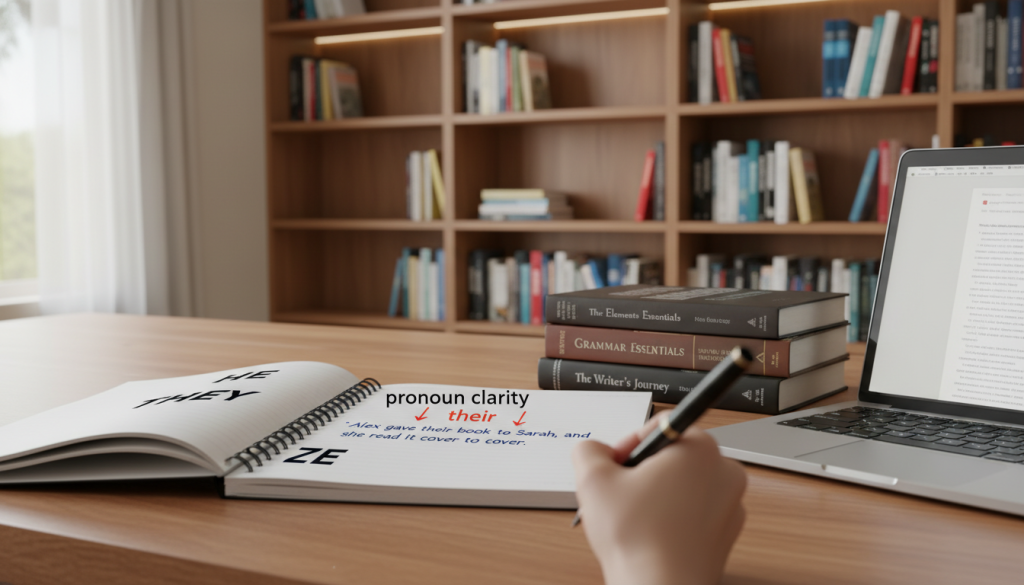
Ghost nouns and dangling pronouns are sneaky. They sneak into your writing and confuse readers. They are called “ghosts” because they haunt your sentences without pointing to anything real. Learning about pronoun clarity is key to improving your grammar.
Fixing “It Is” and “There Are” Constructions
Phrases like “it is,” “there is,” and “there are” make your sentences weak. They add empty words. Even famous authors make this mistake. Here’s how to fix them:
| Weak Construction | Stronger Rewrite |
|---|---|
| It is a privilege having you here. | We are privileged to have you here. |
| There is a cat in the cafeteria. | A cat sneaked into the cafeteria. |
| There are many houses on the street. | Many houses line the street from both sides. |
Notice how the rewrites feel more alive? Each sentence now has a clear subject doing something specific. This small change makes your writing sharper and more direct.
Making Pronouns Point to Clear Antecedents
Pronoun clarity means every “he,” “she,” or “it” must point to one obvious noun. Look at this messy example: “Ravi loved Akshara. Akshara fantasized about Aditya. He told me he couldn’t love her as his best friend loved her.” Who is “he”? Which “her”?
I fix this by naming names. Replace vague pronouns with the actual noun. When I first started writing, I was lazy about this. And that laziness showed in my writing.
- Read each pronoun and ask: Can the reader identify who or what this refers to instantly?
- If two people share the same gender, use their names instead of pronouns.
- Rewrite the entire sentence when grammar improvement demands it.
Cleaning up ghost nouns and dangling pronouns prepares you for the next step. It helps you build a writing life that supports your craft beyond the page.
Build Your Writing Life Beyond the Page
Writing is more than just sitting at a desk. It’s about building a writing life that goes beyond the page. I’ve found that improving your craft means investing in your writing community, following a sustainable writing practice, and protecting your relationships with other writers. These three things help you stay grounded when things get tough.
Finding Your Writing Community
Writing friends are invaluable. They help you see your work in new ways and offer support when you’re stuck. Being part of a writing community can help you grow faster than any book or course. They get the ups and downs of writing and celebrate your wins with real joy.
You can find your writing friends at local libraries, bookstores, and online groups like Crit Collective. Professional organizations like the Authors Guild and writing conferences across the country are also great places to meet them.
Creating a Sustainable Writing Routine
Rejection is a big part of publishing. Agents and editors say no, and readers might leave harsh reviews. If you base your happiness on getting a big agent or being a bestseller, you’ll be setting yourself up for disappointment.
Having a sustainable writing practice means showing up every day, no matter what. It’s about writing as part of your job, but not letting it define you. Leaving your desk and exploring the world outside is important too.
Nurturing Relationships While Pursuing Writing
Writing can take a toll on your mental health. It can make you lose sight of everything else. Having strong relationships with family, friends, and yourself is key. Make time for things that bring you joy outside of writing.
Your worth as a person never depends on your publishing credits.
| Life Area | Why It Matters for Writers | Action Step |
|---|---|---|
| Writing Community | Feedback, encouragement, and shared understanding | Join a local or online critique group |
| Daily Routine | Prevents burnout and builds momentum | Set a realistic daily word count goal |
| Family and Friends | Emotional grounding outside the craft | Schedule regular non-writing social time |
| Physical Health | Fuels creativity and focus | Walk, stretch, or exercise before writing sessions |
| Personal Hobbies | Replenishes inspiration and prevents isolation | Pursue at least one creative or active hobby weekly |
Conclusion
In the last three years, I’ve written almost every day. I’ve shared my work on my blog, earned money from clients, and posted poems. I’ve also written for Medium and Quora, becoming a top writer in travel.
My writing journey might seem impressive, but I’m still learning. I’m a beginner, figuring things out one sentence at a time.
Writing is both hard and addictive. It takes discipline to find stories and choose the right words. It’s about making meaning from a mess of thoughts.
Let this be encouragement for new writers: the struggle is normal. Every writer has faced the blank page.
Here are some tips to help you: write honest first drafts, use specific details, and cut weak words. Reading aloud can also help. These tips can guide you on your writing journey.
I won’t say writing gets easy. But these ideas will help you keep going. So, start writing today, even if it’s just one messy paragraph. That’s how I began.
FAQ
How do I start writing if I have no experience or formal training?
I started writing with no formal training. I came from investment banking, not a creative writing program. My advice is to start by writing what you know and what moves you.
Follow Rainer Maria Rilke’s advice from “Letters to the Young Poet”. Write about your childhood, experiences, and what matters to you. When you write from the heart, it can’t be bad.
Start with a daily practice, even if it’s messy. Let the craft develop over time through consistent effort.
How do I overcome writer’s block when I feel stuck?
Overcoming writer’s block starts with giving yourself permission to write badly. I use a technique from Anne Lamott’s book “Bird by Bird”. Just dump everything in your mind onto the page without editing or spellchecking.
Type incessantly and empty your mind first. When that doesn’t work, find writing inspiration through reading. Authors like Jhumpa Lahiri or Ruskin Bond can spark your creativity.
Writing about themes you genuinely care about makes words rush out. I’ve written five-thousand-word drafts for two-thousand-word pieces because the subject mattered to me. Having writing friends who can brainstorm with you when you’re stuck also helps a lot.
How do I develop a consistent writing habit as a beginner?
Developing a writing habit requires discipline and patience. When I was teaching English in Chile, I still managed to write most days. The key is establishing daily writing goals — not perfection goals, but showing-up goals.
Creating a writing routine means sitting down at roughly the same time, even when inspiration isn’t flowing. Over the past three years, I’ve written almost daily. I’ve published regularly on my blog, contributed to Medium publications and magazines, and became a top writer on Quora.
None of that happened overnight. It happened because I committed to the practice, even on days when the words felt forced.
Should I edit my writing as I go or wait until I finish the first draft?
Never edit while you’re writing your first draft. I learned this the hard way. Editing or spellchecking while writing kills the creative flow entirely.
Starting your first draft should feel like a mind dump — let it be long, awful, and embarrassing. As Anne Lamott teaches, write that “really shitty first draft” where everything pours out and romps everywhere.
However, I do follow basic etiquette even in first drafts. I replace weak constructions immediately, like swapping “very hungry” for “famished” and using correct grammar. After finishing, let your draft rest for a day or two, then return with fresh eyes. You’ll notice awkward words and broken sentences that were invisible when your brain was saturated.
How do I make my writing more vivid and engaging?
Use proper nouns and specific sensory details instead of generic category names. Instead of writing “red car,” write “crimson-red Hyundai.” Instead of “food,” describe “butter-toasted glistening buns.”
Nobody cares about a plant, but everyone wants to admire a “medley of pink, purple, and yellow bougainvillea hanging off a courtyard wall.” Practice showing rather than telling — instead of “San Pedro was a beautiful town and I fell in love immediately,” write something like “Stars crowded above snow-capped volcanoes as folk dancers whirled in moonlight.”
Replace weak modifiers like “very upset” with “heartbroken” and “really beautiful” with “gorgeous.” Cut redundant adjectives entirely — sunflowers are always beautiful, so drop the word “beautiful” before them.
How important is reading my work aloud during the editing process?
Reading your work aloud is one of the most powerful writing practice techniques I use, and I do it with every draft. When you read aloud, you create distance from your writing and become a listener hearing the story for the first time.
Awkward words and clunky phrases that looked fine on screen suddenly startle you when spoken. I always catch redundant words and over-ambitious dialogues this way. If you want technological assistance, use the speech option on MacBooks and other laptops to hear your writing read back to you in a different voice — it provides yet another perspective on how your prose actually sounds to a reader.
How do I find a writing community and get feedback on my work?
Writing friends are invaluable — they point out flat characters, confusing plots, and help you level up your craft faster than anything else. They also understand the emotional toll of rejection, which is built into the publishing process.
I recommend looking for writing groups at local libraries, bookstores, or online through platforms like Crit Collective, professional writers’ organizations, and writing conferences. Having a support system that celebrates your milestones and encourages you through discouragement makes the lonely path of writing feel far less solitary.
Beyond your writing circle, remember to build a happy life outside writing too — nurture family and friend relationships, do joyful things, and remember your worth doesn’t depend on external markers like bestseller lists or prestigious agents.
How long does it take before writing gets easier?
I’ll be honest with you — after three years of writing almost daily, publishing my memoir “Journeys Beyond and Within” on Amazon globally, earning from client writing, and becoming a top Travel Writer on Medium, writing still hasn’t become easy. It remains simultaneously challenging and addictive.
It requires discipline in finding stories, choosing words, and creating meaning. But here’s what changes: you develop building writing confidence over time. You learn what makes readers laugh or cry, and that knowledge becomes addictive.
The process becomes more familiar, your instincts sharpen, and your foundations grow stronger. As a fellow novice writer still learning, I promise these ideas will help when you’re struggling — they provide a foundation for a sustainable writing practice that keeps you moving forward, even on the hardest days.
Can I really become a writer if I’m coming from a completely different career?
Absolutely. I left a career in investment banking three years ago to pursue writing full-time, and it was the most terrifying and rewarding decision I’ve made. My memoir received praise from the Sikkim Express for its “simple, free-flowing, but immensely evocative” style, and The Telegraph Online called it an “introspective as well as adventurous read.”
Your previous career isn’t a barrier — it’s material. Everything you’ve lived, every experience you’ve accumulated, feeds your writing. The key is beginning your writing journey with honesty, patience, and a willingness to learn. Start by writing what you have to write, let your writing be a living character who frets, shouts, and parties until noon. Allow your creative juices to flow, be yourself, and the words will come in abundance.