Preface vs Introduction: How to Position Your Book
You're revising the opening pages of your book and have reached an awkward question: should this material be called a preface or an introduction? Both appear near the front, both can explain what readers are about to encounter, and both may seem like an invitation into the book. The label becomes easier once you stop asking what the section is called and ask what job each paragraph performs.
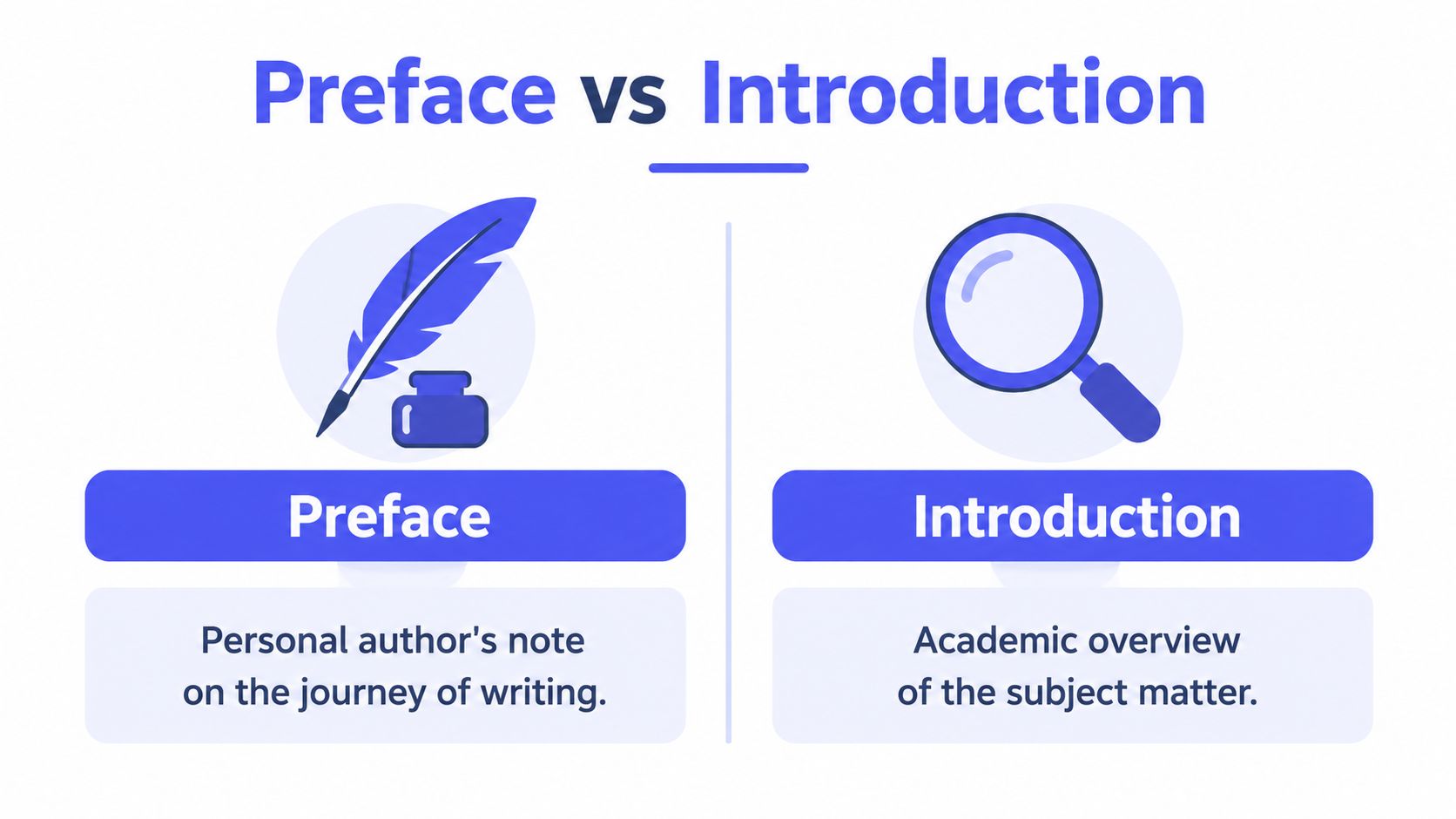
The practical distinction is simple: a preface explains the book's origin and production, while an introduction explains the book's subject and prepares readers for its content. That rule handles most borderline cases, including research notes, historical context, author reflections, and opening material in fiction.
Table of Contents
- Preface vs Introduction – What Each Section Actually Does
- Placement, Pagination, and Front Matter Rules
- What Belongs in a Preface
- What Belongs in an Introduction
- Tone, Length, and Authorship Differences
- Genre Expectations and Special Cases
- How to Decide and Draft the Right Section
Preface vs Introduction – What Each Section Actually Does
A preface is author-centered. It tells readers why you undertook the project, how the work developed, what approach shaped it, who you intended to reach, and whether particular permissions or acknowledgments matter. An introduction is reader-centered. It establishes the subject, argument, narrative frame, definitions, stakes, or analytical method that readers need before entering the main text. Oxford Reference describes the distinction%20f-n%20ed%20(2).doc) in these functional terms.
| Question | Preface | Introduction |
|---|---|---|
| Main focus | The book as a project | The book's subject |
| Typical perspective | Author's motivation and process | Reader's orientation |
| Common material | Origins, method, scope, audience, permissions | Thesis, context, definitions, stakes, chapter logic |
| Relationship to the main text | Usually optional front matter | Often part of the substantive text |
| Key test | Why did this book come into being? | What must readers understand before continuing? |
A preface might explain that a memoir began after a particular experience, that a research method changed during the project, or that a revised edition responds to later developments. An introduction might define the central term, establish the historical setting, explain the book's argument, or show how the chapters build on one another.
Editorial rule: If removing the passage would make the book's argument difficult to follow, the passage probably belongs in the introduction.
Authors often create confusion by placing necessary subject matter in a personal preface. A short account of your research journey can help readers trust the project, but a detailed explanation of the subject should move into the introduction. For a broader look at how opening sections work together, consult this guide to content structure. You can also review the wider architecture in this overview of the sections of a book.
Placement, Pagination, and Front Matter Rules
The location of a section changes how readers interpret it. A preface belongs to the preliminary matter, which sits before the main body of the book. An introduction commonly sits at the beginning of the main text, particularly when it presents material readers need in order to understand the chapters that follow.
Pagination reinforces that distinction. Preliminary matter is normally separated from the main body and may use Roman numerals, while a text introduction commonly uses Arabic page numbers with the main text. These conventions aren't decorative. They signal whether readers should treat a passage as optional project context or as part of the book's substantive route.
Why pagination affects reader expectations
A researcher quoting an argument from an introduction may treat that section as part of the work's citable content. A reader skimming a preface may regard it as useful background but not essential evidence. In scholarly and nonfiction publishing, that difference affects citations, cross-references, indexes, and the reader's understanding of where the argument begins.
The exact presentation can vary across publishers and formats, but the underlying principle remains stable:
- Place project history in preliminary matter. This includes motivation, acknowledgments, permissions, and reflections on how the work was produced.
- Place essential subject orientation with the main text. Readers should find the thesis, definitions, stakes, and necessary context where the substantive discussion begins.
- Apply pagination consistently. Print, ebook, and PDF exports should preserve the distinction as far as the format allows.
- Check internal references after layout. A change in front matter can affect page references, chapter openings, and navigation.
Authors preparing multiple editions should make the function clear before styling the heading. Guidance on producing consistent front matter appears in this resource on formatting front and back matter.
What Belongs in a Preface
A preface is best understood as metadata about the book as a project. It gives readers the circumstances behind the work without asking them to process the book's full subject before they reach the main text. Yale University Press guidance advises keeping a preface to no more than two printed pages, approximately three manuscript pages, and says it shouldn't function as exposition or extended subject-matter discussion.
Four useful purposes
A focused preface can perform several related jobs:
- Explain the work's aims. State what prompted the project and what you hoped the finished book would accomplish.
- Identify the intended readership. Tell readers whether the book is written for practitioners, students, specialists, general readers, or a particular community.
- Position the coverage. Explain the project's scope, relationship to existing literature, or reason for selecting a particular angle.
- Note special features. Mention a revised edition, unusual research method, permissions, translations, or organizational choices.
These purposes align with the common preface functions listed in Chicago Manual of Style author guidance. They give readers useful provenance without making the preface compete with the opening chapter.
A paragraph-level classification test
Take each paragraph in your draft and assign it to one of three categories:
| Paragraph type | Likely destination |
|---|---|
| Personal motivation or research process | Preface |
| Information needed to understand the subject | Introduction |
| Thanks, permissions, or edition information | Preface or acknowledgments |
Suppose you write, “I began this book after observing how local planning decisions affected my neighborhood.” That explains the project's origin, so it belongs in a preface. If you then define the planning system, summarize its history, and introduce your argument, the material has crossed into the introduction.
A preface should remain removable without damaging comprehension. Use a front and back matter builder to keep these elements separate while you revise. If readers must know something before they can understand chapter one, move it out of the preface rather than expanding the preface to carry two jobs.
What Belongs in an Introduction
An introduction answers the reader's practical questions about the book's subject. What problem does the book address? What terms require definition? Why does the issue matter? What method, evidence, or narrative structure will guide the pages ahead?
The introduction may establish the thesis, stakes, context, definitions, methods, and chapter logic. Because it performs substantive work, it can share the tone, numbering, and evidentiary standards of later chapters. Readers shouldn't have to treat its argument as a personal aside because it appears before chapter one.
Subject matter, not production history
Historical background belongs in the introduction when it directly explains the subject. For example, a history of a legal doctrine belongs there if readers need that history to follow the book's argument. The author's explanation of why that doctrine became personally or professionally important belongs in the preface.
The same topic can therefore appear in either section, but the purpose changes its location:
| Material | Preface treatment | Introduction treatment |
|---|---|---|
| Historical background | Why the author chose to study it | How it explains the subject |
| Research method | How the project developed | How readers should assess the argument |
| Intended audience | Who the author had in mind | What readers need to know to proceed |
| Chapter structure | Why the author organized the book this way | How the argument unfolds |
An introduction can also prevent repetition. Instead of explaining your motivation at length and then repeating the subject's context, keep the personal account concise in the preface and let the introduction do the intellectual work.
Oxford's guidance identifies several purposes associated with a preface, including aims, intended readership, relationship to existing literature, and special features. Those points can help you decide what to reserve for authorial framing, while the introduction develops the material readers need to interpret the book itself.
Tone, Length, and Authorship Differences
The distinction becomes clearer when you compare the two sections across voice, scope, and authorship. A preface often sounds personal because the author is discussing a relationship to the project. An introduction usually sounds more analytical or narrative-driven because it begins the reader's engagement with the subject.
Voice and purpose
A preface can use first person naturally:
I began this project after years of working with records that were rarely available to general readers.
That sentence gives provenance. It doesn't ask readers to accept a claim about the subject.
An introduction might instead say:
Public records shape the argument because they reveal how policy moved from formal language into everyday decisions.
That sentence belongs to the book's intellectual or analytical path. The distinction isn't about whether “I” appears. It's about whether the paragraph explains the author's process or develops the reader's understanding.
Your broader guide to tone in writing can help you keep those voices deliberate rather than allowing the preface and introduction to blur together.
Length and development
A preface should be concise because it offers orientation, not exposition. The Yale guidance cited earlier recommends no more than two printed pages, so a long preface is a warning sign that essential subject matter may be misplaced.
An introduction may need more space because it can carry definitions, context, argument, and structural direction. Its length depends on the book's demands, not on a fixed universal rule. A scholarly work may need careful methodological framing, while a practical nonfiction book may move quickly into its central problem.
Authorship and the foreword
A foreword is different again. It's an introductory essay written by someone other than the author, often to provide an independent perspective on the work or its significance. The author normally writes both the preface and the introduction, although a book may include either one, both, or neither.
For a hybrid project, make authorship visible through the section's purpose. The preface can acknowledge collaborators or explain the project's development. The introduction should guide readers through the content, even if the author's personal voice remains prominent.
Genre Expectations and Special Cases
Genre changes the reader's expectations, but it doesn't erase the functional test. A scholarly monograph, a memoir, a practical guide, and a novel may arrange front matter differently. The reliable question remains: is this passage about why and how the book came to exist, or does it give readers information they need to understand the work?
A novel can have an introduction when the section supplies necessary context outside the narrative itself. It might explain the historical setting, establish a translation issue, or frame the edition. But a plot-bearing opening usually belongs to the narrative. If the scene introduces conflict, reveals character, or advances events, calling it an introduction may mislead readers who expect optional front matter.

Scholarly and nonfiction works
In academic writing, an introduction can become part of the substantive argument. It may use the same tone, numbering, evidence, and citation practices as later chapters. A preface generally remains outside the main text and may discuss research methods, permissions, acknowledgments, or the author's account of the project, as explained in this discussion of preface, introduction, and foreword distinctions.
That difference matters when readers cite the book. If a claim establishes the argument's conceptual framework, place it where readers will recognize it as part of that framework. If a paragraph explains why you selected the archive, interviewed participants, or revised the edition, it may be better suited to the preface.
Print and digital editions
Ebooks can make front matter feel less fixed because readers move through navigation links rather than physical page turns. Print books, PDFs, and academic editions still communicate hierarchy through placement, pagination, headings, and contents pages.
Define the function first, then apply the format. A heading won't rescue material that performs the wrong job.
How to Decide and Draft the Right Section
Start with a paragraph audit rather than choosing labels by instinct. Copy every paragraph from your opening pages into a working document and classify it as author-process context, reader-essential context, or acknowledgments and publication information.
Then apply this test:
- Ask what the paragraph explains. If it explains the book's origin, motivation, research choices, scope, audience, or publication history, mark it for the preface.
- Ask whether readers need it to follow the book. If they need the information to understand the thesis, subject, definitions, stakes, method, or chapter sequence, move it toward the introduction.
- Test removal. Hide the preface and begin with chapter one. If comprehension suffers, essential material is sitting in the wrong place.
- Separate acknowledgments. Thanks and permissions can remain in the preface when they illuminate the project, but they shouldn't interrupt the reader's route into the subject.
- Check repetition. The preface can state the project's purpose briefly, while the introduction develops the subject without retelling the author's journey.
- Review the export. Confirm that headings, navigation, page numbering, citations, and contents entries remain consistent in print and ebook files.
A useful functional summary from editorial guidance is that the preface offers author-centered commentary on motivation, process, scope, audience, research choices, or publication history, while the introduction establishes reader-centered content such as thesis, stakes, context, definitions, methods, and chapter logic. For authors developing nonfiction, this guide to writing an ebook that builds authority offers helpful context for connecting structure with reader trust.
Draft the introduction when you know what readers must understand. Draft the preface after you can describe how the project came together. That order often prevents the preface from becoming a storage area for material that belongs in the book's argument.
Storyloft brings manuscript drafting, AI-assisted editing, research organization, illustration, cover design, and print-ready ebook and paperback formatting into one writing environment. Use it to separate front matter from the main text, track revisions, and test a consistent structure across formats, then visit Storyloft to start shaping your book.