How Do You Outline a Book for Beginners Made Simple

Picture this: you’ve got a brilliant story idea bouncing around in your head, like a marble in a tin can. It’s exciting, but now the question looms—how do you outline a book without losing that precious spark of inspiration? The blank page isn’t your enemy; it’s just a canvas waiting for a roadmap. That’s where a solid novel outline comes into play.
Even legendary writers like Stephen King start with a character and a problem, writing to discover what happens next. Whether you’re a Pantser, like King, or an Outliner, knowing where you’re headed is crucial. Fortunately, Storyloft’s Free Outline Generator can help transform your rough idea into a structured plan in mere minutes. This interactive tool adapts to your book type, organizing themes, characters, and pacing into a format you can actually work from.
By the end of this guide, you’ll have a clear way to outline your novel that respects your unique writing style. Whether you plot every detail or fly by the seat of your pants, the journey to writing starts here.
Key Takeaways
- Outlining helps turn your story idea into a structured plan.
- Even famous Pantsers start with a character and a challenge.
- Storyloft’s Free Outline Generator makes the outlining process easy and quick.
- Every writer has a unique style; some prefer detailed outlines, while others thrive on spontaneity.
- Understanding your story structure is essential for effective writing.
Why Outlining Matters: Understanding Your Writing Journey
Visualize your story as a river, flowing towards a destination, but needing banks to guide it. This is where outlining comes into play. A solid outline acts as your roadmap, providing direction and clarity throughout your writing journey.
Think of a story outline as the GPS for your novel—you can still take scenic detours, but you won’t end up stranded in a cornfield at 3 a.m. with no idea how you got there. With a roadmap, your writing gains focus without stifling creativity. It’s the difference between wandering aimlessly and hiking with a trail map in your pocket.
Outlines also help maintain pacing, ensuring readers don’t experience whiplash from three action scenes in a row followed by forty pages of characters drinking tea. The blank page loses its power to intimidate when you have a plan to lean on. Writer’s block often crumbles when you know where things are heading.
Character development, plot progression, and even research areas become clearer when you can see the whole story laid out before you. It’s like a treasure map with X marking the good stuff. Both Pantsers and Outliners benefit from some form of roadmap. Even Jerry Jenkins admits he never writes a novel without a structure in mind, even if it’s just a list of anticipated plot points.
Storyloft’s Free Outline Generator eliminates the blank page entirely by turning your rough idea into a structured plan in minutes. It provides chapter breakdowns and supporting notes, making the outlining process quick and easy. Remember, outlines aren’t just for novels; short stories, memoirs, and even poetry collections can benefit from a little pre-writing organization that keeps your mind focused on the goal.
The beauty of a flexible outline is that it adapts as your story evolves. You’re not carving commandments into stone tablets; you’re sketching a path you can redraw anytime. Whether you’re a first-time writer or a seasoned author with a dozen novels under your belt, a roadmap saves you time, reduces frustration, and keeps your beginning connected to your ending.
Outliners vs. Pantsers: Choosing Your Writing Approach
Imagine standing at a crossroads, where your writing path can take many different turns. Each direction leads to a unique approach: the spontaneous Pantser or the meticulous Outliner. Understanding these styles can help you navigate your own writing journey.
What is a Pantser and why some writers prefer spontaneity
A Pantser is a writer who embraces spontaneity, crafting their stories by the seat of their pants. They thrive on the thrill of discovery, allowing characters and plots to unfold naturally. Jerry Jenkins, a self-proclaimed Pantser, has penned nearly 200 novels without a detailed outline. He starts with a character and their journey, letting the narrative reveal itself as he writes.
Pantsers are like jazz musicians, improvising and riffing on themes.
“I put interesting characters in difficult situations and write to find out what happens,”
saysStephen King, the patron saint of Pantsers. This approach can lead to unexpected twists and engaging narratives that keep both the writer and readers on their toes.
What is an Outliner and the benefits of detailed planning
On the flip side, Outliners are the architects of storytelling. They meticulously plan every detail, from character arcs to plot points, before writing a single word. This method provides a clear roadmap, ensuring that every element of the story aligns with the intended structure.
For Outliners, having a plan reduces anxiety and keeps the writing process focused. They avoid the pitfalls of wandering aimlessly through their narrative. The structure allows them to maintain pacing and build tension effectively, creating a satisfying journey for readers.
Are you a hybrid writer? Mixing freedom with structure
Most writers find themselves somewhere in between. Hybrid writers appreciate the security of an outline but also crave the freedom to explore. They may start with a detailed plan but leave room for characters to surprise them along the way.
Storyloft’s Free Outline Generator is perfect for hybrids, adapting to your unique approach. Whether you need a detailed chapter-by-chapter plan or just a loose framework, it helps keep your protagonist from wandering off a cliff.
If you try outlining and feel the urge to just start writing, congratulations—you might be a Pantser. Conversely, if you dive in and quickly feel lost, you may be an Outliner who needs to rethink your strategy. Remember, neither approach is superior; it’s about finding what feels most natural for you.
Popular Story Structures to Frame Your Outline
Every story needs a sturdy frame, much like a house. Choosing the right structure can make all the difference. With a solid outline, your narrative will flow seamlessly from beginning to end. Let’s explore some popular story structures that can help you build your outline effectively.
Dean Koontz’s Classic Story Structure
Dean Koontz offers a thrilling approach to storytelling. His classic structure can be summed up in four key points:
- Plunge your main character into terrible trouble as soon as possible.
- Everything your character does to try to escape makes things worse.
- Things reach a point of apparent hopelessness.
- Ultimately, the character’s struggles lead to the skills needed to triumph—or fail.
This method keeps readers on the edge of their seats, making every twist and turn feel earned.
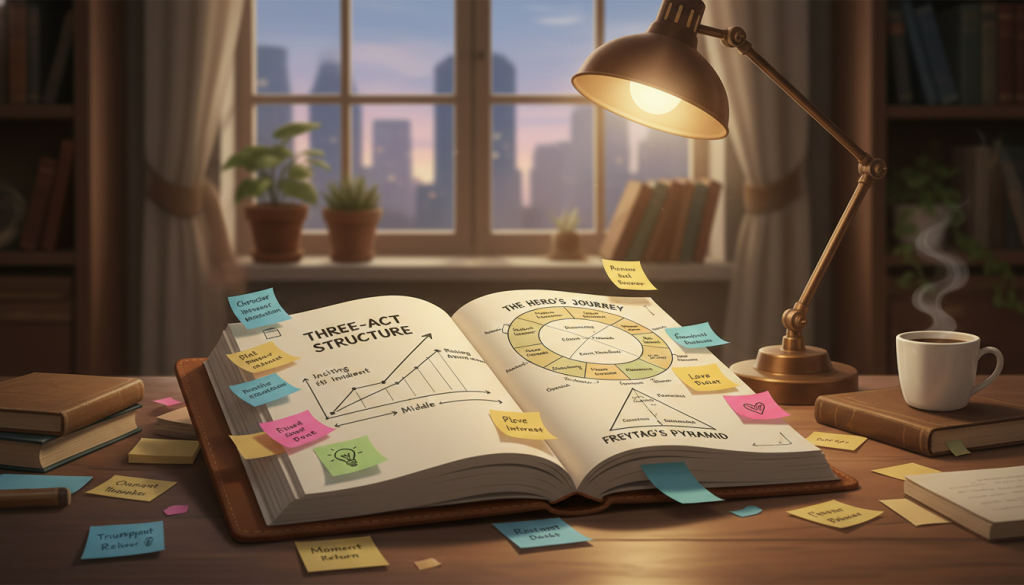
The Three-Act Structure
The Three-Act Structure is a timeless framework that divides your story into three parts:
- Act One: Introduces characters and setting, ending with an Inciting Incident.
- Act Two: Contains rising action and conflict development, featuring a low point for the protagonist.
- Act Three: Culminates in the climax, followed by falling action and resolution.
This structure is popular in both novels and screenplays, ensuring a compelling narrative arc.
The Hero’s Journey
Popularized by Joseph Campbell, the Hero’s Journey is a blueprint for epic storytelling. It includes stages like:
- Ordinary World
- Call to Adventure
- Refusal of the Call
- Meeting the Mentor
- Crossing the First Threshold
- Tests, Allies, and Enemies
- Ordeal
- Reward
- The Road Back
- Resurrection
- Return with the Elixir
This structure resonates with readers, as it mirrors their own journeys and transformations.
Save the Cat’s 15 Plot Beats
Blake Snyder’s Save the Cat breaks your story into 15 essential emotional moments. Key beats include:
- Opening Image
- Theme Stated
- Setup
- Catalyst
- Debate
- Break Into Two
- B Story
- Fun & Games
- Midpoint
- All is Lost
- Dark Night of the Soul
- Break Into Three
- Finale
- Final Image
This structure is especially useful for screenwriters, ensuring emotional engagement throughout.
The Snowflake Method
Randy Ingermanson’s Snowflake Method starts with a one-sentence summary and expands outward. This approach allows for detailed development of your plot and characters, making it ideal for those who love organization.
Freytag’s Pyramid (Plot Pyramid)
Freytag’s Pyramid uses five stages:
- Exposition
- Inciting Incident
- Rising Action
- Climax
- Falling Action and Resolution
This structure provides a clear path for your narrative, ensuring a satisfying progression.
Choosing the Right Structure for Your Story
Choosing the right structure is like picking the right vehicle for a road trip. A motorcycle may suit a solo adventure, but an SUV is better for a journey with multiple character arcs and subplots. Each structure has its own rhythm and emphasis. Some focus on character transformation, while others highlight plot beats.
Experiment with these frameworks until you find the one that resonates with your story. Remember, Storyloft’s Free Outline Generator can help you apply these structures without needing a PhD in narrative theory. It adapts to your book type and organizes your plot points into a coherent, writeable plan.
The Role of Character Development in Your Outline
Every character in your story serves as a thread, weaving together the fabric of your narrative. Character development will make or break your story. Outliners have a natural advantage here; they get to know each character by mapping out backstories and conducting imaginary interviews. This process helps them ask the characters about themselves, even if readers won’t see most of this information.
Make your characters human, vulnerable, and flawed. They should be eventually heroic and inspiring, but not perfect. Nobody identifies with perfection. In the end, your hero should rise to the occasion and win against all odds, but must grow from a stance of reality and humanity.
Jerry Jenkins recommends downloading a Character Development Worksheet. For creating a main character, choose one who goes on a journey from Point A to Point B—emotional, physical, or both. Give them a Big Problem or Big Goal. The stakes should be high, but what matters most is that it matters to the character. Fill in the blanks: “I started out _______. I ended up _______.”
Creating compelling, flawed, and relatable characters
- Your protagonist should be flawed enough to feel human but not so irritating that readers start rooting for the antagonist by chapter three—a delicate balancing act.
- A compelling character arc traces the journey from “I started out scared and selfish” to “I ended up brave and selfless,” creating real emotional resonance.
- Nobody identifies with perfection, so give your hero warts, bad habits, and questionable life choices that make their eventual triumph feel earned.
Mapping character arcs from beginning to end
Mapping character arcs ensures your protagonist doesn’t remain stagnant, which is the narrative equivalent of a flat tire. Tools like character development worksheets help you dig into motivations, fears, and secret desires—the stuff that makes a person leap off the page and into a reader’s heart.
Tools and worksheets to deepen character profiles
Every character in your novel, even the minor ones, should have a goal—something they want in every scene, even if it’s just a sandwich or world domination. The best characters surprise you as you write, and a flexible outline gives them room to reveal themselves while keeping their development on track.
With Storyloft’s Free Outline Generator, you can organize themes, structure, audience, characters, ideas, and pacing into a format you can actually write from. Along the way, Eddy helps create notes and visual inspiration, so your project feels alive before you write page one.
Plot and Pacing: Crafting the Story’s Heartbeat
Think of your plot as the pulse of your story, driving the narrative forward with each beat. The plot is the sequence of events that makes up your novel—the beginning, middle, and end. It compels readers to either keep turning the pages or set your book aside. The stakes need to matter to your protagonist, whether it’s saving the family home from foreclosure or finding shoelaces that won’t betray them during an important meeting.
Defining your main conflict and stakes
Your main conflict needs to resonate with the audience. It should involve stakes that truly matter to your protagonist. Consider what drives them, what they stand to lose, and what they are willing to fight for. This emotional investment keeps readers engaged, making them care about the outcome.
Using plot points and scenes to maintain tension
Every scene must earn its place by containing a goal, conflict, and some form of disaster—even if that disaster is just a spilled cup of coffee that ruins a crucial document. Billy Wilder famously said, “Get your character up a tree. Throw rocks at them. Get them down.” This advice encapsulates the essence of plot construction. Each plot point should propel the story forward, creating tension and intrigue.
Balancing action, exposition, and character moments
Pacing is the art of balancing action sequences with quiet character moments. Ensure readers get breathers between heart attacks rather than one long, exhausting sprint. A well-paced novel alternates between action, exposition, and character development like a perfectly mixed cocktail—too much of any one ingredient and the whole thing falls flat.
Storyloft’s Free Outline Generator helps you organize plot points and chapter breakdowns so your pacing doesn’t accidentally lull readers into a coma during the middle act. With this tool, you can create a structured outline that keeps your story dynamic and engaging.
Plot types range from Adventure and Romance to Mistake and Lure—pick one that fits your story’s DNA and use it to shape every scene you write. Tension isn’t just about car chases and explosions; it’s about unanswered questions, unresolved emotions, and the constant sense that things could go terribly wrong at any moment.
The midpoint of your novel should hit like a thunderclap—a false victory or devastating defeat that raises the stakes and sends your protagonist careening toward the climax. With the right pacing, your plot will resonate, leaving readers eager for the next page.
Setting and Research: Bringing Your World to Life
The world of your story is not just a backdrop; it breathes life into every scene. A well-crafted setting draws readers in, making them feel as if they are walking alongside your characters. It includes not only the location and time but also the sensory details that make the environment tangible.
Integrating the setting naturally into your narrative is essential. Avoid lengthy descriptions that halt the story’s momentum. Instead, weave the setting into the action and dialogue. For instance, let the rain reflect your protagonist’s mood rather than pausing to describe it in detail. This technique keeps the narrative flowing and keeps readers engaged.
Integrating setting naturally into the narrative
Setting isn’t just a backdrop for your characters to stand in front of—it’s the sensory world your readers will inhabit. It should smell, sound, and feel as real as the room you’re sitting in. Layering the setting into action and dialogue makes it nearly invisible, yet it registers in the theater of your readers’ minds while they’re focused on the tension and drama.
Research strategies without overloading your story
Research is the seasoning, not the main course. Your readers didn’t sign up for a dissertation on 18th-century button-making. Sprinkle in historical details like a chef, not a dump truck. An outline helps you identify which research areas matter most, preventing you from spending three weeks learning about medieval blacksmithing when your story only needs one brief forge scene.
Creating sensory details that immerse readers
Sensory details—the creak of a floorboard, the tang of salt air, the rough texture of a wool blanket—immerse readers more effectively than straightforward description. The best settings are the ones readers can taste, touch, and smell without ever noticing the author’s hand guiding them there. Time and place are characters in their own right; a novel set in 1920s Chicago should feel as distinct from one set in modern-day Tokyo as your protagonist feels from the antagonist.
With Storyloft’s Free Outline Generator, you can organize research areas and creative assets. This way, you know exactly which rabbit holes to dive into before you start writing. Remember, avoid the temptation to dump all your research onto the page in one go; parcel it out like a miser distributing gold coins, giving readers just enough to stay oriented.
How Do You Outline a Book: A Simple Step-by-Step Process
Crafting a novel is like building a bridge; it needs a strong foundation to support the journey. To transform your idea into a structured narrative, follow these simple steps. Each step will guide you through the process, ensuring you don’t miss any crucial elements along the way.
Step 1: Summarize your novel idea in one sentence
Start by distilling your entire novel idea into a single sentence. Think of it as your elevator pitch—sharp enough to catch an editor’s attention at a publishing party. For example, Jerry Jenkins once wrote a novel about a judge who tries a man for a murder that the judge committed. That one line became his first published book, proving that a killer premise can fit into just a few words.
Step 2: Choose your story structure and framework
Next, decide on a story structure for your novel. This choice is crucial, as it acts like the frame of a house. Will you use the Three-Act structure, the Hero’s Journey, or perhaps the Save the Cat method? Each framework shapes how your plot points will come together.
Step 3: Develop your main characters and goals
In this step, get to know your characters. Make them human, vulnerable, and flawed. This depth is essential for your protagonist to earn their heroic moment by the end of the story. Each character should have clear goals that drive their actions throughout the narrative.
Step 4: Outline major plot points and chapters
Now it’s time to outline the major plot points and chapters. This transforms your vague idea into a visible roadmap. Each chapter should earn its place in the narrative, much like beads on a string, connecting the story seamlessly.
Step 5: Identify key obstacles and turning points
Here, identify the key obstacles and turning points—those “rocks” you’ll throw at your character while they’re stuck up that metaphorical tree. These challenges are what make your story compelling and keep readers engaged.
Step 6: Break down chapters with brief synopses and notes
Finally, break down each chapter with brief synopses written in the third person, present tense. Leave no mysteries or teasers. For example, “Jason learns his daughter has been kidnapped.” This clarity reveals any fatal flaws in your story before you invest months in writing.
Storyloft’s Free Outline Generator automates this entire process through an interactive conversation with Eddy. It turns your concept into a complete working outline in minutes. Each step builds on the last, creating momentum that carries you from “I have an idea” to “I have a plan” without the existential dread that usually accompanies novel planning.
The beauty of this process is its flexibility. You can follow it religiously or use it as a loose guide, adapting each step to fit your unique way of working.
Advanced Outlining Techniques and Tools
Envision your writing process as a garden, where every technique nurtures the growth of your story. In this section, we’ll explore advanced outlining methods that can elevate your writing. Each technique offers unique advantages, allowing you to choose what fits your style best.
The Snowflake Method in depth
The Snowflake Method, created by physicist Randy Ingermanson, builds your novel like a fractal. It starts with a one-sentence summary and expands outward until you have an intricately detailed, beat-by-beat plan. This method is as much a map for writing as it is for creating an outline.
Mind mapping and Zettelkasten for story organization
Mind mapping turns your story into a visual playground. Plot points, characters, and themes sprawl across the page like a beautiful, chaotic spider web of genius. Nina Amir recommends using a separate mind map for each chapter, character, and major event.
The Zettelkasten method uses index cards to capture scenes, character traits, and plot twists. This allows you to physically drag and drop your story into order, like a literary game of solitaire. It’s a tactile way to organize your thoughts and see connections clearly.
Reverse outlining and beat sheets
Reverse outlining, championed by writing coach K.M. Weiland, starts at your story’s end and works backward. By asking questions like “How did the character get injured?” you can build scenes with purpose. This method ensures every scene contributes meaningfully to the narrative.
Beat sheets strip your novel outline down to its essential elements in bullet-point form. This approach is perfect for writers who want structure without the fluff. Each advanced technique serves a different kind of writer, whether you’re a visual thinker or prefer systematic expansion.
Storyloft’s Free Outline Generator incorporates these advanced techniques seamlessly. It adapts to your book type and organizes everything from themes to pacing into a coherent plan. The beauty of these tools is that they’re not mutually exclusive. You can mind map your characters, Snowflake your plot, and use beat sheets for individual chapters all in the same novel outline.
Experimenting with different outlining techniques is like test-driving cars. You won’t know which one fits your writing style until you take it for a spin around the block.
Balancing Planning and Creative Flexibility While Writing
Imagine your outline as a flexible framework, ready to adapt as your story unfolds. Writing is an adventure, and sometimes, your characters will take unexpected turns. Embracing this spontaneity can lead to delightful discoveries.
Kirsten Bakis, an award-winning novelist, emphasizes that your outline will likely change before your last draft is done. This is a feature of the creative process, not a bug. The beauty of writing lies in its ability to evolve as you craft your narrative.
George Saunders once said,
“An artist works outside the realm of strict logic.”
This highlights the importance of allowing your characters to drive the story. If they take a detour, celebrate it! It means they are coming alive on the page.
Consider Nicholson Baker’s novel, The Mezzanine, which revolves around a man buying shoelaces on his lunch break. If such a seemingly simple plot can work, your evolving story can certainly thrive despite deviations from the original plan.
When your protagonist does something unexpected, it’s a sign of growth. This moment can be a joyous occasion, showing that they are co-writing the novel with you. Storyloft’s Free Outline Generator offers a structured starting point, but the real magic happens when you treat that outline as a living document.
Many writers prefer to outline after drafting. This allows them to identify what they’ve already created and strengthen the structure retroactively. Breaking from your outline isn’t failure; it’s a chance for discovery. Some of the best scenes in literary history emerged from unexpected moments.
Ultimately, your outline’s purpose is to keep you from stalling, provide a safety net, and narrow your focus. Think of it as a jazz chart—it provides the chord changes and tempo, but the solos and unexpected key changes are where the art truly lives.

Storyloft’s Free Outline Generator: Your Shortcut from Idea to Plan
Picture yourself at the starting line of a race, where every great story begins with a spark of inspiration. With Storyloft’s Free Outline Generator, that inspiration transforms into a structured plan in no time. This tool is designed to help authors move from a rough idea to a polished outline, all while keeping the creative juices flowing.
Imagine having a seasoned editor in your pocket. Eddy guides you through an interactive conversation that turns your concept into a complete working outline in minutes, not months. This is not just a generic chapter list; it’s a detailed roadmap tailored to your unique writing style.
How Eddy guides you through an interactive outlining conversation
The experience with Eddy feels less like filling out a form and more like brainstorming with a writing partner. As you share your ideas, Eddy adapts to your book type—whether it’s fiction or non-fiction. This personalized approach helps organize themes, structure, audience, characters, ideas, and pacing into a coherent format.
Generating detailed, adaptive outlines tailored to your book type
Instead of generating a simple list, Storyloft builds a full outline complete with sections, chapter breakdowns, subpoints, and supporting notes. This means you can actually write from it, making the transition from planning to writing seamless.
From themes and characters to pacing and creative assets
Along the way, Eddy creates notes and visual inspiration, so your project feels alive before you even write page one. Early creative assets—from character sketches to thematic notes—mean you’re not just planning a book; you’re already building the world your protagonist will inhabit.
Creating your free account and seamless workspace integration
When you’re finished, creating a free account unlocks a seamless workspace where your entire book project lives. No more blank pages or intimidating cursors blinking at you like an accusatory eye. Just a faster way to turn an idea into a real book that you can start writing immediately.
The tool is genuinely free, allowing you to test-drive your novel idea without committing anything but your time and imagination. Visit Storyloft and discover how a short conversation with Eddy can shortcut your journey from “I have an idea” to “I have a book plan” faster than you can sharpen a pencil.
Conclusion
Your writing journey has transformed from confusion to clarity. You’ve moved from wondering, “What even is an outline?” to confidently saying, “I could teach a masterclass on story structure!” Along the way, that intimidating blank page lost its power over you.
The wisdom of Jerry Jenkins and Kirsten Bakis is clear: your outline will evolve, your characters will surprise you, and the final book may look nothing like your initial plan—and that’s perfectly fine.
Whether you’re a Pantser with a sticky note or an Outliner with a detailed document, the right approach is the one that helps you get words on the page. Storyloft’s Free Outline Generator is ready to assist you in turning your idea into a structured plan, with Eddy guiding you to create a complete working outline in minutes.
The best time to start writing your novel was yesterday; the second-best time is now. Remember, your story deserves to exist outside your head. Stop planning and start writing, armed with just enough structure to navigate the creative wilderness.
Visit Storyloft to create your free account and let Eddy help you turn that idea into a real book, one chapter at a time.
FAQ
Why should I outline my story?
Outlining acts as a roadmap for your narrative, helping you navigate through twists and turns without getting lost in the creative wilderness.
What’s the difference between an outliner and a pantser?
An outliner loves structure and planning, while a pantser thrives on spontaneity and surprises. It’s like choosing between a GPS and a treasure map!
Can I mix outlining and spontaneity?
Absolutely! Many writers find a sweet spot between the two, enjoying the freedom of discovery while still having a solid framework to guide them.
What are some popular story structures?
Classic structures include the Three-Act Structure, the Hero’s Journey, and Save the Cat’s 15 Plot Beats. Each offers a unique lens to frame your tale.
How do I develop my characters in an outline?
Start by crafting compelling backstories, defining their goals, and mapping their arcs. Think of them as the heartbeats of your story!
What role does pacing play in my outline?
Pacing is crucial! It keeps readers engaged by balancing action with quieter moments, ensuring the story flows smoothly like a well-tuned engine.
How can I effectively integrate setting into my narrative?
Weave sensory details throughout your scenes, making the setting feel alive and integral to the characters’ journeys.
What’s a simple process for outlining?
Start with a one-sentence summary, choose a structure, develop characters, outline major plot points, identify obstacles, and break down chapters. Easy peasy!
What advanced outlining techniques should I consider?
Techniques like the Snowflake Method, mind mapping, and reverse outlining can elevate your planning game, making it more dynamic and flexible.
How can I balance planning with creative flexibility?
Use your outline as a guide, not a rulebook. Be open to changes as your story evolves; sometimes the best ideas come from unexpected places!
What is Storyloft’s Free Outline Generator?
It’s a nifty tool that guides you through an interactive outlining process, generating tailored outlines based on your unique story elements.