
Structure of Book: How to Build a Manuscript That Works

I still remember the moment I realized my first manuscript was a mess. I'd written 80,000 words of what I thought was a brilliant novel, but when I sent it to a beta reader, she gently asked, "Where's your dedication? And why does Chapter One start on page one?" I had no idea what she meant. Like many first-time authors, I'd focused entirely on the story itself and completely ignored the architecture that surrounds it. Understanding the structure of book design changed everything about how I approached writing, and it's a lesson that's saved me countless revision hours since then.
The Three-Part Foundation Every Author Needs
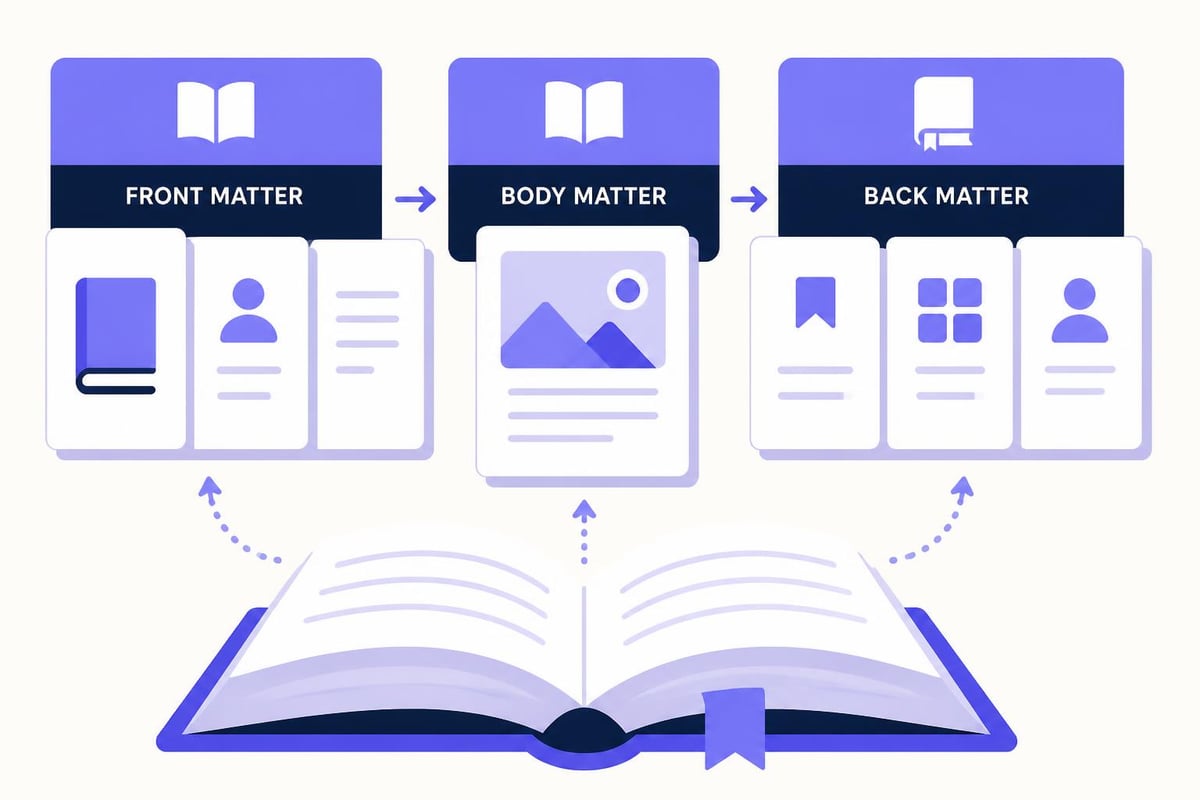
The structure of book publishing follows a time-tested framework that readers have come to expect, whether they consciously realize it or not. Every professionally published book, from mass-market thrillers to academic textbooks, follows a three-part architecture that creates a cohesive reading experience.
Front matter establishes your book's identity and sets reader expectations. Body matter contains your actual content, the story or information you're sharing. Back matter provides closure and additional resources. Together, these three sections create what publishing professionals recognize as a complete book.
Think of it like a theater performance. The front matter is the overture and opening curtain, preparing the audience for what's to come. The body is the performance itself, the reason everyone bought tickets. The back matter is the curtain call and program notes, offering context and closure.
Why Structure Matters More Than You Think
When I judged a writing contest last year, I could immediately spot manuscripts from authors who understood professional book structure versus those who didn't. The difference wasn't just aesthetic. Proper structure signals to readers, reviewers, and industry professionals that you understand the craft.
Publishers and distributors have specific requirements for understanding book elements that go beyond just good writing. Amazon's KDP platform, IngramSpark, and other publishing services expect certain elements to appear in specific locations. Miss these expectations, and your book might look amateurish, no matter how brilliant your prose.
Front Matter: Your Book's First Impression
Front matter encompasses everything that appears before your main content begins. These pages might seem like formalities, but they serve crucial legal, commercial, and navigational purposes that protect both you and your readers.
Essential Front Matter Elements
Most books include these components in roughly this order:
- Half-title page: Displays just your book title
- Title page: Shows title, subtitle, and author name
- Copyright page: Contains copyright notice, ISBN, publisher information, and disclaimers
- Dedication: A brief personal message (optional but common)
- Table of contents: Navigation for readers, especially important in nonfiction
- Foreword or preface: Context about the book's creation or purpose
The copyright page alone carries significant weight. This single page protects your intellectual property, establishes publication dates, credits your cover designer, and provides the ISBN that makes your book discoverable in retail systems. I learned this the hard way when my first self-published book lacked proper copyright information, and a reader actually asked if it was in the public domain.
| Element | Required? | Purpose |
|---|---|---|
| Title Page | Yes | Establishes book identity |
| Copyright Page | Yes | Legal protection and metadata |
| Table of Contents | Depends | Navigation (essential for nonfiction) |
| Dedication | No | Personal touch |
| Acknowledgments | No | Credit collaborators |
Optional but Valuable Front Matter
Beyond the essentials, you might include an acknowledgments section, thanking those who helped bring your book to life. Some authors place this in the back matter instead, which is equally acceptable. An epigraph, a relevant quote from another work, can set the thematic tone before Chapter One begins.
For nonfiction books, a preface or introduction helps readers understand your methodology, expertise, or approach. Fiction rarely needs these elements, though some genre series include a "previously in this series" recap page.
The parts of a book work together to create professional presentation. Each element serves a specific function, and understanding when to include or exclude them demonstrates your publishing knowledge.
Body Matter: Where Your Story Lives
This is the heart of your book, the content readers actually purchased. Whether you're writing fiction or nonfiction, the body matter contains your chapters, parts, or sections where your main message unfolds.
Organizing Chapters and Parts
The structure of book chapters varies dramatically by genre and purpose. A mystery novel might have 30 short chapters building suspense, while a business book might feature 8 lengthy chapters exploring complex concepts. Neither approach is wrong-they serve different storytelling needs.
Fiction structure typically follows these patterns:
- Three-act structure: Setup, confrontation, resolution
- Hero's journey: Departure, initiation, return
- Sequential chapters: Chronological or scene-based progression
- Part divisions: Grouping chapters into larger movements
Nonfiction structure often organizes around:
- Problem-solution framework: Identify issues, then provide answers
- Chronological progression: Historical or developmental sequence
- Thematic sections: Group related concepts together
- Step-by-step processes: Instructional or how-to content
I discovered the power of structural variation when writing a dual-timeline novel. By alternating between past and present chapters, I created tension and revelation in ways a linear structure couldn't achieve. The importance of story structure becomes evident when you see how different frameworks support different narrative goals.

Chapter Elements That Create Consistency
Within your body matter, consistency matters enormously. Each chapter typically includes:
- Chapter number or title
- Opening hook or scene-setting paragraph
- Body content developing your ideas or story
- Transition to the next chapter
Some authors use epigraphs at chapter openings, particularly in literary fiction or thematic nonfiction. Others include section breaks within chapters to signal time jumps or perspective shifts. Whatever elements you choose, use them consistently throughout your manuscript.
Modern writing tools help manage this consistency. Book writing software designed specifically for authors can track chapter structure, ensure formatting remains uniform, and even help identify pacing issues that might disrupt your book's flow. Having all your manuscript tools in one platform eliminates the formatting inconsistencies that plague authors juggling multiple applications.

Back Matter: The Professional Finishing Touch
Back matter provides closure, additional resources, and marketing opportunities that many new authors overlook. These pages appear after your final chapter and can significantly impact reader engagement and future sales.
Core Back Matter Components
The most common back matter elements include:
- Epilogue: Story continuation or "where are they now" closure
- Afterword: Author's reflection on the book's themes or creation
- Acknowledgments: If not placed in front matter
- Appendices: Supplementary material, charts, or references
- Bibliography or references: Citations for nonfiction
- About the author: Brief biography with author photo
- Books by this author: Catalog of your other works
- Preview chapter: First chapter of your next book
The "about the author" page serves double duty. It satisfies reader curiosity while establishing your credentials. For fiction authors, this page humanizes you and builds connection. For nonfiction authors, it reinforces your expertise and authority on the subject matter.
Strategic Marketing Through Back Matter
Here's where savvy authors gain a competitive edge. Your back matter is prime real estate for reader conversion. Someone who just finished your book is your warmest possible prospect for your next book.
I increased my series readership by 40% simply by adding a compelling preview chapter of Book Two at the end of Book One. Readers who loved the story couldn't resist clicking to purchase the next installment. This same strategy works for standalone books-preview a different book in a similar genre or theme.
Effective back matter marketing includes:
- Newsletter signup invitation with reader magnet offer
- Links to your author website or social media
- Request for reviews with simple instructions
- Sneak peek at upcoming releases
- Bonus content or deleted scenes
The conventional structure and organization of back matter follows reader expectations while creating opportunities for deeper engagement. Don't waste these pages with generic content-make them work for your author platform.
Special Structural Considerations for Different Book Types
Not every book follows identical structural patterns. Genre, audience, and purpose all influence how you arrange your manuscript's components.
Fiction Structure Variations
Mystery and thriller books often include a cast of characters page in the front matter, helping readers track suspects and alibis. Fantasy novels frequently feature maps, pronunciation guides, or glossaries of invented terms. Historical fiction might include an author's note explaining which events are factual versus fictionalized.
I once beta-read a fantasy manuscript that lacked a map. Readers kept getting confused about geography and travel times. Adding that single front matter element solved a major comprehension problem.
Nonfiction Structure Requirements
Academic and professional books require rigorous structure. These typically include:
| Element | Purpose | Location |
|---|---|---|
| Abstract | Summary of contents | Front matter |
| Methodology | Research approach | Introduction or appendix |
| References | Source citations | Back matter |
| Index | Topic finder | Final back matter element |
| Glossary | Term definitions | Back matter |
Business books benefit from case studies integrated into body chapters, with additional examples in appendices. Self-help books often include worksheets or reflection questions at chapter endings, then compiled in the back matter for easy reference.
Understanding how to create effective outlines and chapters helps ensure your structure supports your content goals rather than fighting against them.
Physical Book vs. Ebook Structure
Here's something many new authors don't realize: the structure of book formatting differs between print and digital editions. What works beautifully in a paperback can create problems in an ebook, and vice versa.
Print Book Structural Needs
Print books follow strict conventions about page placement. The title page traditionally appears on a right-hand (recto) page. Chapter openings typically start on recto pages as well. Copyright information goes on the verso (left-hand) page opposite the title page.
Print-specific structural elements include:
- Intentional blank pages to position key elements correctly
- Running headers with book title or chapter name
- Page numbers (pagination) with specific formatting rules
- Part title pages separating major sections
When I formatted my first print book, I didn't understand recto and verso placement. The result looked unprofessional, with odd page breaks and awkward white space. Learning proper print book formatting transformed my books from amateur to professional in appearance.
Ebook Structure Adaptations
Ebooks don't have physical pages, which changes structural decisions dramatically. Chapter breaks matter more than page breaks. Navigation relies on the table of contents hyperlinks rather than page flipping.
Ebook-optimized structure includes:
- Active table of contents with clickable links
- Minimal front matter (readers want to start the story quickly)
- Strategic placement of "about the author" (end is better than beginning)
- Preview chapters linked directly to retail pages
Many authors create slightly different versions of front and back matter for ebook versus print editions. Your ebook might have a more concise copyright page, while your print book includes the full ISBN and printing information required by distributors.

Common Structural Mistakes Authors Make
After years of editing manuscripts, I've noticed patterns in structural errors that prevent otherwise good books from achieving professional polish.
The Missing Foundation
New authors often skip essential front matter elements. They dive straight into Chapter One without a proper title page, copyright notice, or table of contents. This might seem like eagerness to get to the story, but it signals amateur production to industry professionals and experienced readers.
The most frequent omissions include:
- Copyright page with proper legal language
- Table of contents in nonfiction books
- ISBN and publication information
- Edition statements (First Edition, Second Edition, etc.)
Inconsistent Chapter Formatting
I recently judged a contest where one manuscript switched between numbered chapters and titled chapters halfway through the book. Another used different fonts for chapter headings in different sections. These inconsistencies break reader immersion and suggest the author lacks attention to detail.
Maintaining consistency means:
- Same chapter heading format throughout
- Uniform spacing between elements
- Consistent use of scene breaks or section dividers
- Matching treatment of special elements like letters, texts, or journal entries
Neglected Back Matter Opportunities
The biggest missed opportunity? Authors who end their book with "The End" and nothing more. No author bio, no other books listed, no way for readers who loved the story to discover more of your work.
Think about the reader journey. They just invested hours in your book. They're emotionally connected to your storytelling. This exact moment is when they're most receptive to learning about your other books, joining your newsletter, or following you on social media. Don't waste that goodwill with empty back matter pages.
Building Structure Into Your Writing Process
The most effective approach? Plan your structure before you write, not during formatting. Understanding the complete architecture of your book helps you make better decisions about content placement, chapter organization, and supplementary material.
The Pre-Writing Structure Blueprint
Before drafting your manuscript, create a structural outline that includes:
- Front matter checklist: Which elements you'll include
- Chapter framework: Number of chapters, tentative titles, and purpose
- Part divisions: If using multi-part structure
- Back matter plan: Marketing elements and supplementary content
This blueprint guides your writing while remaining flexible enough to adapt as your book evolves. I outline my front and back matter before writing Chapter One, which helps me understand the complete package I'm creating.
Using Tools That Support Structure
Modern book writing software features include structural templates that guide you through proper book organization. Rather than manually formatting every element, you can work within a framework designed for professional publication.
Look for tools that offer:
- Pre-built templates for front and back matter
- Automatic table of contents generation
- Consistent chapter formatting
- Export options for both print and ebook formats
- Visual structure overview showing your complete manuscript organization
The difference between using a word processor versus dedicated book writing software becomes obvious during formatting. What might take days of manual adjustment happens automatically when your tool understands book structure from the ground up.
The Living Structure: Revisions and Updates
Here's something experienced authors know that surprises beginners: the structure of book manuscripts often changes during revision. You might start with 25 chapters and end with 32. Those part divisions you planned might disappear, or new ones might emerge as themes clarify.
When to Adjust Structure
Remain open to structural revision when:
- Beta readers struggle with navigation or pacing
- Chapters feel too long or too short compared to surrounding ones
- Thematic connections suggest different part groupings
- Your ending reveals the need for different setup in earlier chapters
I once completely restructured a book from chronological to thematic organization after early readers found the timeline confusing. The story remained the same, but reordering chapters by theme rather than date created much stronger impact. This required adjusting my table of contents, chapter titles, and transition sentences, but the improvement justified the effort.
Version Control and Structure
When you update your book for a second edition, structure changes might include:
- Adding new chapters based on reader questions
- Expanding appendices with additional resources
- Updating the copyright page with new publication information
- Revising the "about the author" with recent accomplishments
Maintaining clear version control helps you track these structural changes across editions. Professional authors date their revisions and note significant structural modifications in edition statements.
Structure as a Reader Service
Ultimately, the structure of book design serves your readers. Every element exists to help them navigate, understand, and enjoy your content more fully. When you view structure through this lens, decisions become clearer.
Ask yourself:
- Does this table of contents help readers find specific information?
- Will this chapter breakdown maintain narrative momentum?
- Does my back matter provide genuine value or just fill space?
- Have I made it easy for readers to discover my other work?
The answers guide you toward structure that serves the reading experience rather than just following convention. Sometimes that means including unconventional elements that specifically support your content. A cookbook might include metric conversion charts. A memoir might include photo sections. A science fiction novel might feature character dossiers from the fictional universe's perspective.
The key elements and purpose of book organization all point toward creating the most effective reading experience possible. Structure isn't about rigid rules. It's about thoughtfully guiding your readers from first page to last.
Mastering book structure transforms your manuscript from a collection of chapters into a professional publication that meets both industry standards and reader expectations. Whether you're writing your first novel or your tenth nonfiction title, understanding how front matter, body, and back matter work together creates a foundation for publishing success. Storyloft combines manuscript organization, AI-powered editing that preserves your voice, and professional formatting tools that handle print and ebook structure automatically, so you can focus on writing while ensuring every element of your book meets professional standards.