
Author Writing a Book: The Complete Journey in 2026

The moment you decide to become an author writing a book, you step into a world that's equal parts exhilarating and terrifying. I remember sitting in my cramped apartment in 2019, staring at a blank screen, wondering if the story swirling in my head would ever make it onto paper. That first sentence felt like jumping off a cliff without knowing if my parachute would open. Seven years later, the landscape has changed dramatically, but the emotional journey remains remarkably similar. Every author writing a book today faces the same fundamental challenges: turning ideas into words, maintaining momentum through doubt, and transforming a manuscript into something readers will cherish.
Understanding the Commitment Before You Begin
Becoming an author writing a book isn't just about having a great idea. It's about committing to a relationship with your work that will test your patience, discipline, and resilience.
Most people underestimate the sheer volume of hours involved. A typical novel requires 200-400 hours of writing time, not including planning, research, editing, or revision. Nonfiction authors often spend even longer verifying facts and organizing complex information into digestible chapters.
The reality check includes:
- Time investment: 6-18 months for most first books
- Emotional labor: Wrestling with self-doubt and creative blocks
- Learning curve: Mastering craft elements like pacing, dialogue, and structure
- Revision cycles: Most manuscripts need 3-5 complete revision passes
I've watched dozens of writer friends start books with enthusiasm, only to abandon them at the 30,000-word mark. The difference between those who finish and those who don't rarely comes down to talent. It's about realistic expectations and building systems that support the work.
Setting Your Foundation Right
Before typing Chapter One, an author writing a book needs clarity on several fundamental questions. Who is this book for? What promise are you making to readers? What makes your approach unique?
These aren't marketing questions disguised as creative ones. They're navigation tools. When you hit the inevitable moment where your plot feels tangled or your argument seems weak, understanding your audience becomes the compass that guides you back.
Consider creating a one-page document that captures:
- Your book's core promise in one sentence
- Your target reader's specific challenges or desires
- Three books similar to yours and how yours differs
- The transformation readers will experience
This document becomes your North Star during the messy middle months.
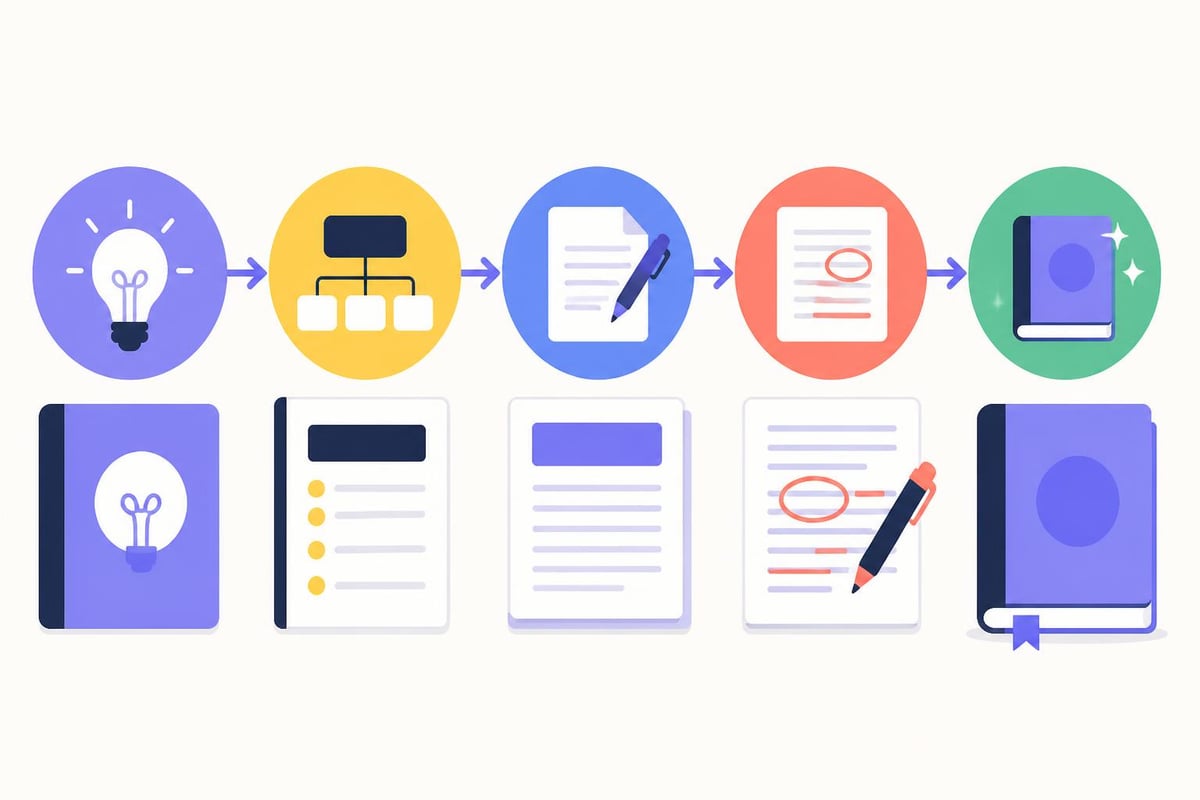
The Planning Phase: Blueprint or Discovery
The eternal debate among authors: should you outline or discover your story as you write? After interviewing hundreds of successful authors, I've learned the answer frustrates perfectionists: it depends entirely on how your brain works.
Planners (Architects) thrive with:
- Detailed chapter-by-chapter outlines
- Character profiles and world-building documents
- Scene-by-scene beat sheets
- Research compiled before drafting begins
Discovery writers (Gardeners) prefer:
- Starting with a situation and a character
- Uncovering the story through the writing process
- Minimal upfront planning
- Course-correcting during revision
Neither approach is superior. The key is understanding your natural tendencies and building a process around them. I'm a hybrid writer who needs a loose roadmap but discovers the best moments in the moment. My outlines look nothing like the finished book, but creating that outline gives my subconscious permission to play.
The Power of a Flexible Structure
Even discovery writers benefit from knowing certain structural elements. Understanding three-act structure, character arcs, or the hero's journey doesn't constrain creativity. Instead, it provides a framework your instincts can work with or against.
Think of structure like knowing music theory. Jazz musicians master the rules before they break them beautifully. Your book deserves the same foundation.
| Planning Approach | Strengths | Challenges | Best For |
|---|---|---|---|
| Detailed Outline | Clear roadmap, fewer major revisions | Can feel restrictive, may lose spontaneity | Complex plots, multiple storylines |
| Discovery Writing | Organic feel, surprising moments | May require extensive revision | Character-driven stories, literary fiction |
| Hybrid Method | Balance of direction and flexibility | Requires self-awareness about process | Most authors after their first book |
Establishing Your Writing Practice
An author writing a book needs more than inspiration. You need a sustainable practice that produces words even when motivation vanishes.
The romanticized image of writing only when the muse strikes is a recipe for unfinished manuscripts. Professional authors show up whether they feel like it or not.
Your writing practice should account for:
- Daily word count goals: Start modest (500 words) and build up
- Dedicated time blocks: Same time daily helps build habit
- Physical environment: A space that signals "work mode" to your brain
- Preparation rituals: Whatever helps you transition into creative flow
I write best between 6 and 9 AM, before emails and obligations crowd my mental space. My friend Sarah, a thriller author, writes from 10 PM to midnight after her kids sleep. The timing matters less than the consistency.
Managing the Inevitable Resistance
Every author writing a book will face days when opening the manuscript feels impossible. The words feel clunky. The plot seems derivative. The whole project appears pointless.
This isn't writer's block. It's resistance, and it's proof you're doing something that matters. Resistance shows up strongest right before breakthroughs.
Strategies that actually work:
- Lower the bar: Write badly on purpose, just to get words down
- Change location: Coffee shop, library, park bench
- Switch tools: Pen and paper when the screen feels intimidating
- Talk it out: Voice record yourself explaining what happens next
- Skip ahead: Write the scene you're excited about, not necessarily the next one
The goal isn't perfect prose in your first draft. It's creating raw material you can shape later.
Navigating the Messy Middle
Around the 40% mark of your manuscript, something predictable happens. The initial excitement fades. The ending still seems impossibly far away. This is where most unfinished books die quiet deaths.
I call this phase "the swamp." Everything feels harder. Your writing seems worse. Doubts multiply. An author writing a book through this phase needs different skills than the beginning required.
The middle demands endurance rather than enthusiasm. This is where your practice and structure prove their worth. When you can't rely on excitement, you lean on systems.
Keeping Track of Complex Elements
As your manuscript grows, continuity becomes challenging. Did your character have blue eyes or brown? Was that conversation in Chapter 3 or Chapter 5? What was the name of the protagonist's childhood friend?
Fiction writers juggle:
- Character details and development arcs
- Timeline consistency
- Setting descriptions
- Plot threads and foreshadowing
- Thematic elements
Nonfiction authors manage:
- Research sources and citations
- Argument progression
- Example placement
- Expert quotes and permissions
- Statistical accuracy
Tools designed specifically for authors help manage this complexity. For example, Storyloft for Authors lets you keep all your manuscript notes, character profiles, and research organized alongside your actual writing, so you're not constantly switching between different apps trying to remember details.


The Revision Process: Where Books Are Really Written
First drafts are permission slips to write second drafts. This truth frustrates new authors who expect their initial words to sparkle. Experienced authors know that revision is where the real work happens.
An author writing a book completes several distinct types of revision, each serving a different purpose:
- Structural revision: Does the overall architecture work?
- Scene-level revision: Is each scene necessary and effective?
- Line editing: Improving prose quality, clarity, and style
- Copy editing: Grammar, punctuation, consistency
- Proofreading: Final typo hunt
Trying to do all these simultaneously creates chaos. Your brain can't simultaneously evaluate whether Chapter 12 should exist while also fixing comma splices.
Working with Feedback
Revision means confronting the gap between the book you intended and the book you actually wrote. This requires outside perspective.
Beta readers offer reader reactions before publication. They catch plot holes, confusing passages, and pacing issues. Choose readers who represent your target audience and who will be honest rather than just nice.
Professional editors provide expertise most authors lack. Developmental editors focus on big-picture issues like structure and character development. Copy editors polish prose and catch errors.
Some authors resist feedback, viewing it as criticism rather than collaboration. The best manuscripts emerge from conversations between author vision and reader experience.
Managing the Emotional Rollercoaster
The psychological journey of an author writing a book deserves acknowledgment. This process will test your confidence in ways you can't anticipate.
You'll have days when you're convinced you're writing the next great American novel. The next day, you'll wonder why you thought you could write at all. Both feelings are normal and neither is true.
Common emotional patterns include:
- Week 1: Excitement and possibility
- Weeks 2-4: Productive flow state
- Weeks 5-8: First doubts creep in
- Weeks 9-16: The slog, questioning everything
- Weeks 17-20: Renewed energy seeing the end
- Weeks 21-24: Sprint to finish
- Post-draft: Weird emptiness mixed with relief
Understanding these patterns helps. When week 9 arrives and everything feels terrible, you'll recognize it as a phase rather than truth.
Building Your Support System
Writing is solitary work, but successful authors rarely work in complete isolation. You need people who understand the unique challenges of this creative pursuit.
Consider joining:
- Online writing communities: Daily accountability and encouragement
- Local writing groups: In-person connection with fellow authors
- Genre-specific organizations: Networking with authors in your field
- Critique partners: Regular manuscript exchanges with peers
My critique partner relationship has lasted nine years and four books each. Having someone who knows my writing intimately and cares about my success has saved me from countless bad decisions.
The Technical Side: Formatting and Publishing Preparation
An author writing a book eventually faces technical requirements that have nothing to do with storytelling. Modern publishing demands specific formatting standards whether you're going traditional or independent.
Understanding Format Requirements
Different publishing paths require different preparations:
Traditional publishing submissions need:
- Standard manuscript format (12pt Times New Roman, double-spaced)
- Proper chapter heading formatting
- Clean file without extra styling
- Professional query letter and synopsis
Self-publishing requires:
- Interior formatting for print and ebook
- Cover design that meets retailer specifications
- Metadata optimization (categories, keywords, description)
- ISBN and copyright registration
The learning curve for self-publishing software can be steep. Many authors outsource formatting, but understanding the basics helps you make informed decisions and communicate with designers effectively.
| Publishing Path | Timeline | Author Control | Revenue Share | Marketing Responsibility |
|---|---|---|---|---|
| Traditional | 18-36 months | Low | 10-15% royalties | Shared with publisher |
| Small Press | 12-24 months | Medium | 25-40% royalties | Mostly author-driven |
| Self-Publishing | 1-6 months | Complete | 35-70% royalties | Entirely author-driven |
Building Your Author Platform While Writing
The old advice was to finish your book before building an audience. In 2026, that's outdated. An author writing a book today has opportunities to connect with future readers throughout the process.
This doesn't mean posting every chapter on social media. It means being visible and valuable to your target audience before you have something to sell them.
Platform-building strategies that don't distract from writing:
- Share writing insights and lessons learned (not your actual manuscript)
- Post about your research process and interesting discoveries
- Discuss books in your genre and what makes them work
- Build connections with other authors in your space
- Create content related to your book's themes
I started my newsletter two years before my book released. By launch day, I had 2,400 people excited to read it. Those weren't strangers I was begging to buy. They were readers who'd followed my journey.
The Social Media Balance
Every author writing a book today grapples with how much energy to invest in social media. The answer isn't zero, but it also isn't "all day scrolling Twitter."
Choose one or two platforms where your readers actually spend time. Be genuinely helpful and interesting rather than constantly self-promoting. Consistency matters more than virality.

Collaborating and Co-Authoring Considerations
Some projects benefit from partnership. Co-authoring relationships can combine complementary strengths, but they require clear agreements and compatible working styles.
Before committing to co-authorship:
- Define exactly who writes what sections
- Establish decision-making processes for disagreements
- Agree on deadlines and accountability measures
- Discuss byline order and credit allocation
- Plan for revenue sharing if applicable
I co-wrote a business book in 2024. My partner excelled at research and framework development. I handled storytelling and case studies. Our different strengths created a stronger book than either of us would have written alone, but only because we established clear roles from day one.
Protecting Your Creative Energy
An author writing a book faces constant decisions about where to invest limited mental energy. Every hour spent researching cover design trends is an hour not spent writing. Every evening lost to comparison scrolling is creative fuel you'll need tomorrow.
Energy management priorities:
- Writing first: Protect your best hours for manuscript work
- Deep work over shallow: One focused hour beats three distracted ones
- Strategic learning: Learn what you need when you need it
- Boundaries: Say no to opportunities that don't serve the book
- Rest as strategy: Exhausted writers produce mediocre work
The books that get finished come from authors who treat their energy as the precious resource it is. Sprint culture and hustle mentality lead to burnout, not sustainable creative careers.
Handling Advice Overload
Every author writing a book encounters conflicting advice. One expert says outline extensively. Another swears by discovery writing. Someone insists you must write daily. Others advocate for batch writing sessions.
The truth? Most advice works for someone. The question is whether it works for you.
Give new approaches genuine trials, but trust your experience over someone else's prescriptions. After 50,000 words, you know more about what works for your process than any guru does.
Learning from First-Time Author Mistakes
Common pitfalls derail many debut books. Knowing them doesn't make you immune, but awareness helps you recover faster when you stumble.
Mistakes I see repeatedly:
- Starting too many projects instead of finishing one
- Revising Chapter 1 endlessly instead of moving forward
- Comparing your first draft to published books
- Skipping essential revision because you're tired of the manuscript
- Rushing to publish before the book is ready
- Giving up when the first draft feels terrible
Every successful author has a drawer full of false starts and abandoned projects. The difference isn't that they avoided mistakes. They kept going anyway.
The Final Push to Completion
The last 10,000 words of your manuscript feel different than the previous 70,000. You're simultaneously excited to finish and reluctant to let go. An author writing a book through this phase needs to resist both perfectionism and rushing.
This is when having a clear publishing plan matters most. Knowing what comes after "The End" helps you actually type those words rather than endlessly tinkering.
Your final manuscript checklist should include:
- Complete read-through for continuity
- Fact-checking for nonfiction, world consistency for fiction
- Formatting review for proper chapter structure
- Backup files in multiple locations
- List of everyone to acknowledge
- Copyright page information prepared
Take time to acknowledge finishing your first draft. Most people who start books never get this far. You've joined a much smaller club than you might think.
The journey of an author writing a book transforms you in ways that extend far beyond the manuscript itself. You discover resilience you didn't know you possessed, develop discipline that serves every area of life, and create something that didn't exist before you sat down to write. Whether you're drafting your first chapter or polishing your final pages, remember that every published author started exactly where you are now, staring at that intimidating blank page. Storyloft brings together everything you need to write, edit, format, and publish your book in one integrated platform, with AI-powered tools designed to support your unique creative process from first draft through publication-ready files.