Chicago Style Ellipses: Rules, Spacing, and Examples
A manuscript lands on your desk with three periods in the middle of a quotation: The committee reached . . . a difficult conclusion. The writer may have removed words, reproduced a speaker's hesitation, or let a sentence fade away. A designer then has a second problem: should those dots stay separated, can they break across a line, and does the sentence need a fourth mark?
These aren't minor questions. Chicago style ellipses treat the mark as a formal punctuation system, not as decorative dots. The answer depends on the ellipsis's job: showing an omission in quoted material, representing a pause or trailing thought, interacting with other punctuation, or surviving the practical demands of page and screen layout. The editing and writing checklist can help you record those decisions consistently across a long manuscript.
Table of Contents
- The Ellipsis Moment Every Editor Recognizes
- The Spaced Three-Dot Baseline
- Marking an Omission Inside a Quotation
- Ellipses for Pauses and Trailing Off
- Ellipses With Other Punctuation
- Ellipses Across Paragraphs and in Poetry
- Typography and Line Breaks in Publication
- A Decision Sequence You Can Reuse
- Quick Reference Cheatsheet
- How the Three-Dot Rule Came to Be
The Ellipsis Moment Every Editor Recognizes
The first editorial task is interpretive. Before changing the dots, identify what the writer meant. A quotation with missing words calls for an omission ellipsis. A character who hesitates may need a pause ellipsis. A narrator who abandons a sentence may need the same visual mark for a different reason.
That distinction matters because Chicago doesn't give every ellipsis the same punctuation treatment. Its guidance separates omissions from pauses and trailing off, then addresses periods, other punctuation, paragraphs, poetry, and bracketed ellipses as related but distinct cases. The result is less a single rule than a controlled set of decisions.
Editorial question: What information are the dots giving the reader, and who is responsible for that missing or unfinished material?
A reliable review follows four questions:
- Is the mark replacing words from a quotation?
- Is it showing a speaker's pause, hesitation, or unfinished thought?
- Does a comma, question mark, exclamation point, or sentence-ending period belong beside it?
- Could the layout split the dots or separate them from the punctuation that follows?
Start with spacing. Chicago's standard construction uses three periods separated by spaces, and the mark is also spaced from surrounding words. Once that baseline is in place, the editor can decide whether the sentence needs a retained period, brackets, or a production adjustment.
The most common mistake is to type ... first and interpret it later. That crowded form hides the distinction between an omission and a pause. A section-by-section reading of Chicago's guidance reverses the process: determine the function, apply the punctuation, then make sure the typesetting preserves the intended meaning.
The Spaced Three-Dot Baseline
Chicago's foundational pattern is simple: type three periods with a space between each one, and place a space before and after the group when the surrounding sentence requires it. In ordinary manuscript text, the basic form looks like this:
The report describes the decision.
If words disappear from the middle, the quotation becomes:
The report describes . . . the decision.
The spaces make the ellipsis visible as a deliberate punctuation mark. They also prevent the dots from blending into a single heavy symbol that readers may interpret as an informal pause or a typographical error.
The same principle applies outside quotation marks when the writer is representing a pause or a thought that trails away:
I thought we could meet . . . tomorrow.
At the end of a complete sentence, the sentence-ending period has its own role. Chicago's spaced construction keeps punctuation legible rather than closing the final word directly against a crowded cluster. The exact arrangement depends on whether the dots represent omission, a pause, or a complete sentence followed by omitted material, so don't treat every final ellipsis as interchangeable.

Why the spaces come first
The three unspaced periods in ... aren't Chicago's normal manuscript baseline. A word processor may insert them automatically, and a writer may use them out of habit, but an editor should convert the construction before resolving the more complicated cases.
Chicago's own character guidance describes the ellipsis as spaced punctuation. It also allows production systems to use nonbreaking spaces when the publication output needs the ellipsis and its following punctuation to remain together. That means the manuscript form and the final typeset form can differ while preserving the same editorial logic. See the Chicago guidance on special characters and ellipses before setting a house style.
The historical reason for the modern baseline appears later, but the practical rule is immediate: begin with three spaced periods. Every exception, including the familiar four-mark sequence, grows out of that pattern.
Marking an Omission Inside a Quotation
An omission ellipsis tells readers that quoted material continues across a gap. It doesn't signal uncertainty on the editor's part. It marks words deliberately left out of an otherwise continuous quotation.
Consider the original prose:
The director wrote, “The revised plan will protect the archive while allowing researchers to work more efficiently.”
A shortened quotation can read:
The director wrote, “The revised plan will protect the archive . . . allowing researchers to work more efficiently.”
The space before the first dot and the space after the last dot keep the omission distinct from the neighboring words. Chicago doesn't require square brackets around an omission ellipsis in ordinary running text. Brackets may be useful in legal or specialized scholarly systems, but they aren't the default Chicago treatment for every editorial omission.
The opening and closing edges
When a quotation begins in the middle of the source sentence, an opening ellipsis usually adds no useful information. The opening quotation mark already tells the reader that the quoted passage starts where the editor has chosen to begin:
The director wrote, “Allowing researchers to work more efficiently.”
The editor doesn't need to insert dots before “Allowing” merely because earlier words existed in the source.
At the other end, don't add an ellipsis just because the quotation stops. If the quoted material is grammatically complete, the closing quotation mark already shows where the excerpt ends. An ellipsis belongs there only when the omission itself carries meaning that the sentence-ending punctuation doesn't express.
The difficult case occurs when omitted material falls between two complete sentences. Retain the period that ends the first quoted sentence, then add the spaced ellipsis for the omitted material. The result contains a period followed by three spaced dots, commonly described as a four-dot sequence:
“The archive will remain open. . . . The revised schedule begins next month.”
The first period belongs to the complete sentence before the omission. The following three dots mark the missing material. Don't collapse the sequence into four unspaced periods.
| Situation | Chicago Pattern |
|---|---|
| Omission inside a continuing sentence | The archive will remain . . . open. |
| Quotation begins after omitted source material | “The archive will remain open.” |
| Omission between complete sentences | “The archive will remain. . . . The schedule changes.” |
| Complete quoted sentence with no meaningful omission at the end | “The archive will remain open.” |
A careful editor should compare the shortened quotation with the source, not just polish its dots. The guide to citing sources in writing is useful when the quotation needs to be shortened without obscuring attribution or context.
Chicago's discussion of omission ellipses also recognizes the problem of mixed-source manuscripts. If a source already contains an ellipsis and an editor removes additional words, the reader needs a way to distinguish the speaker's or author's original dots from the editor's intervention. Brackets or an explanatory note can provide that distinction when plain typography would leave the provenance unclear.
Ellipses for Pauses and Trailing Off
A pause ellipsis doesn't remove words from a source. It represents a pause, hesitation, unfinished thought, or voice that fades before the sentence reaches a conventional ending. Chicago treats that function separately from omission, even though both functions use three spaced periods.
In original prose, the mark can work without brackets:
- Novel:
She reached for the letter . . . then withdrew her hand. - Memoir:
I wanted to explain . . . but the room had gone quiet. - Interview transcription:
I was ready to sign, and then . . . well, circumstances changed.
The reader understands these as moments in the narration or speech itself. The dots belong to the fictional character, memoirist, or interview subject, not to an editor silently removing words.
When brackets protect attribution
The situation changes when an editor inserts a pause into someone else's quoted words. If the speaker didn't trail off and the editor has removed material, a plain ellipsis may falsely suggest that the speaker hesitated. In that case, bracketed dots or an explanatory note can mark the editorial intervention.
Attribution safeguard: A plain ellipsis can reproduce a speaker's pause. A bracketed ellipsis can tell the reader that the editor created the gap.
For example, a transcript might preserve the speaker's words as:
“I agreed to the proposal . . . after the final review.”
If the editor removed an unrelated phrase instead, a bracketed form can distinguish the editorial omission:
“I agreed to the proposal [. . .] after the final review.”
The choice depends on the source and the publication's editorial policy. In mixed-source nonfiction, document the choice in the manuscript style sheet. The essential sentence rules for writers can help writers separate a deliberate rhetorical pause from a sentence that merely needs revision.
A pause ellipsis should earn its place. If the sentence is complete and direct, a period may be clearer. If the interruption is abrupt, an em dash may better represent the speaker's break. Use ellipses when the intended effect is hesitation, suspension, or fading, not as a general substitute for commas.
Ellipses With Other Punctuation
An ellipsis doesn't erase every punctuation mark near it. Chicago's treatment depends on whether the neighboring mark belongs to the original sentence, expresses the speaker's emotion, or closes a complete sentence before omitted material.
Commas stay visible
An internal comma can remain before the ellipsis when the grammar calls for it:
The proposal, . . . after further review, was accepted.
That example is unusual in ordinary prose, but it shows the principle. The comma and the ellipsis perform different jobs. The comma belongs to the sentence's syntax, while the dots indicate missing or suspended material. Keep the mark that carries grammatical information.
Questions and exclamations retain their force
A question mark or exclamation point may precede or follow an ellipsis, depending on the sentence's meaning:
You approved the plan? . . .What did you mean . . .?I can't believe it! . . .
In the first example, the question is complete before the hesitation. In the second, the question mark closes a question that trails into the ellipsis. In the third, the exclamation point records the completed emotional response before the pause.
Don't add punctuation mechanically. Read the sentence aloud and ask which mark belongs to the words and which mark belongs to the omission or pause.
The four-mark sequence
When omitted material comes after a complete sentence and before another sentence, retain the first sentence's period:
The committee issued its decision. . . . The appeal followed.
The first period isn't an extra ellipsis dot. It closes “decision.” The three spaced periods after it represent the omitted passage. Chicago's punctuation guidance covers this distinction along with the treatment of other punctuation and end-of-sentence usage in its punctuation FAQ.
At the end of a quoted complete sentence, don't invent a fourth dot merely because the quotation ends. Compare these patterns:
| Meaning | Correct pattern |
|---|---|
| A complete sentence is quoted in full | “The committee issued its decision.” |
| Words are omitted within a continuing sentence | “The committee issued . . . its decision.” |
| Material is omitted after a complete quoted sentence | “The committee issued its decision. . . .” |
Editors who work with AI-assisted drafts may also want a second review focused on symbol substitutions and misplaced punctuation. These AI Image Detector writing tips offer a broader reminder to distinguish grammar from punctuation during cleanup. The same discipline applies here: identify the sentence function before accepting an automated correction.
Ellipses Across Paragraphs and in Poetry
Paragraph breaks create a visual question as well as a punctuation question. If an omission continues across a quoted paragraph boundary, the new paragraph can begin with the standard spaced ellipsis when the reader needs to know that words were omitted before the paragraph's opening words.
For example:
“The committee reviewed the records and interviewed the witnesses. . . .
“The final report recommends a new preservation policy.”
The paragraph break remains visible, and the ellipsis signals that the quoted material doesn't resume at the beginning of a complete thought. The editor shouldn't replace the paragraph structure with a long string of dots or force the quotation into one block merely to simplify the punctuation.
Poetry requires additional care because lineation carries meaning. Keep an omission within a single line whenever the layout permits. If an entire line disappears, show that absence with an ellipsis occupying its own line, aligned in a way that respects the poem's indentation and the publication's design.
The river keeps its silver course
. . .
and turns beneath the winter moon.
The example preserves the surviving lines as lines. It doesn't pull the poem into prose or hide the missing line inside the neighboring text.
Protecting the source's shape
A prose omission mainly affects syntax and attribution. A poetic omission also affects rhythm, spacing, and visual structure. The editor should therefore check the manuscript in the format in which readers will encounter it, especially when a poem moves from a word processor into a book interior or ebook.
Chicago's punctuation material treats paragraphs and poetry as distinct situations rather than as simple extensions of an in-line quotation. That separation is useful in practice. It reminds editors that the same three dots may need different placement when the surrounding unit is a paragraph, a stanza, or an individual line.
Typography and Line Breaks in Publication
A manuscript instruction and a finished page aren't the same thing. In a draft, the safest Chicago-oriented input is usually three spaced periods. During production, an editor or typesetter may adjust spacing, use nonbreaking spaces, or apply a publication system's approved ellipsis character so the mark behaves correctly in print and digital output.
The key production risk is line breaking. Ordinary spaces allow software to treat the dots as separate break points. In a narrow column or justified paragraph, that can leave one period at the end of a line and the remaining dots at the beginning of the next. The reader then sees a broken punctuation mark, and a period may look like sentence punctuation rather than part of an ellipsis.
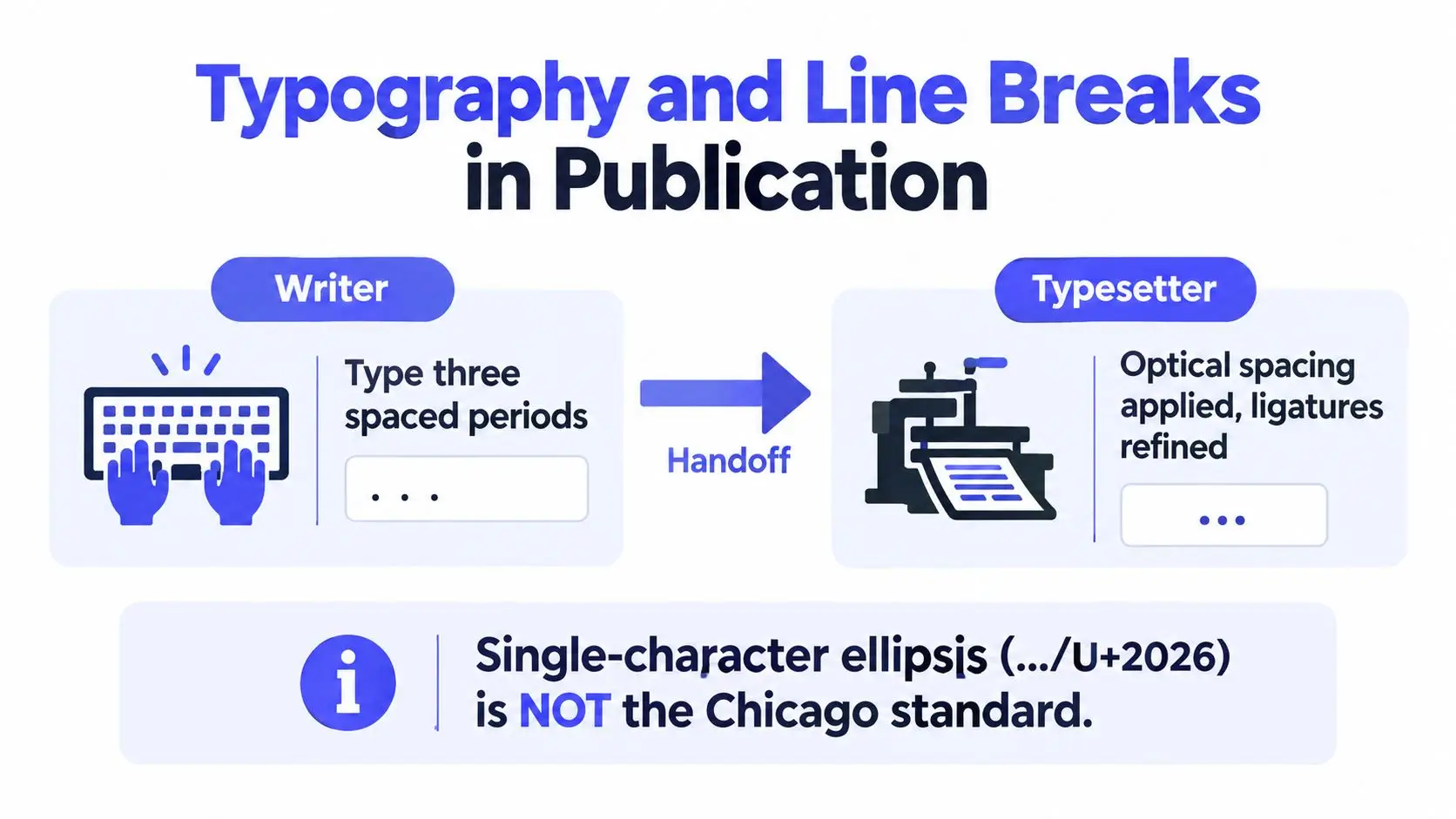
Manuscript input versus production output
Use the workflow that matches your role:
- Writer: Type the spaced form,
. . ., unless the publisher supplies a different manuscript convention. - Copyeditor: Preserve the editorial meaning and flag inconsistent use, rather than applying visual fixes that may be lost on export.
- Typesetter: Use nonbreaking spaces or the publication's controlled character style where line stability requires it.
- Web editor: Test the rendered HTML at narrow widths, not just in the source editor.
Chicago notes that nonbreaking spaces can keep an ellipsis and following punctuation together for publication output. Its guidance also addresses line beginnings, which means an ellipsis isn't automatically forbidden from starting a new line. The purpose of a nonbreaking space is narrower: prevent an ellipsis from separating from punctuation that must remain with it.
Unicode and software behavior
The single-character ellipsis can look like three dots, but it isn't the same underlying construction as three spaced periods. Word may autocorrect a typed sequence, InDesign may apply a character or GREP style, and HTML may preserve ordinary spaces unless the production team deliberately uses nonbreaking spaces. None of those behaviors should decide the editorial meaning.
For web output, CSS can help control presentation with a character style and appropriate white-space handling. For print, inspect the PDF at the page level and confirm that the ellipsis, quotation mark, question mark, or retained period stays in the intended relationship. If pasted text contains invisible spacing or unexpected symbol substitutions, a tool for cleaning AI-generated text can help expose and remove hidden characters before the copy reaches layout.
When a manuscript moves through Word, InDesign, HTML, and ebook conversion, create a house rule for input and a separate rule for output. Storyloft, for example, provides manuscript formatting and symbol conversion within a long-form writing and publishing workflow, which can be useful when an author needs consistent treatment across book text and exported formats. The manuscript formatting guide can be used alongside the publisher's own specifications.
A Decision Sequence You Can Reuse
When you meet an ellipsis, don't begin by counting dots. Begin by identifying the meaning.
- Ask whether words were removed. If the mark replaces material from a quotation and the sentence continues afterward, use three spaced periods:
The witness said, “I saw the vehicle . . . near the station.” - Check whether a complete sentence ends before the omission. Retain that sentence-ending period, then add the three spaced dots:
“I saw the vehicle. . . . The driver left.” - If no words were removed, ask whether the voice pauses or trails off. Use three spaced periods without a retained sentence-ending period:
I thought we could . . . perhaps not. - Decide whether the pause belongs to the quoted speaker. If it does, a plain ellipsis may represent it. If an editor created the gap, use brackets or an explanatory note so attribution stays clear.
- Inspect adjacent punctuation. Keep a comma, question mark, or exclamation point when it belongs to the sentence. Place it according to the sentence's grammar and meaning, not according to a blanket dot-counting rule.
- Inspect the container. At a paragraph break or in poetry, preserve the original structure. In layout, prevent accidental separation where the publication requires the ellipsis and its following punctuation to remain together.
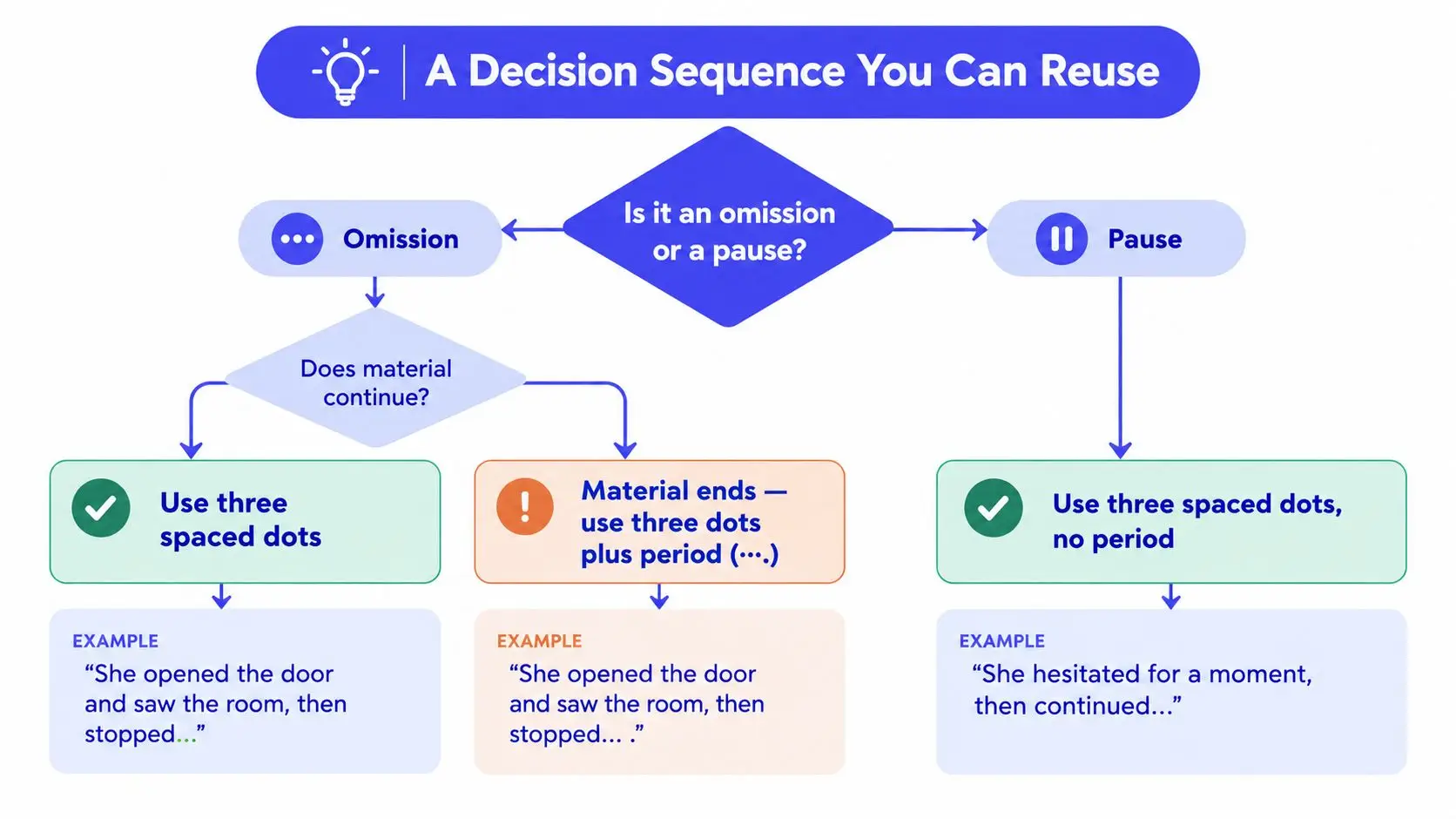
A useful final test is substitution. Replace the dots mentally with the words that might be missing. If the sentence describes a source gap, you're handling an omission. If no words need to be restored and the effect is vocal or rhetorical, you're handling a pause or trailing thought.
The final pattern should communicate both meaning and structure. Three spaced periods usually mark the ellipsis itself. A retained period before those dots tells readers that a complete sentence ended before the omitted material.
Quick Reference Cheatsheet
Use this table when you're editing line by line. The “Type As” column describes the manuscript input, not an instruction to ignore a publisher's production specifications.
| Situation | Correct Pattern | Type As |
|---|---|---|
| Omission in the middle of a quotation | “The record shows . . . a change.” |
Three spaced periods |
| Omission at the beginning of a quotation | “A change appears in the record.” |
Usually no opening ellipsis |
| Omission after a complete quoted sentence | “The record shows a change. . . . The review continues.” |
Period plus three spaced periods |
| Narrative pause within a sentence | She opened the file . . . and stopped. |
Three spaced periods |
| Trailing thought at sentence end | I thought I knew . . . |
Three spaced periods |
| Question that trails into an ellipsis | Did you approve it . . .? |
Question mark with spaced ellipsis |
| Exclamation followed by a pause | Stop! . . . |
Exclamation point plus spaced ellipsis |
| Editorial gap in quoted speech | “The plan [. . .] requires review.” |
Bracketed spaced periods when needed |
| Omission in poetry | A separate ellipsis line where a full line is omitted | Preserve line structure |
| Omission across a paragraph break | New paragraph begins with . . . when the gap needs marking |
Preserve paragraph break |
| Publication output requiring line stability | Same editorial pattern with controlled spacing | Nonbreaking spaces as needed |
The table can't replace context. It does, however, prevent two frequent errors: treating every ... as equivalent and adding a fourth dot whenever a quotation ends. First determine whether a sentence-ending period is present. Then decide whether the reader needs to see an omission, a pause, or an editorial intervention.
How the Three-Dot Rule Came to Be
Chicago's current convention has a documented history. The first edition of The Chicago Manual of Style, published in 1906, recommended four spaced dots for ellipses at the beginning, middle, or end of a sentence. That historical convention remained in place until the eleventh edition in 1949, when Chicago shifted to the modern three-dot form with a preceding period retained when the quoted sentence is complete. The history is summarized in Chicago's account of the ellipsis convention.
The logic behind the older pattern is easier to understand when you separate the marks by job. One dot represented the period belonging to the complete sentence, while the remaining dots represented the omitted material. In the modern system, Chicago assigns the sentence-ending period to the sentence itself and uses the three-dot ellipsis for the omission. The visible result still becomes four marks in the complete-sentence case, but the editorial reasoning is clearer.
The change also explains why editors should resist memorizing “three dots” as an absolute rule. The ellipsis remains a three-dot mark, yet a retained period may appear directly before it. Writers who count marks without identifying their roles often delete a necessary period or add one where none belongs.
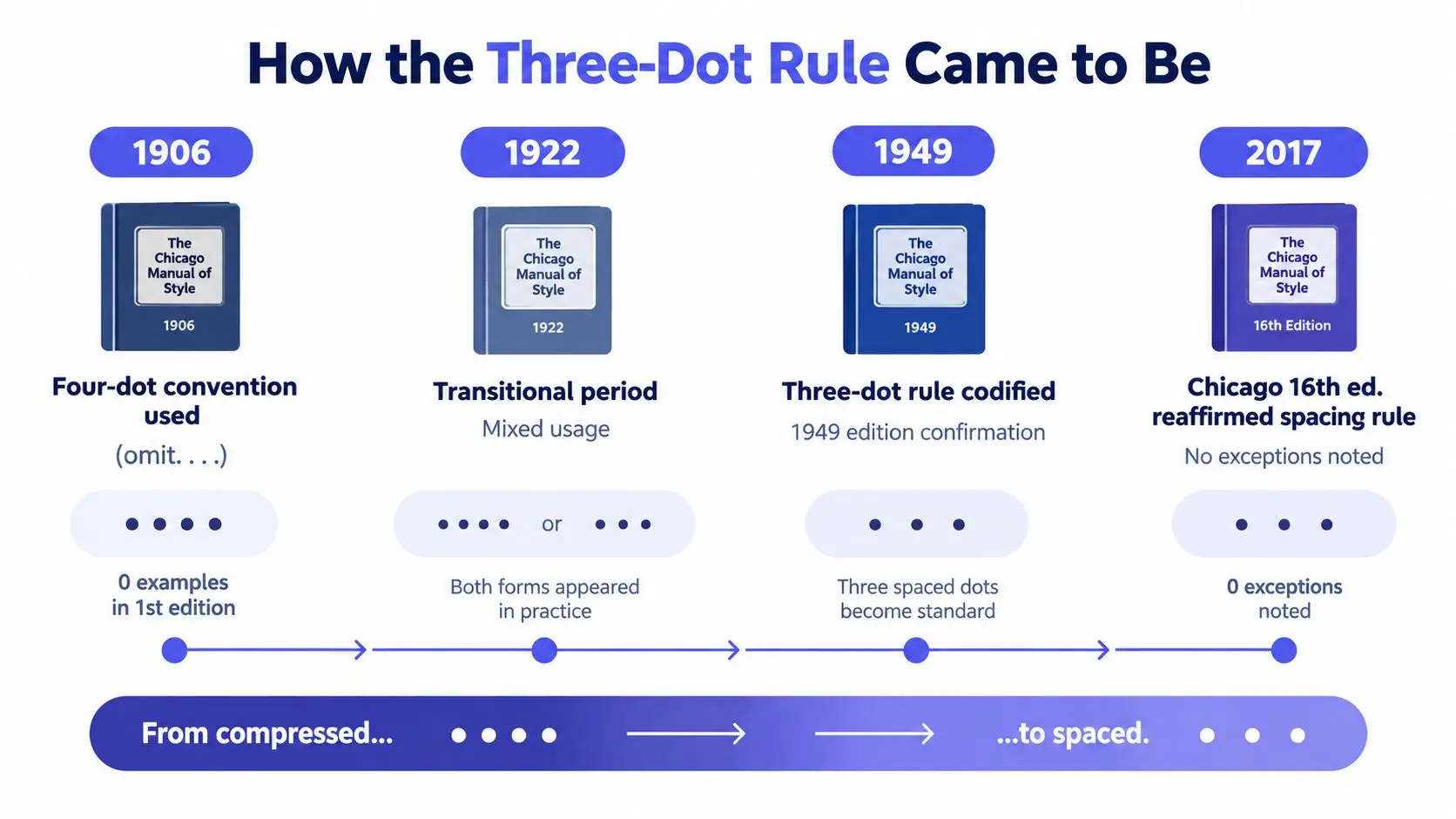
Chicago's guidance now treats ellipses as a connected punctuation system that includes omissions, pauses, periods, other punctuation, paragraphs, poetry, and brackets. The historical shift is therefore more than a change in visual preference. It gives editors a way to explain why . . . is the normal baseline, why . . . can follow a retained period, and why .... is not the correct manuscript form.
Use that explanation when a writer asks why the dots need spaces. The spaces identify the mark's separate components and leave room for the sentence-ending period when the grammar requires it. Once the writer sees the difference between the ellipsis and the punctuation around it, Chicago style ellipses become a system that can be applied rather than a collection of exceptions.
If you're preparing a novel, nonfiction manuscript, or interview collection, Storyloft combines long-form drafting, AI-assisted editing, research organization, collaboration, and print-ready ebook and paperback formatting in one workspace. Use it to keep ellipsis choices, citations, and layout checks consistent from the first draft through publication.