Stephen King Writing Style: A Deep Analysis of How His Storytelling Actually Works
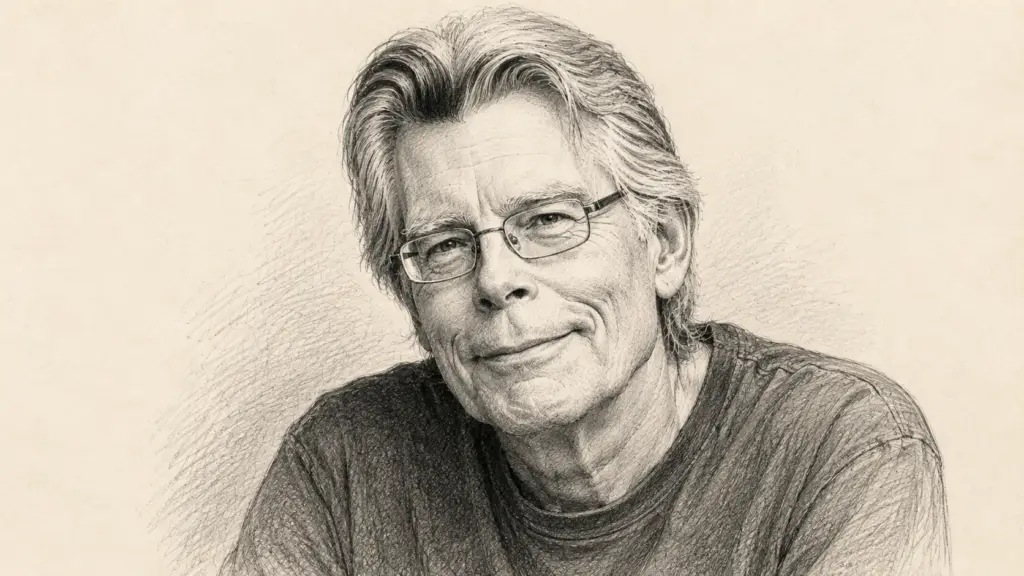
Stephen King is so good at making readers keep turning pages that his prose can look easier than it is. That is part of the trick.
King rarely writes as if the sentence wants applause. He wants the sentence to get out of the way of the room, the person, the joke, the bad decision, the thing under the stairs. His language is usually plain. His paragraphs move. His narrators sound like people rather than monuments. He is willing to be funny inside frightening scenes and frightening inside ordinary ones. Most of all, he understands that suspense is not a special effect. It begins with caring what happens to somebody.
This article takes King’s style apart at the sentence, paragraph, scene, and novel level. It also checks some of King’s famous advice against research on his actual prose. That matters. Writers give advice. Writers also break their own rules. Sometimes before breakfast.
TL;DR: What Makes Stephen King’s Writing Style Unique?
- King optimizes for immersion. His prose is generally readable, direct, and low-friction so the reader spends attention on the story rather than decoding the sentence.
- His plainness is deliberate. A 2023 computational study found his fiction markedly easier to read than his nonfiction and measured his fictional sentences at roughly 13 words on average across its corpus.
- Voice does a great deal of the work. Narrators and characters use colloquial phrasing, jokes, local speech, fragments, and concrete observations that make the page feel spoken even when nobody is speaking aloud.
- Character creates suspense. King often makes the reader live with ordinary people before applying extraordinary pressure.
- He is a scene writer. His strongest sequences unfold through visible action, dialogue, sensory detail, and escalating choices.
- He often discovers plot rather than imposing it. King has repeatedly described starting with situations and characters, then writing forward to see what happens.
- His dialogue is economical but not sterile. People interrupt, ramble, joke, evade, repeat themselves, and reveal class, age, fear, affection, and power.
- His best lesson is not “write horror.” It is: make the reader comfortable enough to enter the story, then make events matter to someone they know.
1. Stephen King’s Writing Style at a Glance
| Known for | Readable prose, strong narrative voice, suspense, ordinary characters under pressure, vivid dialogue, long-form escalation |
|---|---|
| Primary genres | Horror, suspense, fantasy, crime, speculative fiction, literary realism |
| Sentence style | Usually direct and conversational, with frequent fragments and rhythmic variation |
| Vocabulary | Plain to moderately colloquial; concrete; culturally specific; often humorous |
| Dialogue | Character-specific, informal, interruptible, socially revealing |
| Description | Concrete and cinematic, often anchored in familiar objects |
| Point of view | Flexible third person, close interiority, first person, and multi-character structures |
| Pacing | Patient setup followed by pressure, acceleration, reversals, and extended climaxes |
| Best works for studying the style | Misery, The Shining, It, Dolores Claiborne, 11/22/63, shorter fiction, and On Writing |
| Best lesson for writers | Clarity is not the enemy of personality. The sentence can be easy to read and still sound like somebody. |
A Storyloft Style Profile
- Sentence length: Short to moderate, with strategic longer runs
- Vocabulary: Plain to conversational
- Narrative distance: Frequently close
- Description: Concrete and selective
- Dialogue: Extensive
- Pacing: Elastic; patient when building attachment, fast under pressure
- Syntax: Usually transparent
- Interiority: High
2. Where Did Stephen King’s Writing Style Come From?
Childhood: stories before literary respectability
King’s own account in On Writing matters because his development was not built around a tidy march through a literary canon. He read popular fiction, horror, comics, newspapers, paperbacks, and whatever else could get a story into his hands. Movies mattered too. That mixture helps explain one of his permanent strengths: he never developed much interest in pretending entertainment and serious craft live in separate buildings.
His childhood was financially insecure. His father disappeared when King was young. His mother worked hard and moved the family repeatedly before they settled in Maine. That history does not mechanically produce a prose style, but it does help explain King’s lifelong interest in working people, modest houses, bad jobs, local grudges, medical bills, cars that need fixing, and institutions that do not rescue anyone on schedule.
Maine and the authority of place
King’s fictional towns feel specific because he treats local texture as structural material. Roads, weather, convenience stores, schools, accents, radio stations, brands, gossip, and town memory make the impossible easier to believe. A haunted hotel is more frightening if the snowplow schedule sounds right.
This is an important craft point. Verisimilitude is not achieved by describing everything. It is achieved by selecting details that imply the writer knows the rest.
Popular storytelling traditions
King learned from horror and suspense writers, but also from crime fiction, science fiction, literary realism, radio, television, and film. His work has always been omnivorous. That makes genre labels useful to booksellers and less useful to understanding the sentences.
In his 2006 Paris Review interview, King pushed back against the idea that being classified as a horror writer described everything he did. It did not. The same writer produced It, The Body, Rita Hayworth and Shawshank Redemption, Misery, and On Writing. The genres move. The storytelling instincts remain.
Work, rejection, and volume
King wrote a great deal before Carrie changed his career. That volume matters. His style was not discovered in a single moment of revelation. It was trained through stories, rejected submissions, magazine markets, teaching, revision, and repetition.
This is less romantic than being struck by lightning. It is also more useful.
3. How Stephen King’s Style Developed
The early novels: speed, pressure, and strong premises
The early books show King’s gift for a situation that can be understood immediately. A bullied teenager with telekinetic power. A writer trapped by his most committed reader. A family isolated in a hotel. A town exposed to an ancient predator. The premise creates pressure before the prose has to do anything fancy.
But the books are not merely premise machines. King spends time establishing routines and relationships. That patience is one reason the later violence works. Readers know what normal looked like before it broke.
Expansion: the big social novel hiding inside the horror novel
Books such as The Stand and It expand King’s canvas. He moves among many characters, histories, timelines, subcultures, and points of view. At that scale, his accessible syntax becomes useful infrastructure. A dense cast is easier to manage when every sentence is not also auditioning for a prize in Decorative English.
Late-career control
King’s later work often shows greater comfort moving between suspense, crime, nostalgia, fantasy, and domestic realism. The prose remains recognizable, but the range of emotional effects widens. 11/22/63, for instance, needs romance, historical reconstruction, speculative rules, and thriller mechanics to coexist without visible seams.
The persistent core
Across decades, several things stay stable: conversational narration, readable syntax, concrete settings, attention to ordinary social behavior, quick character differentiation, and a willingness to linger before the plot accelerates.
4. Sentence Structure: How Stephen King Builds Sentences
The sentence usually serves the scene
King’s default sentence is not especially ornate. Subject, verb, object. Clear action. Clear perception. When the grammar becomes more elaborate, it usually tracks a character’s thinking or the escalation of a moment.
A useful 2023 study by Mathias Clasen and colleagues, How Stephen King Writes and Why, tested some of the advice in On Writing against King’s books. In its corpus, King’s fiction averaged about 12.96 words per sentence. That was close to a comparison corpus of American fiction. The interesting finding was not that King writes uniquely tiny sentences. He does not. It was that his fiction was much easier to process than his nonfiction, suggesting deliberate simplification in service of immersion.
Fragments create spoken pressure
King uses fragments freely. They can mimic thought, create emphasis, or tighten a frightening sequence.
A fragment on its own line also changes page rhythm. It makes the reader stop. Very briefly. Which is often long enough.
Longer sentences track mental acceleration
King is not allergic to long sentences. When a character panics, remembers, rationalizes, or spirals, clauses can accumulate. The grammar stretches because the mind stretches.
The lesson is not “short equals exciting.” The lesson is that syntax can follow cognition.
Clarity before display
King’s syntax rarely makes the reader ask what a sentence means grammatically. That leaves more cognitive room for what the sentence means dramatically. For commercial storytelling, that trade is powerful.
5. Rhythm and Cadence: What Makes Stephen King Sound Like Stephen King?
Conversational setup, sharp landing
King often writes a loose, conversational run and then ends with a short sentence that changes the temperature. The longer material makes the voice feel relaxed. The short landing line tells you it was not relaxed at all.
Repetition creates obsession
Fear repeats. Memory repeats. Shame repeats. King’s narrators often allow a word, phrase, image, or private joke to recur until it becomes a mental trigger.
This is especially effective because the language around the repeated item is usually simple. The recurring phrase becomes louder each time without needing to become more elaborate.
Parenthetical voice
King frequently lets an aside, memory, joke, or internal correction interrupt the forward line. These interruptions create intimacy. The narrator seems to be thinking with the reader rather than presenting a polished report from a marble lectern.
Rhythm follows emotional state
Calm scenes can breathe. Frightened scenes clip. Obsessive scenes circle. Comic scenes stretch toward a punchline. King changes rhythm to match the nervous system of the scene.
6. Word Choice and Vocabulary
Plain words are not bland words
King has argued for plain, direct language. The 2023 linguistic study gives that claim some empirical support. His fiction is generally easy to process. But “plain” should not be confused with generic.
King’s vocabulary is full of brands, slang, bodily sensations, work language, regional detail, childish nicknames, songs, television, food, cars, schoolyard insults, and bits of cultural debris. The words are familiar. The selection is specific.
Concrete nouns build trust
A generic room is weak. A room with a particular carpet, stale smell, cheap lamp, old paperback, and television muttering from another room has authority. King knows that familiar physical detail makes supernatural intrusion more credible.
Adverbs: the famous rule and the real practice
On Writing contains King’s famous suspicion of adverbs, especially in dialogue attribution. Writers sometimes turn this into a religious ban. The research is more interesting. The 2023 study found support for the idea that reduced -ly adverb use is associated with certain literary effects, but it also showed why simple rules cannot explain a career.
Use the warning as an editing question, not as an arrest warrant.
Profanity and register
King lets characters use the language their social world gives them. That includes vulgarity. The point is usually character, class, age, anger, intimacy, or fear. Sanitizing everybody into the same polite register would destroy one of his central strengths.
7. Paragraph Structure: How King Controls the Reader’s Attention
Short paragraphs lower friction
King often keeps paragraphs manageable during active scenes. The white space helps the page move. Readers do not experience a wall of prose just as someone is trying to get out of the basement.
Single-line paragraphs act like cuts
A one-line paragraph isolates a beat. It can function like a close-up or hard cut in film. King uses this kind of spacing for emphasis, reaction, and dread.
Longer paragraphs establish normal life
When he wants community, memory, explanation, or character background, King allows paragraphs to expand. This gives his novels their unusual elasticity. He can move from an anecdotal history of a town to a two-line burst of violence without making either mode feel accidental.
Paragraph endings turn the screw
King is good at ending a paragraph on the piece of information that changes how the reader reads the next one. This is micro-suspense. It works even when nobody is in danger.
8. Description and Imagery: Making the Ordinary Available to Horror
Start with the recognizable world
King’s horror works because it often begins with things readers already understand: a school hallway, a hotel corridor, a laundry room, a small-town road, a bedroom at night. He does not need to persuade us these places exist.
Specific detail makes the impossible legible
When something impossible enters the scene, it is surrounded by ordinary detail. That contrast matters. A monster in a vague gothic mist is already a monster. A monster beside a chipped cereal bowl feels rude enough to have entered your house.
Images often return
King likes recurring images. They become memory anchors. A sound, smell, phrase, object, or bit of music can acquire meaning across hundreds of pages.
He describes through the perceiver
The most useful detail is often the detail a particular character would notice. A child, mechanic, nurse, alcoholic, teacher, writer, police officer, and teenager should not all describe the same room in the same way.
9. How Stephen King Writes Dialogue
People sound socially located
King’s speakers have age, region, education, class, habits, prejudices, and private histories. Dialogue is not simply information with quotation marks around it.
Speech can be messy without becoming unreadable
Characters repeat themselves. They use filler. They interrupt. They joke at bad times. They say the wrong thing and then try to repair it. King preserves enough mess to feel human while cutting enough mess to keep the scene alive.
Simple tags disappear
King’s well-known preference for ordinary dialogue attribution reflects his broader philosophy. If the line itself has energy, the tag should not compete with it.
Humor deepens fear
King is funnier than his reputation sometimes suggests. That matters to his dialogue. Jokes create affection, reveal character, and lower the reader’s guard. Then the book has something to take away.
Subtext is practical
King’s characters often conceal fear, addiction, anger, desire, or guilt behind banter and routine talk. He does not treat subtext as a literary ornament. It is simply how people behave when saying the truth would make the room worse.
10. Point of View and Narrative Distance
Close third person is one of King’s main engines
King often enters a character’s mind while keeping a third-person frame. That gives him access to fear, memory, association, and self-deception without requiring a formal first-person narrator.
He changes distance quickly
A paragraph can begin outside a character, move into private thought, catch a stray memory, and return to visible action. Done well, the transitions are almost invisible.
Multiple points of view create community
In large novels, King uses POV shifts to make the setting itself feel inhabited. We know the town because we know what different people fear, remember, misunderstand, and gossip about.
The narrator can have personality
King does not always pursue a neutral narrator. The narrative voice may joke, judge, foreshadow, or speak directly enough that the storytelling itself feels companionable. That companionship is useful when the story gets ugly.
11. How Stephen King Controls Pacing
Micro-pacing: readable sentences and active paragraphs
At the local level, King keeps comprehension fast. Dialogue, fragments, concrete verbs, and relatively transparent syntax let scenes move without grammatical drag.
Macro-pacing: patience before pressure
At the novel level, King can be surprisingly slow. He spends pages on childhood, marriages, work, town history, jokes, grudges, and routine. Readers who describe him only as “fast-paced” miss half the mechanism.
He earns speed by first creating attachment.
Suspense comes from unequal information
Sometimes the reader knows more than the character. Sometimes less. King constantly manages that difference. A harmless action becomes suspenseful when the reader knows what waits behind it.
Escalation changes the kind of problem
Good escalation is not merely “the monster gets bigger.” King’s conflicts often move from uncertainty, to recognition, to isolation, to moral choice, to survival. Each stage asks a different question.
12. Seven Signature Techniques That Make Stephen King Sound Like Stephen King
Technique 1: Transparent prose
Technique: Keep syntax and vocabulary easy enough that the reader can inhabit the scene quickly.
Effect: Attention moves toward character and event.
Lesson: Readability can be a deliberate aesthetic choice.
Technique 2: The ordinary detail before the extraordinary event
Technique: Establish a believable physical and social world first.
Effect: The impossible feels like an intrusion rather than a genre decoration.
Lesson: Specific normality makes abnormality stronger.
Technique 3: Character-first suspense
Technique: Let readers know what a person wants and what they can lose.
Effect: Suspense becomes emotional rather than mechanical.
Lesson: A ticking clock is louder when someone matters beside it.
Technique 4: Conversational narrative voice
Technique: Use idiom, asides, jokes, fragments, and culturally specific language.
Effect: The storyteller feels close.
Lesson: Informality can carry authority when the details are precise.
Technique 5: Recurring verbal and sensory motifs
Technique: Repeat a phrase, sound, object, or image across scenes.
Effect: Memory becomes part of suspense.
Lesson: Repetition can accumulate meaning instead of merely repeating information.
Technique 6: Elastic narrative distance
Technique: Move smoothly between visible action and private thought.
Effect: The reader experiences both event and interpretation.
Lesson: POV control is not only about choosing first or third person. It is about deciding how close the camera sits.
Technique 7: Long setup, hard acceleration
Technique: Build relationships and routine before compressing time.
Effect: Later action carries emotional history.
Lesson: Pacing is contrast. If everything races, nothing feels fast.
13. What Stephen King Said About Writing
Read a lot and write a lot
King’s craft philosophy starts with volume. On Writing treats reading and writing as the basic training of the novelist. There is no clever substitute. This is annoyingly sensible advice, which may explain why people keep looking for a clever substitute.
Use the vocabulary you actually have
King argues against dressing up language to sound literary. The goal is not to make every sentence smaller. It is to choose words for accuracy and voice rather than social prestige.
Prefer active construction, but do not worship rules
His warnings about passive voice and adverbs are best read as pressure toward energetic prose. The computational research on his books shows why the rules should remain tools rather than commandments. King’s own success cannot be reduced to a blacklist of grammatical forms.
Start with situation
King has often described himself as a discovery writer. He is interested in putting characters into a strong situation and following the consequences rather than outlining every turn in advance.
Write the truth inside the invention
The supernatural event can be impossible. The human reaction cannot feel fake. King’s strongest work makes emotional behavior more realistic as the premise becomes less realistic.
14. What Critics and Scholars Say About King’s Style
Readability is measurable
The 2023 Orbis Litterarum study is especially useful because it tests craft claims instead of merely praising them. It found that King’s fictional prose is generally easy to read and that his fiction is simpler than his nonfiction. That supports the idea that transparency is a chosen narrative strategy.
Simple language can increase immersion
The same study connects processing ease with narrative immersion. That fits King’s stated goal: the reader should be absorbed in the story rather than repeatedly reminded of the medium.
Popular and literary are not opposites
King’s career has spent decades making this distinction look increasingly silly. His Paris Review interview is useful precisely because it treats him as a craftsman of language and form, not merely a manufacturer of scares.
His rules are less important than his system
If writers copy King’s warnings about adverbs but miss his scene construction, voice, characterization, and control of information, they have copied the least interesting part.
15. Learning From Stephen King Without Copying Stephen King
Learn: Make prose easy to enter
Readers should not need to unpack ordinary narrative sentences unless difficulty is part of the intended effect.
Don’t copy: Generic simplicity
King’s language is readable, not anonymous. Plain words still need specific observation and voice.
Learn: Build normal before breaking normal
Let readers see the routine, relationship, or expectation that danger threatens.
Don’t copy: Small-town Maine surface details
Your local truth is more valuable than King’s local truth. Find your own convenience store.
Learn: Let characters joke
Humor makes people feel alive and creates contrast with darker material.
Don’t copy: Joke through every scene
Voice becomes noise if it refuses to notice when the emotional temperature changes.
Learn: Control information
Ask what the reader knows, what the character knows, and when those two knowledge states should change.
Don’t copy: Manufacture cliffhangers mechanically
A chapter ending is strongest when the new information changes the story, not when the paragraph simply stops before a door opens.
Learn: Write enough to become yourself
King’s most repeatable lesson is volume. Style becomes visible across pages, not in a branding workshop.
16. Writing Exercises Inspired by Stephen King
Exercise 1: The normal room
Describe a room using six details that imply who lives there. Do not mention danger. Then introduce one detail that does not belong.
Exercise 2: Plain-language revision
Take 300 words of prose and replace every word chosen mainly to sound impressive. Keep technical terms that are genuinely more accurate.
Exercise 3: Character before threat
Write 500 words in which a character wants something small and ordinary. Only after the reader understands the desire should a larger threat appear.
Exercise 4: Information imbalance
Write the same scene twice. In version one, the reader knows a danger the character does not. In version two, the character knows something the reader does not. Compare the suspense.
Exercise 5: Dialogue by social world
Give three characters the same piece of bad news. Write each response without dialogue tags. Make age, background, and relationship identify the speaker.
Exercise 6: Rhythm under panic
Write a calm paragraph of 150 words. Rewrite it as the character begins to panic. Change syntax and paragraphing before changing vocabulary.
Exercise 7: Recurring object
Introduce an ordinary object in a neutral scene. Bring it back twice, changing its emotional meaning each time.
Exercise 8: Cut the fancy tag
Write a page of dialogue using elaborate speech tags. Replace them with “said,” action beats, or nothing. See whether the lines themselves can carry the emotion.
17. Frequently Asked Questions About Stephen King’s Writing Style
What is Stephen King’s writing style?
Stephen King’s writing style is generally direct, readable, conversational, and character-centered. He combines plain vocabulary with strong narrative voice, concrete detail, close interiority, naturalistic dialogue, and careful control of suspense.
Does Stephen King write short sentences?
Often, but not unusually so across all fiction. A 2023 computational study found an average of about 12.96 words per sentence in its King corpus, close to its comparison sample of American fiction. His readability comes from more than sentence length.
Why is Stephen King’s prose so readable?
His syntax is usually transparent, his vocabulary is familiar, scenes are anchored in concrete action, and his narrators sound conversational. Research comparing his fiction with his nonfiction suggests he deliberately simplifies language in fiction.
Does Stephen King use adverbs?
Yes. His famous criticism of adverbs is not a literal ban. It is an editing principle aimed at avoiding weak verb choices and over-explained dialogue. Treat it as a diagnostic question.
How does Stephen King create suspense?
He creates suspense by building attachment to characters, controlling who knows what, establishing ordinary routines, introducing threats gradually, and changing the problem as the story escalates.
Does Stephen King outline his novels?
King is well known for favoring discovery writing. He often begins with a situation and follows the characters rather than plotting every turn in advance, although individual projects vary.
How does Stephen King write dialogue?
His dialogue is colloquial, character-specific, and socially grounded. Speakers interrupt, joke, evade, repeat themselves, and use language shaped by age, region, class, and relationship.
What is Stephen King’s best advice for writers?
Probably the least glamorous: read a lot and write a lot. His other advice becomes more useful once those two habits are already in place.
What should writers read to study Stephen King’s craft?
On Writing gives King’s direct craft philosophy. For fiction, Misery is excellent for tension and limited setting, It for ensemble structure and memory, and shorter fiction for compression.
Is Stephen King’s writing literary or commercial?
The distinction is not especially useful. His prose prioritizes accessibility and story, but his work also uses complex structures, recurring motifs, social observation, symbolism, and psychological interiority.
How can I write like Stephen King without copying him?
Do not copy his settings, horror motifs, or verbal mannerisms. Study the underlying craft: concrete normality, readable prose, character-specific dialogue, information control, and emotional stakes.
What makes King’s horror effective?
He usually gives the reader something ordinary and human to care about before the horror fully arrives. Fear gains weight because it threatens a recognizable life.
18. Methodology: How We Analyzed Stephen King’s Writing
Primary and near-primary sources
This analysis relies heavily on King’s own craft book On Writing, his official site, and his 2006 Paris Review interview. Those sources are useful because they show what King says he is trying to do.
Scholarly sources
We used the 2023 Orbis Litterarum computational study because it tests King’s advice against a corpus of his writing. Its findings are particularly useful for readability, sentence length, adverbs, passive voice, and the difference between King’s fiction and nonfiction.
Storyloft close-reading comparison
The qualitative analysis compares recurring features across early, middle, and later work: sentence transparency, paragraph rhythm, dialogue, POV distance, local detail, motifs, and the relationship between setup and escalation.
Limitations
King has published an enormous body of work across genres and decades. No short profile can reduce that work to one fixed statistical fingerprint. The goal here is to identify durable tendencies without pretending every book behaves identically.
19. Sources and Further Reading
Primary texts and interviews
- Stephen King, On Writing: A Memoir of the Craft — official site
- Stephen King, “The Art of Fiction No. 189,” The Paris Review, 2006
- Stephen King official listing for The Paris Review interview
Scholarly and institutional sources
- Mathias Clasen et al., “How Stephen King writes and why: Language, immersion, emotion,” Orbis Litterarum, 2023
- The Horror Story, The Edinburgh Companion to the Short Story in English
Additional craft context
- King, Stephen. Danse Macabre.
- King, Stephen. Selected short fiction, especially collections spanning different decades.
What Stephen King’s Style Ultimately Teaches Writers
Compare the craft: Brandon Sanderson on plotting and payoff, and Ernest Hemingway on economy, dialogue, and narrative restraint.
Stephen King’s prose works because it knows what it is for.
The sentence opens the door. The voice invites the reader inside. The concrete detail makes the room believable. The dialogue introduces the people. The slow pages give those people history. Then the story changes the conditions and asks what they will do.
There is plenty to study in King’s horror machinery, but the deeper lesson is simpler. Do not make the reader admire the bridge when you need them to cross it. Build it well. Give it character. Then get them to the other side.
Preferably before something catches up.