Understanding the Structure of Books: A Simple Guide

I once saw a writer in Portland tear up her notebook. She said her novel was like a puzzle without pieces. She had great characters and scenes, but no plan. This moment changed how I see writing.
It showed me that book structure is more than rules. It’s what makes a story flow smoothly.
Think of the last book that kept you hooked. Its structure was likely seamless. The tension built up perfectly. The ending felt right, not rushed.
Good structure guides you without you noticing. It’s like a map for your reading journey.
Western stories often follow a pattern: exposition, rising action, climax, falling action, and resolution. These aren’t strict rules. They’re tools for writers to use.
Writers like Toni Morrison and Quentin Tarantino played with these patterns. But they knew the rules well before they broke them.
Knowing book structure helps answer big questions at the right time. It makes characters grow and conflicts feel earned. A solid structure turns a draft into a book worth reading.
In this guide, we’ll explore all the pieces of the puzzle. From classic frameworks to genre-specific rules. Let’s make your story complete.
Key Takeaways
- The structure of books creates the framework that turns raw ideas into a compelling narrative readers can follow.
- Strong book organization answers reader questions, builds tension, and delivers a satisfying resolution at the right moments.
- Most stories share five core elements: exposition, rising action, climax, falling action, and resolution.
- Understanding book structure is essential before you can break the rules in meaningful, intentional ways.
- Tight structure supports character development and helps unravel central conflicts throughout the story.
- Different genres carry unique structural expectations, but the foundational principles remain the same.
What Is the Structure of Books and Why It Matters
I see book anatomy as the skeleton of a story. Without it, even the best ideas fall apart. Every book, from novels to memoirs, needs a solid framework to guide readers from start to finish.
A good narrative framework does more than just organize chapters. It affects how readers feel at every turn. Whether it’s a romance or a thriller, it’s all about the rising action, tension, and those moments when all seems lost before the story wraps up.
Defining Book Structure in Modern Publishing
In today’s publishing, a book’s structure is everything from the first page to the last. It includes pacing, act breaks, and story beats that shape the reader’s experience. Books like top structure books for novelists help writers master these key elements.
How Structure Impacts Reader Experience
Readers might not notice a strong structure, but they always feel a weak one. Without the right structure, a story feels like a list of events. Here’s what structure brings:
- A clear sense of momentum that keeps pages turning
- Emotional highs and lows at the right moments
- A satisfying payoff that rewards the reader’s investment
The Connection Between Structure and Storytelling Success
Great storytelling and solid book anatomy go together. Commercial fiction, film, and TV all rely on heroes facing obstacles and growing through conflict. Here’s how different structural elements keep readers hooked:
| Structural Element | Purpose | Reader Impact |
|---|---|---|
| Rising Action | Builds tension toward the climax | Creates anticipation and emotional investment |
| Conflict Moments | Tests the protagonist’s resolve | Keeps readers engaged and curious |
| All-Is-Lost Beat | Deepens stakes before resolution | Amplifies the emotional payoff |
| Climax | Delivers the story’s central turning point | Provides the most memorable reading moment |
| Resolution | Ties up narrative threads | Leaves readers satisfied and fulfilled |
Understanding modern publishing structure helps me craft stories that connect. Next, I’ll explore the key parts every book needs, from start to finish.
Essential Components Every Book Needs
Every book answers three big questions. Whose story is it? What does that person want? What stands in their way? These questions shape the essential book elements that give any manuscript its backbone. I think of them as the foundation before any real writing begins.
Front Matter Elements That Set the Stage
The front matter is often overlooked. It includes everything a reader sees before the main text starts. Think of the title page, copyright notice, dedication, and table of contents. These pieces create a first impression and build trust with your audience.
Core Body Content Organization
The body is where your story lives. I break it into three clear sections:
- Act I — Introduce your characters and set the world in motion.
- Act II — Throw obstacles at your protagonist and raise the stakes.
- Act III — Deliver the outcome your readers have been waiting for.
Before writing each scene, I ask myself four things: who’s in it, where it takes place, what happens, and why it matters. Knowing how your book ends keeps every chapter on track.
Back Matter and Supporting Materials
Back matter rounds out the book components readers rely on. It can include an epilogue, glossary, bibliography, acknowledgments, or an author bio. These supporting materials add depth and credibility.
| Book Section | Key Elements | Purpose |
|---|---|---|
| Front Matter | Title page, copyright, dedication, foreword | Sets expectations and builds credibility |
| Body | Chapters, scenes, acts | Delivers the core story or content |
| Back Matter | Glossary, bibliography, acknowledgments, index | Provides reference and closure |
Understanding these essential book elements helps you craft a manuscript that feels complete and professional from the very first page to the last.
Classic Story Structure Elements
Every great book follows a pattern. Whether it’s a military thriller by Tom Clancy or a romance by Nora Roberts, the same elements appear. These elements guide readers through an emotional journey from start to finish.
Let’s explore each stage of this literary structure. This way, you can spot these beats in every book you read.
Exposition and Setting the Scene
This is where it all begins. The exposition introduces the main character’s normal world. It shows their daily life, desires, and struggles. It gives readers a reason to care before the story changes.
Rising Action and Building Tension
Once the story changes, the protagonist chases a new goal. The rising action introduces obstacles, allies, and enemies. Each scene raises the stakes, building tension like a pressure cooker.
Climax as the Turning Point
The climax is the story’s peak. It’s the moment when the hero achieves their goal—or thinks they do. This turning point is the most intense scene in the book.
Falling Action and Resolution
After the climax, the story deals with consequences. The falling action shows how the world has changed. The resolution ties together plot threads, character arcs, and themes. It establishes a new status quo for the characters.
| Story Stage | Purpose | Reader Emotion |
|---|---|---|
| Exposition | Introduces characters and setting | Curiosity |
| Rising Action | Builds conflict and stakes | Anticipation |
| Climax | Delivers the major turning point | Excitement |
| Falling Action | Explores consequences | Reflection |
| Resolution | Wraps up all story threads | Satisfaction |
These classic story elements appear across every genre. Mastering them is the first step toward building a compelling book. We’ll explore the three-act structure framework next.
The Three-Act Structure Framework
The three-act structure is a top choice for writers. It divides a story into Setup, Confrontation, and Resolution. This method has helped writers for centuries, from Aristotle to today’s Hollywood screenwriters.
In Act 1, you introduce the ordinary world and main characters. An event changes the protagonist’s life. By the end, they face a big challenge at Plot Point One.
Act 2 is the longest part. Here, the stakes get higher. A midpoint event changes the protagonist’s mission. By Plot Point Two, they face a huge test. This act makes up about 50% of most books.
“Structure is the most important thing. Without it, there is no story.”— Robert McKee, Story: Substance, Structure, Style, and the Principles of Screenwriting
Act 3 ties everything together. The protagonist must decide on a bold action or give up. The climax is the final confrontation, and the denouement wraps up the story.
| Act | Purpose | Approximate Length | Key Book Elements |
|---|---|---|---|
| Act 1 – Setup | Introduce characters and world | 25% of the book | Exposition, inciting incident, Plot Point One |
| Act 2 – Confrontation | Deepen conflict and raise stakes | 50% of the book | Rising action, midpoint shift, Plot Point Two |
| Act 3 – Resolution | Resolve the central conflict | 25% of the book | Pre-climax decision, climax, denouement |
This framework works well with classic story elements. It offers a clear plan before exploring more detailed models like Freytag’s Pyramid.
Freytag’s Pyramid and Modern Applications
Gustav Freytag, a 19th-century German novelist, created a famous framework in literature. Freytag’s Pyramid is based on classical Greek tragedies. It breaks down stories into five stages, not just three acts.
This model is great for analyzing stories that are tragic or deeply emotional.
Five Key Points of Dramatic Structure
Freytag’s Pyramid outlines a story in five key stages. Each stage has a specific role in the story’s structure. Here’s a quick overview:
| Stage | Purpose | Example (Shakespeare’s Hamlet) |
|---|---|---|
| Introduction (Exposition) | Shows the normal world and the event that starts the story | The ghost of Hamlet’s father appears |
| Rise (Rising Action) | The main character tries to achieve their goals as challenges grow | Hamlet plans to prove his uncle’s guilt |
| Climax | The moment when the main character can’t go back | Hamlet kills Polonius behind the curtain |
| Return (Falling Action) | The story moves toward its final outcome with rising tension | Laertes seeks revenge; chaos grows |
| Catastrophe | The main character reaches their lowest point | Hamlet and many others die |
Adapting Classical Structure for Contemporary Writing
Freytag’s Pyramid isn’t as popular today. Modern readers often prefer stories with happy endings. Yet, this structure is still valuable for building your story.
Works like The Road by Cormac McCarthy and Requiem for a Dream show its influence. These stories follow the tragic arc that Freytag’s Pyramid outlines. Even if you don’t use it exactly, knowing it helps you understand why some stories are so moving.
Next, we’ll look at the Hero’s Journey and how it evolved from Freytag’s Pyramid to appeal to today’s audiences.
The Hero’s Journey Pattern
The Hero’s Journey has shaped many books, films, and games. It’s found in all genres, from fantasy to sports dramas. This pattern offers a roadmap that deeply connects with readers.
Joseph Campbell’s Monomyth Influence
In 1949, Joseph Campbell published The Hero with a Thousand Faces. He found a common pattern in myths: a hero goes on a journey, faces challenges, and returns changed. George Lucas was inspired by Campbell’s work for Star Wars.
The monomyth has become key in all storytelling formats. It reflects the universal challenges we face.
Christopher Vogler’s Simplified Twelve Steps
Christopher Vogler made Campbell’s ideas easier to use in The Writer’s Journey. His guide has twelve steps for writers.
- Ordinary World
- Call to Adventure
- Refusal of the Call
- Meeting the Mentor
- Crossing the First Threshold
- Tests, Allies, and Enemies
- Approach to the Inmost Cave
- The Ordeal
- Reward
- The Road Back
- Resurrection
- Return with the Elixir
Applying Hero’s Journey to Different Genres
This framework works for all stories, not just epic ones. Rocky, a sports drama, follows the Hero’s Journey. It fits all genres, from romance to thrillers.
| Genre | Example | Key Hero’s Journey Stage |
|---|---|---|
| Fantasy | The Lord of the Rings | Crossing the First Threshold |
| Sports Drama | Rocky | The Ordeal |
| Science Fiction | Star Wars | Meeting the Mentor |
| Coming-of-Age | The Hunger Games | Call to Adventure |
The monomyth gives your story a strong emotional base. It helps readers connect with your story. Using it with other structures, like Freytag’s Pyramid, makes your story even stronger.
Character Development Within Book Structure
I think the best stories are about their characters. A great plot isn’t enough without strong characters. Character arcs are what make a story feel alive.
Before I start writing, I learn a lot about my characters. They have conflicting wants and needs. For example, a detective might want justice but also need forgiveness.
Every character has their own struggles. A mother might want freedom but also need to stay connected. This inner conflict makes the story interesting.
Obstacles are key to a good story. Without challenges, there’s no story. I plan out what gets in the way of my characters’ goals.
- A clear desire that drives the character forward
- An internal flaw or wound that creates self-sabotage
- External forces that raise the stakes
- A transformation that feels earned by the final pages
Tools like Blake Snyder’s Save the Cat! beat sheet can help. But remember, your own ideas are just as important. Let your characters surprise you for a more real story.
Strong character arcs need a good story structure. The rising tension, turning points, and resolution are all important. Characters and plot work together to make a great story.
Plot Points and Narrative Frameworks
Every great book has key moments that move the story forward. These moments are like the engine of the plot. Without them, a story lacks direction.
Writers need clear plans to map out these important events. Exploring different templates can bring new ideas to any project.
Identifying Critical Story Beats
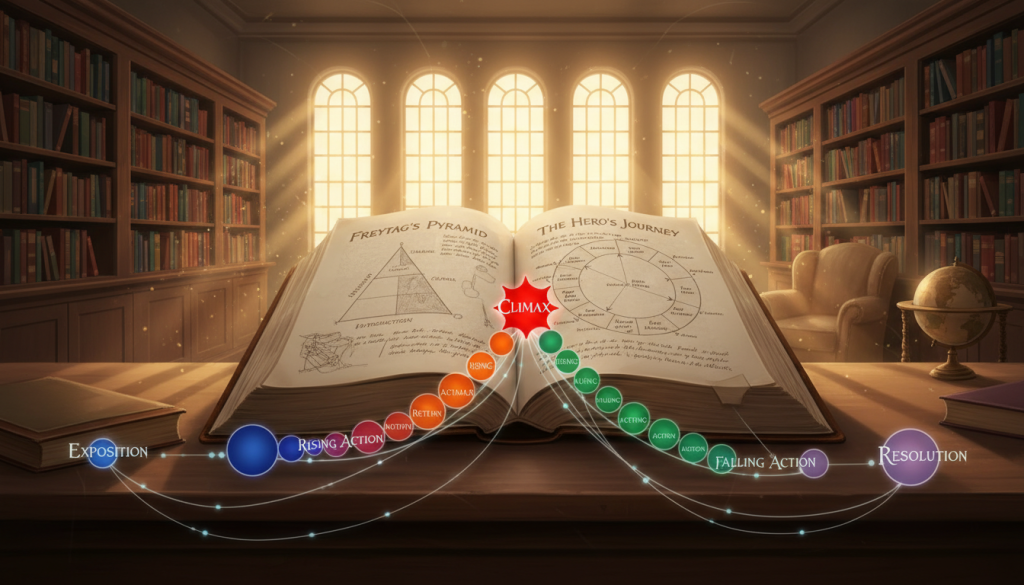
Story beats are the emotional highs that keep readers hooked. I use mind mapping to brainstorm and visually connect each beat. This helps me see how they fit together.
Templates like the Save the Cat method by Blake Snyder or the Snowflake Method by Randy Ingermanson are great starting points. Each beat should change the reader’s feelings — surprise, tension, hope, or dread.
Creating Meaningful Turning Points
Narrative turning points change everything for your characters. A twist at the midpoint or a shocking climax can change the whole story. I look beyond Western storytelling for inspiration.
Kishōtenketsu, a four-act structure from East Asia, introduces surprise without conflict.
Balancing Conflict and Resolution
A good plot needs a balance between tension and release. Too much conflict wears out readers. Too much resolution puts them to sleep. Here’s how popular frameworks balance this:
| Framework | Number of Key Story Beats | Conflict Style | Resolution Approach |
|---|---|---|---|
| 3-Act Structure | 3–5 | Escalating external conflict | Single decisive climax |
| Hero’s Journey | 12 | Internal and external trials | Transformation and return |
| Save the Cat | 15 | Emotional highs and lows | Character-driven payoff |
| Kishōtenketsu | 4 | Twist without direct opposition | Reconciliation of ideas |
Choosing the right framework depends on your genre and story goals. Try out different approaches to find the narrative turning points that make your book unforgettable.
Genre-Specific Structural Expectations
Every genre has its own set of rules. When I read a thriller, I look for fast action and high tension. A love story, on the other hand, should have deep emotions and a happy ending. Knowing these genre conventions helps me meet my readers’ needs.
Romance and Relationship Arcs
Romance stories follow a well-known pattern. Characters meet, sparks fly, and then obstacles appear. The story builds up to a happy ending, known as the happily ever after (HEA). Romance Writers of America says readers expect this ending.
I see romance as a dance. The push and pull between characters keeps the story exciting. Each scene should make their bond stronger or test it.
Mystery and Thriller Conventions
Mystery stories are like puzzles. A crime happens early, clues are scattered, and the detective solves it by the end. Readers enjoy guessing and feeling surprised and happy when it’s solved.
“The mystery framework demands that every clue planted must pay off. Cheating the reader is the one unforgivable sin.” — Writing Mysteries, edited by Sue Grafton
Literary Fiction’s Flexible Approach
Literary fiction breaks the rules. It focuses on characters rather than plot. These stories explore inner changes and have a more flexible structure. While they promise a story, the payoff often comes from deep emotional insights.
| Element | Romance | Mystery/Thriller | Literary Fiction |
|---|---|---|---|
| Primary Drive | Relationship arc | Puzzle-solving | Character growth |
| Expected Ending | Happily ever after | Crime solved | Emotional resonance |
| Pacing | Moderate with emotional peaks | Fast with rising tension | Reflective and deliberate |
| Structure Flexibility | Low — genre conventions are strict | Low — mystery framework is rigid | High — open to experimentation |
Planning Your Book’s Architecture
Before I start writing, I spend a lot of time planning. It’s like building a house. You wouldn’t start without a blueprint. Your book needs the same care.
I start with a treatment. It’s a short summary of the whole story. Fiction writers use it to plan their story. Nonfiction writers outline their chapters and decide on chapter lengths.
Organizing your manuscript is more than just knowing your content. It’s about making a schedule. Most writers write about 1,000 words per hour. Here’s how that works:
| Book Length | Word Count | Estimated Writing Hours | Weeks at 10 hrs/week |
|---|---|---|---|
| Short Novel | 40,000 | 40 | 4 |
| Standard Novel | 60,000 | 60 | 6 |
| Epic or Nonfiction | 90,000 | 90 | 9 |
After setting my timeline, I schedule non-negotiable writing sessions. I treat them like doctor’s appointments. This habit has boosted my productivity more than any tool.
Your writing space is also important. I create a comfy, distraction-free area. I use apps to block social media during writing. A clean space helps keep my focus sharp.
Good planning and organization give you confidence. You’ll be ready to build chapters and scenes that grab readers’ attention.
Chapter Organization and Scene Building
I see a book as a set of small, connected pieces. Each piece has its own role. When put together right, they make reading smooth.
Good chapter structure comes from knowing how scenes fit together. It keeps readers eager to turn the page. And it makes the story flow well.
Determining Chapter Length and Breaks
Chapter length has no one-size-fits-all answer. Some authors, like James Patterson, write short chapters. Others, like Donna Tartt, write longer ones. I let the content guide where to break.
Having a chapter outline helps me spread out the information. I aim for scene goals, not just word counts. It feels better to finish a scene than to reach a number.
Here’s a quick guide I use for planning:
| Writing Approach | Daily Target | Weekly Output |
|---|---|---|
| 15-minute sprints | 500 words per sprint | 3,500 words |
| Scene-based goals | 1–2 complete scenes | 7–14 scenes |
| Chapter-based goals | 1 chapter draft | 5–7 chapters |
Scene Structure Within Chapters
Every scene should have a clear goal, conflict, and outcome. This keeps chapters focused. Before writing a scene, I ask myself three questions:
- What does my character want in this moment?
- What stands in the way?
- How does this scene push the story forward?
Creating Natural Flow Between Sections
Good section flow comes from daily engagement with your manuscript. Even on slow days, I review my work and note new ideas. This keeps me in the story’s flow.
Writing small pieces daily and rearranging them later helps. It keeps my chapter structure strong.
Revision Strategies for Structural Improvement
Your first draft is like a brain dump. It’s messy but full of potential. The real magic happens when you shape it into something readers love.

Stephen King writes his first draft with the door closed. He lets the story breathe. But for the second draft, he opens the door and shares it with others.
Before sharing your draft, read it yourself. Fix any obvious gaps and scenes that don’t flow. Beta readers should focus on the story, not grammar.
Improving your manuscript means looking at the big picture. Ask yourself:
- Does each chapter move the story forward?
- Are turning points in the right places?
- Do subplots tie back to the main story?
- Is the pace even from start to finish?
King says to cut your story to the bone. Remove anything that doesn’t help the story. Even if it’s hard.
| Revision Stage | Focus Area | Key Action |
|---|---|---|
| Self Read-Through | Coherence and Flow | Fix scene order and logic gaps |
| Beta Reader Feedback | Story and Characters | Identify weak plot points |
| Structural Edit | Overall Architecture | Reshape chapters and arcs |
| Final Cut | Excess Content | Remove scenes that don’t serve the story |
Editing is not done in one go. It takes many rounds of review. Each round makes your book tighter and more engaging. Staying away from common mistakes makes this easier.
Common Structural Mistakes to Avoid
Every writer makes structural mistakes at some point. I’ve seen it in my work and in manuscripts from talented authors. The good news is that most story problems follow predictable patterns. Once you spot them, you can fix them before they ruin your book.
Pacing Problems and Solutions
Pacing issues are a common complaint from beta readers and editors. Your story might drag in the middle or rush through its ending. I recommend checking each chapter for a clear purpose.
If a chapter doesn’t move the plot forward or deepen a character, it needs reworking.
- Spending too long on setup before the first conflict
- Rushing through emotional beats that need room to breathe
- Stacking action scenes without quiet moments between them
- Letting subplots stall the main narrative thread
Missing Story Elements
Some story problems come from leaving out key ingredients. A character without a clear want or need feels flat. A plot without real obstacles feels hollow.
I always check my drafts for sufficient conflict and critical story beats. These give readers a reason to keep turning pages.
“The first draft is just you telling yourself the story.” — Terry Pratchett
Don’t try to perfect every sentence in your first draft. Save the hard structural questions for revisions. Self-editing too early traps you in an endless loop on page one.
Overcomplicating Your Narrative Framework
Being too mathematical about structure can drain the life from your writing. I’ve watched writers dissect their stories so scientifically that nothing felt human anymore. Structure should serve as a guide, not a cage.
Trust your instincts during that first draft. Let your revision strategies handle the rest.
Conclusion
I think mastering book structure is a great investment for writers. This guide covered the three-act structure, Freytag’s Pyramid, and the Hero’s Journey. These are solid foundations, not strict rules that limit your creativity.
Understanding structure helps you see your story as a whole. You learn where to put key moments, how to pace chapters, and when to release tension. Once you get this, breaking rules can be a powerful choice, not just a mistake.
Success in writing means showing up daily, setting goals, and accepting messy drafts. Your structure is a guide, but your voice makes the story special. So, pick your favorite framework, start writing, and trust the process. Your story is worth telling.
FAQ
What exactly is the structure of books, and why should I care about it?
Book structure is like a map for stories. It shows how events unfold. Most stories have parts like the beginning, middle, and end.
Knowing this helps authors create engaging stories. Without these parts, stories can feel flat. Even simple stories need a good structure.
What are the three fundamental questions every book must answer?
Every book needs to answer three key questions. Who is the main character? What do they want? And what stops them from getting it?
These questions help shape the story. Knowing the answers helps you plan the story’s start, middle, and end. Knowing the ending helps keep you focused.
How does the three-act structure work in practice?
The three-act structure is simple. It divides stories into Setup, Confrontation, and Resolution.
Act 1 introduces the world and the main character. Act 2 shows the challenges and obstacles. Act 3 is the climax and the end.
What is Freytag’s Pyramid and is it still relevant today?
Freytag’s Pyramid is an old model from the 19th century. It has five parts: Introduction, Rise, Climax, Return, and Catastrophe.
It’s less common today because readers prefer happier stories. But it’s still important in Western literature.
How does the Hero’s Journey apply beyond epic fantasy stories?
The Hero’s Journey is not just for fantasy. It’s a universal story pattern. It has 12 steps that apply to many genres.
Even simple stories like Rocky follow this pattern. It shows how stories can be universal.
How does genre affect the structure of books?
Genre shapes how books are structured. Some genres focus on plot, while others focus on characters.
For example, romance stories need a clear love story. Mysteries need a puzzle to solve. Each genre has its own rules.
What’s the best way to plan my book’s architecture before writing?
Start by knowing what you want to write. Create a treatment or chapter breakdown.
For nonfiction, decide on structure and chapter length. Fiction writers should focus on plot and organization. Create a dedicated writing space and schedule.
How should I handle chapter length and scene building?
View chapters as short articles or scenes. Write small sections daily and organize them later.
Use chapter outlines to plan your story. Scene goals help you stay focused. Use writing sprints to make progress.
What revision strategies work best for improving book structure?
Follow Stephen King’s advice: keep your first draft closed. Share second drafts with trusted readers.
Read and clean up your draft before getting feedback. Use beta readers for storytelling and plot feedback. Revision is about cutting unnecessary parts.
What are the most common structural mistakes writers make?
Writers often lack compelling story elements. They forget to create tension and conflict.
Being too strict with structure can also harm your story. Focus on character wants and needs. Don’t overthink your first draft.
Can I break traditional story structure rules and still write a successful book?
Yes, but first, master the rules. Understanding them lets you break them on purpose.
Start with established structures like the three-act structure. Practice to develop your own style. Balance structure with creativity to succeed.