How I Use the Structure of Books to Stay Organized

Last spring, I was stuck at my desk. It was covered in sticky notes, planners, and phone apps. Nothing seemed to work. My projects mixed together, and deadlines slipped away.
That week, I found “The Hero with a Thousand Faces” by Joseph Campbell. Reading about the hero’s journey changed me. I saw that great books have a clear path. A start, a middle, and an end. Why not my life too?
I started seeing my tasks and goals as chapters in a book. The structure of books gave me a framework. I mapped my weekly plans to follow the story beats.
This change helped me organize my life. I gave each day a story arc. Projects got their own “chapters” with clear starts, middles, and ends. Book organization became a guide for my life.
My productivity soared, and stress fell. I stopped losing track of deadlines. I felt like the hero of my own story. Let me show you how I did it.
Key Takeaways
- The structure of books — beginning, middle, and end — provides a natural framework for organizing daily tasks and long-term goals.
- The hero’s journey (call to adventure, finding guides, facing challenges, confronting the big fight, and integrating lessons) maps directly onto personal and professional growth.
- Breaking projects into “chapters” creates a clear and manageable organizational system that prevents overwhelm.
- Classic story elements like exposition, rising action, climax, and resolution help you plan with purpose and direction.
- Book organization principles can transform not just your schedule but your mindset around productivity.
- Treating your goals as a narrative arc keeps you motivated through difficult middle phases of any project.
Why the Structure of Books Transformed My Organizational System
My life was like a rough draft without an outline. I had goals, dreams, and a long to-do list. But nothing seemed to work. That changed when I learned about the parts of a book and applied them to my life.
My Journey from Chaos to Clarity
I started by writing a 76,000-word novel in three months. This taught me that storytelling needs structure. A story needs more than just a start, middle, and end. It needs a solid structure to keep it together.
I used a yellow legal pad and Jodi Picoult’s My Sister’s Keeper. I tracked every twist and shift in tension. I made posters to map the story’s ups and downs. Suddenly, the parts of a book made sense to me.
The Epiphany That Changed Everything
My big breakthrough came from learning from craft teachers. They broke things down clearly. Here are the key resources that helped me:
- Larry Brooks — taught me the four-part narrative framework and its turning points
- Donald Maass — showed me how to build emotional tension across scenes
- K.M. Weiland’s Helping Writers Become Authors — gave me a clear story structure
“Write with the door closed, rewrite with the door open.” — Stephen King
That quote fits my approach perfectly. I plan in private and execute in public. Once I understood this narrative framework, it wasn’t just for writing. It became a way to organize my whole life. The same principles that make a great novel can boost your productivity too.
Understanding Book Anatomy for Better Life Management
When I started learning about book anatomy, I saw a pattern in all great stories. Western stories follow a clear path. They start with setting the scene, then build up to a climax, and finally wrap up.
Think of a rural romance novel. It starts with tentative love, faces obstacles, and hits a low point. Then, it ends on a high note. Without these steps, the story is dull and lacks purpose.
I started to apply these book elements to my life. A structured plan does wonders:
- It answers important questions at the right time
- It builds up to a meaningful climax
- It helps you grow and develop
- It solves problems in a clear, step-by-step way
Here’s how each part of a story helps with life management:
| Story Component | Book Function | Life Management Application |
|---|---|---|
| Exposition | Introduces characters and setting | Define your current situation and resources |
| Rising Action | Builds tension through conflict | Take on challenges that push you forward |
| Climax | Peak moment of confrontation | Face the biggest decision or deadline head-on |
| Falling Action | Shows consequences of the climax | Evaluate results and adjust your approach |
| Resolution | Ties up loose ends | Celebrate wins and document lessons learned |
Learning about these story parts gave me a repeatable system for life. It’s the same structure that keeps readers engaged, now helping me stay on track.
How I Apply the Beginning, Middle, and End Framework to My Daily Tasks
Aristotle taught us a key lesson centuries ago. Every great story has a beginning, middle, and end. I applied this to my daily routine. The three-act structure helps anyone have a productive day with purpose.
Think of each day as a short story. You need to know who’s involved, where the action takes place, what happens, and why it matters. This structure gives every hour meaning.
Setting Up My Day Like an Opening Chapter
Act I is about setup. In book composition, the opening chapter introduces characters and sets the scene. I do the same each morning. I identify my priorities, review my calendar, and set the stage for what’s ahead.
Building Momentum Through the Middle
Act II is where conflict and obstacles live. Something always disrupts the plan. I lean into this tension. Like a protagonist fighting to save the day, I tackle the hardest tasks during this peak energy window.
A novel blueprint for building your book reminds us to stay flexible. This principle applies here too.
Creating Satisfying Conclusions
Act III brings resolution. I wrap up loose ends, review what I accomplished, and prepare for tomorrow. The goal is a satisfying ending — not perfection.
| Act | Story Element | Daily Task Equivalent | Time of Day |
|---|---|---|---|
| Act I | Setup — introduce characters, setting | Morning planning and priority setting | 7:00 AM – 9:00 AM |
| Act II | Conflict — obstacles and rising action | Deep work and problem-solving | 9:00 AM – 3:00 PM |
| Act III | Resolution — outcome revealed | Wrap-up, review, and next-day prep | 3:00 PM – 5:00 PM |
This three-act structure keeps me grounded. Every day becomes a small, complete narrative. This changes how I show up.
Using Chapter Divisions to Break Down Complex Projects
Big projects used to scare me. I’d look at the work and feel too much to handle. But then I started breaking down big projects into smaller parts, like chapters in a book.
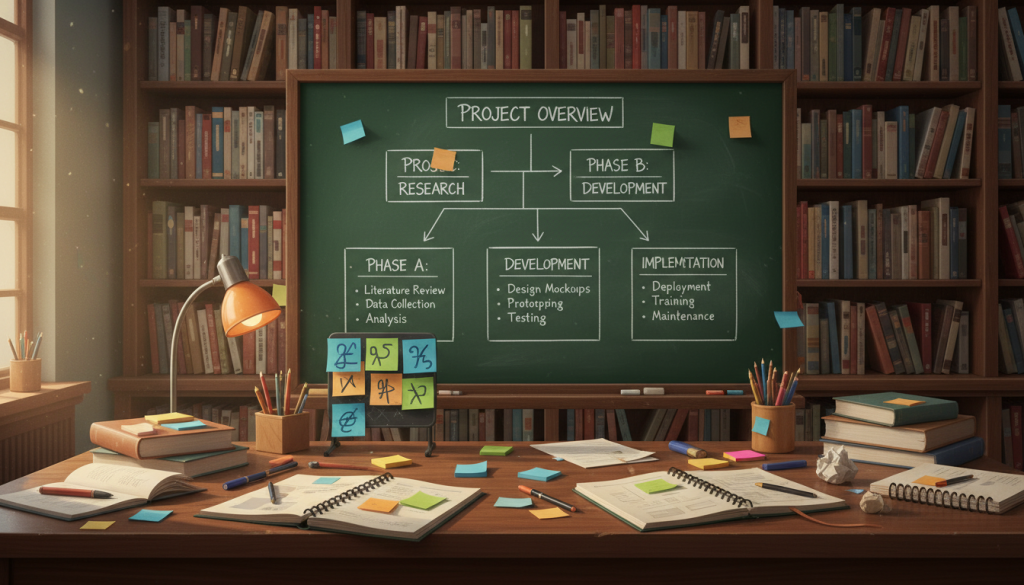
Imagine a big book with 80,000 words. It’s divided into eight big parts, each about 10,000 words. And in between, there are ten chapters of 1,000 words each. These are just right for a single day’s work.
I apply this same idea to my projects. Each “chapter” is a task I can finish in one sitting.
Here’s how a book’s structure helps with planning projects:
| Story Pillar | Word Range | Project Equivalent |
|---|---|---|
| Hook to Inciting Event | 0–10,000 | Research and discovery phase |
| Inciting Event to First Plot Point | 10,001–20,000 | Define scope and deliverables |
| First Plot Point to 1st Pinch Point | 20,001–30,000 | Early execution and testing |
| Midpoint Sections | 30,001–50,000 | Core development and iteration |
| Third Plot Point to Climax | 60,001–70,000 | Refinement and quality review |
| Climax to Resolution | 70,001–80,000 | Launch and wrap-up |
This method gives me a clear plan and freedom. I see how each part fits into the whole, but I only focus on one thing at a time. The beauty of this is turning chaos into a clear plan. Every big project becomes a series of small wins, keeping me moving forward.
My Hero’s Journey Approach to Personal Goals
Every great story has a pattern of change. Joseph Campbell showed this in The Hero with a Thousand Faces. I use it for my personal goals. Maureen Murdock added more depth with The Heroine’s Journey. Together, they guide my growth in a way that’s both epic and easy to follow.
Identifying My Call to Adventure
The Hero’s Journey starts when you face something new. For me, this often comes from a tough experience. It could be losing a job, failing a project, or feeling really unhappy.
I see this discomfort as a sign. It’s like the start of my story, the spark that sets everything off.
“A hero is someone who has given his or her life to something bigger than oneself.” — Joseph Campbell
Finding Mentors and Guides Along the Way
No hero goes it alone. In my journey, I look for mentors who’ve been where I am. These guides, like coaches or friends, help me through tough spots. Their advice makes my path clearer and keeps me moving.
Facing Challenges and Growing Stronger
The middle of the Hero’s Journey is tough. Things usually get worse before they get better. I’ve learned to expect this.
Each challenge makes me stronger. It’s like a phoenix rising from the ashes.
| Stage of the Journey | What It Looks Like in Real Life | Growth Outcome |
|---|---|---|
| Call to Adventure | A painful or disruptive experience | Awareness and motivation |
| Finding Guides | Seeking mentors and trusted advisors | Clarity and direction |
| Facing Challenges | Setbacks, failures, and tough decisions | Resilience and skill-building |
| The Big Fight | Confronting the ultimate obstacle with courage | Breakthrough and confidence |
| Integration | Applying lessons learned to daily life | Lasting personal transformation |
Using Joseph Campbell’s ideas, I turn daily struggles into a meaningful story. This way, I build long-term story arcs that help me grow over time.
Creating Story Arcs for Long-Term Planning
Every great novel has a clear arc that pulls readers from the first page to the last. I plan my year the same way. By using story structure for my goals, I make a roadmap that’s exciting and purposeful. This method gives my long-term vision a clear shape to follow.
Mapping Out My Year Like a Novel
I see January through December as chapters in a book. Christopher Vogler’s 12-step Hero’s Journey, from The Writer’s Journey, guides me. I match each year’s phase to a journey stage:
- January–February: My “Ordinary World” — I assess where I stand and define my starting point.
- March–April: The “Call to Adventure” — I commit to a major goal and cross my first threshold.
- May–August: “Tests, Allies, and Enemies” — I face real challenges and build momentum.
- September–October: The “Ordeal” — I push through the toughest stretch and claim my reward.
- November–December: “Return with the Elixir” — I reflect, celebrate, and carry lessons forward.
This method keeps me grounded. I always know which “chapter” I’m in and what comes next.
Building Tension and Resolution Points
No story works without tension. I set deliberate pressure points throughout the year. These are my rising action moments.
“A story without conflict is just a list of events. Conflict is what transforms events into meaning.”
Each resolution point is a chance to pause and recalibrate. Narrative planning taught me that growth happens at these pressure peaks. When I resolve one arc, I carry that energy straight into the next chapter of my goals.
How Book Formatting Helps Me Structure My Workspace
My workspace looks like my writing. I have charts of the three-act story structure above my desk. These charts show key moments like the inciting incident and the climax. They help me stay on track.
Book formatting guides my work from start to finish. I start in Scrivener, a tool for complex manuscripts. Then, I move to Google Docs for editing and sharing.
This way, I get the best of both worlds. Deep structure in drafting and easy sharing in editing.
Here’s what my workspace looks like:
- A printed three-act timeline pinned above my monitor
- Color-coded sticky notes matching each act’s plot points
- A digital folder system in Scrivener that mirrors chapter divisions
- A Google Docs workspace for polished drafts and feedback
This setup should help me, not the other way around. I’m in charge of my creative work. The structure I follow helps, but I can change it if needed.
“The structure is the servant, not the master.” — Robert McKee, Story: Substance, Structure, Style and the Principles of Screenwriting
Visual aids make ideas clear. Seeing where a project fits in a story arc helps me decide what to do next. Book formatting is more than page layout. It’s a guide for my daily thinking and creating.
Implementing the Three-Act Structure in Project Management
Every great story has a natural flow. I found that the three-act structure works well for managing projects. It helps me guide my team from start to finish.
Setup Phase for New Initiatives
Act One is about setting the stage. I define the current state and goals. I also gather my resources.
This is like the beginning of a book, where we learn about the setting and characters. The project kickoff is my “inciting incident.” It sets everything in motion. By the end, the team is committed, and there’s no going back.
Confrontation and Problem-Solving
Act Two is the longest and most challenging part. This is where the real work begins. Stakes rise, obstacles appear, and I find out who my allies and blockers are.
I see the midpoint of a project as a pivotal turning point. It’s when I reassess, pivot if needed, and push through resistance. This framework helps me stay calm when things get tough. Challenges are expected and are part of the story.
Resolution and Integration
Act Three brings everything together. Just like a book’s ending, my projects have a final sprint before completion. I tie up loose ends, document lessons learned, and establish a new status quo for the team.
The three-act structure ensures a satisfying end. Nothing feels rushed or unfinished.
| Act | Project Phase | Key Action | Duration (Typical) |
|---|---|---|---|
| Act One | Setup | Define scope, gather resources, kick off | 15–20% of timeline |
| Act Two | Confrontation | Execute tasks, solve problems, adapt | 50–60% of timeline |
| Act Three | Resolution | Deliver results, document, integrate | 20–25% of timeline |
This approach to project management fits well with my love for literature.
Using Literary Themes to Connect Different Life Areas
Every great book has themes that link its chapters. I found that my life works the same way. By using thematic organization, I see how my career, relationships, health, and growth are connected.
Think about your favorite novels’ themes — love, resilience, forgiveness, loss, transformation. These themes are not random. They are the story’s emotional core. When I looked at my life through this lens, I saw patterns.
My work-life balance issues were linked to saying no in friendships. My fear of change at work was the same as at home.
Identifying these themes requires honest reflection. I asked myself: What ideas keep showing up in my story? The answers were surprising. Here are the themes I found:
- The courage to speak my truth, even when it feels uncomfortable
- Accepting change as a path to growth rather than a threat
- Building trust after experiencing betrayal or disappointment
- Finding strength in vulnerability
“The unexamined life is not worth living.” — Socrates
These themes gave me a unified way to view my life. Instead of seeing each area separately, I see them as chapters in one story. My thematic organization brings coherence that lists can’t.
This structure acts like a compass. When facing a tough decision, I check it against my core themes. Does this choice fit my story? This question helps me find clarity.
My Narrative Framework for Goal Setting and Achievement
Every great book starts with a central question: who is the main character, and what do they want? I use this idea for my goals. I ask three questions: What do I truly want? What stops me? How will my story end?
Writing My Own Success Story
In book writing, authors decide the ending first. I do the same with my goals. I imagine the outcome I want and plan backward.
My plan might change, but that’s okay. A story structure guides me, not traps me.
“The scariest moment is always just before you start.” — Stephen King
Creating Plot Points and Milestones
Every scene in a good book has a purpose. It moves the story forward or shows something about the character. I treat my milestones the same way.
- Set a clear inciting incident — the moment I commit to the goal
- Define midpoint milestones that build momentum
- Identify the climax — the biggest challenge before success
- Plan the resolution — how I’ll celebrate and integrate the win
Tracking Character Development (Personal Growth)
The best part of any story is watching the main character grow. I keep a simple journal to track my growth. Each month, I write about what I’ve learned and how I’ve changed.
This method keeps me honest. When I read my journal, I see real progress. It’s not just about checking boxes, but about growing and changing.
How Book Elements Guide My Decision-Making Process
Every tough choice I face gets easier when I use a decision framework based on storytelling. I rely on Freytag’s Pyramid. It’s a five-point structure inspired by Greek tragedies. It helps me make choices with clarity and purpose.
Freytag’s model has five stages. The introduction sets the scene and introduces a key event. The rising action shows the stakes getting higher as the main character tries to reach a goal. The climax is a turning point. The falling action builds tension towards a disaster. The catastrophe is the lowest point where fears are realized.
I use these stages to see the possible outcomes of my decisions. This framework makes me think: What’s my point of no return? What’s the worst-case outcome?
| Freytag’s Stage | Decision-Making Application | Key Question I Ask |
|---|---|---|
| Introduction | Define the current situation | What is my status quo right now? |
| Rising Action | Identify escalating commitments | What stakes am I raising by moving forward? |
| Climax | Pinpoint the point of no return | Where can I no longer reverse course? |
| Falling Action | Anticipate unintended consequences | What tensions might build after I commit? |
| Catastrophe/Resolution | Prepare for worst-case scenarios | Can I handle the lowest possible outcome? |
Modern stories usually don’t end in tragedy. People like happy endings. I follow this instinct too. When I see my story heading towards disaster, I change it. I make a new choice before it’s too late. The structure of books helps me avoid regretful decisions.
Applying Manuscript Structure to Email and Communication
Every email I send has a pattern, like a story. I organize my inbox like a book, with a clear start, middle, and end. This way, people respond better to my emails at work and in my personal life.
Cooks follow recipes closely, but chefs add their own twist. A good communication framework is like that. It guides you without making your messages seem too formal.

Crafting Clear Openings and Hooks
In The Hunger Games, Suzanne Collins grabs readers from the start. I do the same with my emails. My first line tells you why I’m writing, without extra words. A good hook grabs your attention right away.
Developing Ideas Through Rising Action
Manuscript structure says the first big event should happen at 25% of the story. Too soon, and people aren’t interested. Too late, and they get bored. In my emails, I build my case step by step. I share context, details, and raise the stakes before asking for something.
Delivering Impactful Conclusions
Every great story ends with a purpose. My emails conclude with a clear call to action or a next step. No vague endings.
| Email Element | Book Organization Equivalent | Purpose |
|---|---|---|
| Subject Line | Book Title | Grab attention instantly |
| Opening Sentence | Opening Hook | State the reason for writing |
| Body Paragraphs | Rising Action | Build context and present key points |
| Closing Line | Resolution | Deliver a clear call to action |
This framework helps me make every message have a story. People actually want to read what I write.
Lessons from Book Composition That Revolutionized My Productivity
More than half of Americans think they have a great novel idea. But most don’t start writing it. They find it too big and scary. Learning about book composition changed my approach to goals.
Think about Pride and Prejudice by Jane Austen. Every part of the story is planned perfectly. Mr. Darcy’s first proposal is right at the middle, making it a key turning point. Austen didn’t just write it by chance. She had a clear plan for her story, making each scene important and moving.
“Structure doesn’t stifle creativity — it gives it a place to thrive.”
A middle-grade novel has 60,000 words, divided into eight main parts. This means about 7,500 words between each big event. Breaking down big tasks into smaller, spaced-out goals makes them easier to handle. I use this method in my productivity system too.
Here are the main lessons I’ve learned from book composition:
- Every project needs solid bones — a beginning, middle, and satisfying end
- Spacing out key milestones keeps momentum alive
- Structure doesn’t mean formulaic — it means intentional
- A strong payoff ending requires deliberate setup early on
Learning about literary structure showed me that being structured doesn’t mean being rigid. A good productivity system, like a well-written book, feels natural. The framework is there, but it doesn’t get in the way. What’s left is a story of success and progress.
These lessons also help me at work. They start with how I organize my emails.
Conclusion
Books have given me a way to organize my life. They help me with daily tasks and long-term goals. These frameworks are like blueprints that make sense of chaos.
They don’t make me feel stuck. Instead, they let me be creative while staying focused. My favorite authors have used story structures for years. Using them in my life has changed everything.
Learning about book anatomy has shown me the value of rules. It helped me see how exposition, rising action, climax, and resolution work together. This knowledge lets me apply it to projects, emails, and personal growth.
Knowing the rules gives me confidence to bend them when needed. This balance between discipline and flexibility is key to success. It’s what drives me to stay organized.
Writing is an art, but book structure is more like a science. Mastering it has opened up new possibilities for me. Whether it’s planning a career change, managing a project, or just getting through the week, book anatomy offers a clear path.
I encourage you to try these methods for yourself. Your own success story is waiting to be written.
FAQ
What exactly is the structure of books, and why does it matter for organization?
Book structure is how stories are told. It includes parts like the beginning, middle, and end. These parts help us manage projects and set goals.
They bring clarity to complex tasks. A good structure answers questions and solves problems.
How does the three-act structure apply to everyday project management?
The three-act structure is like a roadmap for projects. Act I sets up the project and identifies challenges. Act II tackles obstacles and navigates changes.
Act III is the final push and the resolution. This structure keeps projects on track.
What is the Hero’s Journey, and how can I use it for personal goals?
The Hero’s Journey is a path for personal growth. It starts with a challenge that pushes you out of your comfort zone. Then, you find mentors and face challenges.
It ends with integrating lessons into your life. It’s like Dorothy on the Yellow Brick Road or Luke Skywalker’s journey.
How do I identify the main theme of my project or life plan using book anatomy principles?
Themes in books are like the underlying messages in your life. Reflect on your experiences to find these themes. They might be about resilience or growth.
Look for patterns in your life. Use these patterns to guide your planning. This adds depth to your efforts.
What tools do I need to implement book structure in my daily routine?
You need simple tools to follow book structure. Use visual aids like infographics to track your progress. Scrivener software helps with planning.
Posters and a yellow legal pad for notes are also helpful. These tools make the structure easy to follow.
Can following the structure of books make my work feel formulaic?
Following book structure doesn’t make your work formulaic. It’s like a recipe for a chef. You can still add your own flair.
Books like Pride and Prejudice show how structure can be creative. It gives a solid foundation for your work.
How do I break a large project into manageable pieces using book formatting techniques?
Divide your project into sections like a novel. Use 8 structural elements to guide you. This makes your project feel doable.
Work in smaller chunks during sessions. This approach makes big projects seem achievable.
What is Freytag’s Pyramid, and is it still relevant today?
Freytag’s Pyramid is a five-part dramatic structure. It includes Introduction, Rise, Climax, Return, and Catastrophe. It’s still useful for understanding tension and release.
It’s not used as much today, but its principles are still valuable. They help in planning for challenges and building resilience.
How does Stephen King’s writing advice relate to organizing my life?
Stephen King advises writing with the door closed and editing with it open. This is useful for organizing your life. Focus on planning first, then open up to feedback.
This approach works for business proposals and personal goals. It’s about structure and then refinement.
Do I need to be a writer to benefit from understanding the parts of a book?
No, you don’t need to be a writer. Book anatomy offers universal wisdom. It’s about organizing your life, not just writing.
Understanding story structure is useful for many areas. It makes your plans focused and your outcomes satisfying.