
Writing a Book Using AI: A Modern Author’s Guide

I still remember the first time I watched a friend struggle with their manuscript, drowning in sticky notes and handwritten margin scribbles, frustrated by the endless revision cycle. Fast forward to 2026, and that same writer just published their third novel using AI assistance. The transformation wasn't about replacing their creativity; it was about amplifying it. Writing a book using AI has evolved from a controversial experiment into a practical approach that thousands of authors now embrace, and the results speak for themselves when done thoughtfully.
The Reality Behind AI-Assisted Book Writing
The conversation around writing a book using AI often gets polarized between two extremes: purists who reject any technological assistance and opportunists who think AI can write entire books with zero human input. The truth lives in the nuanced middle ground.
Modern AI tools don't write books for you. They collaborate with you, much like a skilled writing partner who never sleeps. I've watched authors cut their revision time in half while improving manuscript quality, not because AI did the work, but because it helped them see their blind spots faster.
The Authors Guild has even launched certification programs to distinguish human-authored works in response to AI's growing presence. This isn't about fear; it's about clarity and preserving what makes storytelling fundamentally human.
What AI Can Actually Do for Your Manuscript
Think of AI as having three distinct capabilities that matter for authors:
- Pattern recognition: Spotting inconsistencies in character behavior, timeline errors, or prose issues you've read too many times to notice
- Structural feedback: Identifying pacing problems, chapter balance, and narrative flow challenges
- Draft acceleration: Generating variations of scenes or dialogue to overcome writer's block
What AI cannot do is understand the emotional truth you're trying to convey or make the artistic choices that define your voice.

Building Your AI-Assisted Writing Process
When you start writing a book using AI, the workflow matters more than the tools themselves. I've seen authors achieve breakthrough results by treating AI as a developmental editor that's available 24/7, not as a ghostwriter.
Phase One: Outlining and Planning
Begin with clarity about what you want AI to help with. Some authors use AI for:
- Brainstorming plot possibilities based on genre conventions and innovative twists
- Researching historical details or technical accuracy for nonfiction elements
- Generating character backstory ideas that you refine and personalize
- Testing story premises by exploring different opening chapters
The key is maintaining authorial control. AI suggests; you decide. This approach aligns with what research on creative writers using AI reveals: successful authors employ deliberate strategies to maintain authenticity while leveraging AI capabilities.
Phase Two: Drafting with AI Support
This is where writing a book using AI gets practical. Rather than asking AI to write chapters wholesale, use it strategically:
For dialogue refinement, write your scene first, then ask AI to suggest variations that reveal character better. You'll typically find that 80% of AI suggestions don't work, but that 20% sparks ideas you wouldn't have found alone.
For description enhancement, draft your setting or action sequence, then request sensory details you might have missed. AI excels at remembering to include sounds, textures, and smells that deepen immersion.
| Writing Task | Your Role | AI's Role | Result Quality |
|---|---|---|---|
| Plot development | Create core story arc | Suggest subplot connections | High (with curation) |
| Character voice | Define personality traits | Generate dialogue variations | Medium (needs heavy editing) |
| World-building | Establish rules and logic | Fill in supporting details | High (for consistency) |
| Emotional beats | Craft genuine moments | Identify pacing issues | Medium (AI lacks emotional intelligence) |
Maintaining Your Voice While Using AI
Here's what nobody tells you about writing a book using AI: the biggest challenge isn't technical; it's psychological. You need to stay connected to why you're telling this story.
I worked with a memoir writer who started letting AI handle too much of her first draft. Three chapters in, she read back what she'd written and felt nothing. The prose was clean, technically correct, and completely lifeless. She had outsourced the writing but forgotten to inject her lived experience.
The Voice Preservation Framework
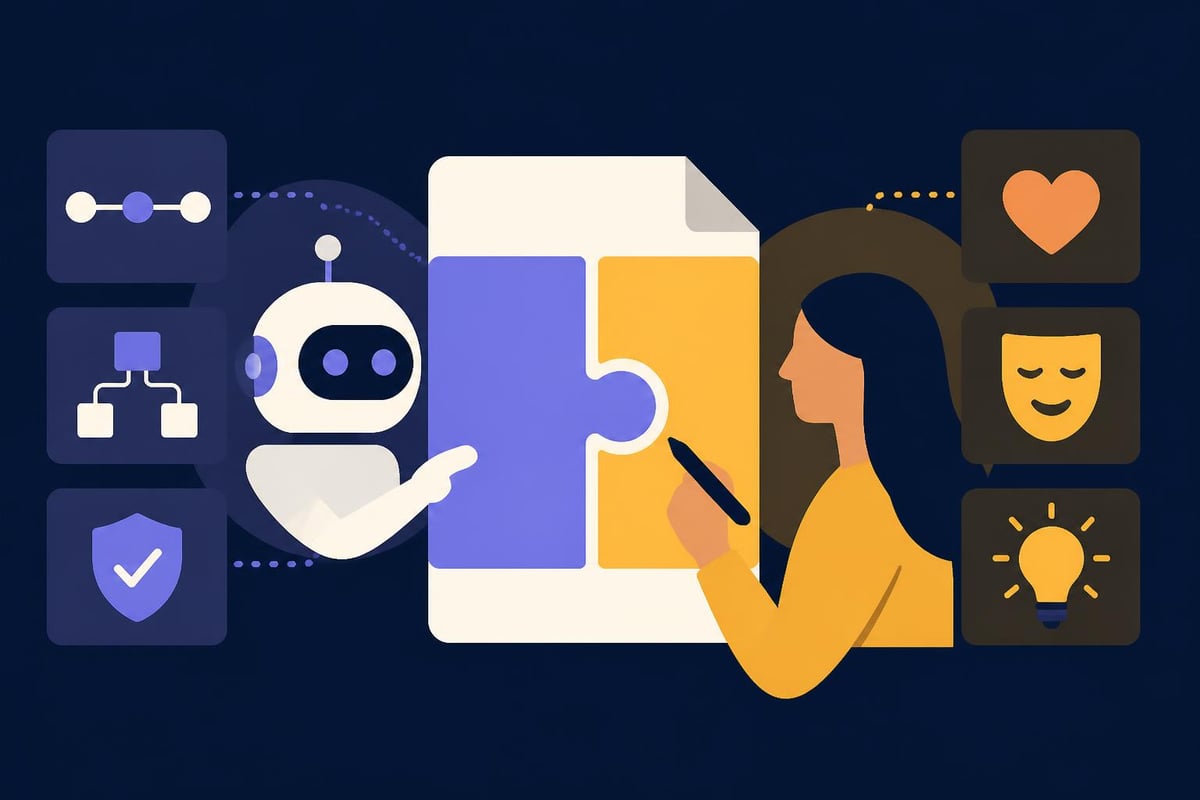
Your unique voice comes from three sources that AI cannot replicate:
- Personal experience and perspective shaped by your specific life
- Stylistic choices that reflect your aesthetic preferences and risk tolerance
- Emotional authenticity rooted in genuine feeling about your subject
Tools designed specifically for authors understand this. AI manuscript editors built for writers focus on preserving your voice while improving technical elements like pacing and structure.
Editing Strategies That Work
When writing a book using AI reaches the revision stage, your approach determines whether AI enhances or diminishes your work:
- Complete your messy first draft without AI interference
- Use AI for structural analysis: chapter balance, pacing issues, plot holes
- Review AI feedback critically: accept what resonates, reject what doesn't
- Rewrite in your own voice: never accept AI prose without making it yours
- Run final consistency checks: character details, timeline, setting accuracy
The polished but shallow output that AI typically produces becomes obvious when it lacks the depth of genuine human thought. Your job is ensuring every sentence passes through your sensibility.
Practical Tools and Techniques for Book Projects
Different genres and project types benefit from AI assistance in distinct ways. Fiction writers often need help with consistency across long manuscripts, while nonfiction authors value research assistance and structural organization.
Fiction-Specific Applications
Character tracking becomes crucial in novels with large casts. AI can maintain databases of character descriptions, relationships, and development arcs, flagging when someone's eye color mysteriously changes or their backstory contradicts earlier chapters.
Scene variations help when you're stuck on a pivotal moment. Write your version, then ask AI to suggest three different approaches. You probably won't use any of them directly, but they'll trigger your own breakthrough idea.
Dialogue polish works when you capture the emotional truth first, then refine how it sounds. AI suggestions often sound too formal or generic, but they highlight when your dialogue doesn't match character voice.
Nonfiction and Memoir Considerations
Research integration matters differently here. AI tools for long-form content creation can help organize complex information, but you need to verify every fact and add the interpretive layer that makes nonfiction compelling.
For memoir and personal narrative, AI should function as a structural consultant, never as a prose generator. Your stories only work when readers feel your presence on every page.
The Publishing and Formatting Connection
Writing a book using AI doesn't end when you type "The End." The path to publication requires formatting, design decisions, and platform-specific requirements that can overwhelm authors who've just completed a manuscript.
Many writers discover that professional book formatting makes the difference between a manuscript that looks self-published and one that stands alongside traditional releases. The technical standards for KDP, IngramSpark, and other platforms demand precision that AI can help achieve.
This is where comprehensive platforms that combine writing, editing, and publishing tools prove valuable. Storyloft gives authors everything needed to write, edit, format, and publish a professional book in one place, using an AI editor built specifically to preserve your unique voice while improving structure, pacing, and consistency.

Export and Distribution Considerations
Once your manuscript is complete, you face:
- File format requirements for different retailers and printers
- Interior layout standards that vary by trim size and genre
- Cover design specifications with exact dimension and resolution needs
- Metadata optimization for discoverability in crowded marketplaces
AI can assist with technical compliance, but your creative decisions about how the book looks and feels remain essential.
Ethical Considerations and Transparency
The conversation around writing a book using AI inevitably touches on questions of authorship and authenticity. These aren't abstract philosophical puzzles; they have practical implications for your career and reader trust.
When to Disclose AI Use
Different contexts demand different levels of transparency:
| Context | Disclosure Needed | Reason |
|---|---|---|
| Fiction (AI for editing/feedback) | No | Standard writing tool usage |
| Fiction (AI-generated prose) | Yes | Impacts authorship claims |
| Nonfiction (AI for research) | No | Common research method |
| Nonfiction (AI-written sections) | Yes | Affects credibility and expertise |
| Academic/professional | Always | Institutional requirements |
| Creative competitions | Check rules | Many explicitly address AI |
The recent controversy over AI-suspected prize submissions demonstrates that literary communities are actively grappling with these boundaries. Better to err toward transparency than risk reputation damage.
Maintaining Craftsmanship
Writing a book using AI tests your commitment to the craft. The ease of generating text can seduce you into accepting "good enough" when you're capable of "genuinely excellent."
Ask yourself regularly: Am I using AI to enhance my capabilities or to avoid developing them? The former leads to growth; the latter leads to dependence on tools that can't make art.
Common Pitfalls and How to Avoid Them
After watching dozens of authors navigate AI-assisted book writing, I've noticed patterns in what succeeds and what fails. The mistakes are predictable; so are the solutions.
The Over-Reliance Trap
The problem: Letting AI write too much of your first draft, then spending more time editing AI prose than you would have spent writing originally.
The solution: Use AI for feedback and suggestions, not generation. Write your scenes first, get AI input second, rewrite in your own voice third.
The Generic Voice Problem
AI tends toward safe, middle-of-the-road prose that could describe anyone's experience. Your book needs the specificity that comes from your unique perspective.
Combat this by: Reading your favorite authors before writing sessions, tracking phrases or constructions that feel distinctly "yours," and ruthlessly cutting anything that sounds like it came from a corporate blog.
The Fact-Checking Failure
AI confidently states incorrect information. Always verify facts, quotes, statistics, and historical details through primary sources.
I know a nonfiction author who published with an AI-generated historical anecdote that never happened. The embarrassment and corrections damaged her credibility far more than the time saved was worth.
Advanced Strategies for Serious Authors
Once you've mastered basic AI integration, more sophisticated approaches become possible. These require understanding both AI capabilities and your own creative process at a deeper level.
Creating Custom Feedback Loops
Train yourself to recognize which types of AI feedback improve your work versus which lead you astray. Keep a log:
- Helpful AI suggestions: What patterns emerge in useful feedback?
- Unhelpful AI suggestions: What does AI consistently misunderstand about your goals?
- Blind spots revealed: What issues does AI catch that you miss repeatedly?
This metacognitive approach transforms writing a book using AI from following tool instructions to building a customized workflow that serves your specific needs.
Genre-Specific Optimization
Different genres have different conventions where AI help varies in usefulness. Comprehensive guides on AI writing tools cover general principles, but you need to adapt them to your genre.
Mystery and thriller writers benefit from AI tracking multiple plot threads and ensuring clues are planted consistently. Romance authors might use AI to vary love scene approaches while maintaining emotional authenticity. Science fiction writers can leverage AI for consistency in world-building details.
Collaboration with Human Editors
AI doesn't replace human editors; it changes what you need them for. When you've already addressed structural issues and consistency problems with AI assistance, your human editor can focus on deeper elements: emotional resonance, thematic coherence, and subtle craft issues that AI cannot perceive.
This approach maximizes the value of professional editorial investment while reducing the number of revision rounds needed.
Measuring Success and Iteration
How do you know if writing a book using AI is actually improving your work? Intuition isn't enough; you need concrete ways to assess impact.
Quantitative Metrics That Matter
Track these elements across projects:
- Time to completed draft: Are you actually faster, or just generating more throwaway text?
- Revision cycles needed: Has AI feedback reduced the number of major rewrites?
- Consistency errors in final manuscript: Does AI catch these before beta readers?
- Reader feedback patterns: Do readers comment on improved pacing or structure?
- Personal satisfaction: Do you feel more or less connected to your finished work?
Qualitative Assessment
Numbers don't capture everything. Read passages you wrote with heavy AI assistance versus passages you crafted alone. Which feel more alive? Which would you be prouder to share with readers who matter to you?
Your answer guides how much to rely on AI going forward. There's no universal right amount; only what serves your specific artistic goals and working style.
The Future of AI-Assisted Authorship
As we move deeper into 2026, AI capabilities continue expanding. The tools available today would have seemed like science fiction just three years ago. Where is this headed?
The trajectory suggests AI will become better at understanding context, maintaining consistency across longer works, and providing more nuanced feedback. What won't change is that great books require human vision, empathy, and the willingness to make bold creative choices.
Writing a book using AI will likely become as common as using word processors instead of typewriters. The technology becomes invisible; the storytelling remains paramount. Authors who thrive will be those who view AI as one tool among many, valuable for specific tasks but never a substitute for the hard, beautiful work of crafting something true.
The craft of writing has always involved tools, from quill pens to printing presses to spell-checkers. AI is simply the latest evolution. Your job remains unchanged: tell stories that matter, in voices only you possess, about truths worth sharing.
Writing a book using AI offers genuine advantages when approached thoughtfully, helping authors improve structure, pacing, and consistency while preserving the irreplaceable human elements that make stories resonate. If you're ready to experience AI assistance designed specifically for authors, Storyloft combines manuscript writing, AI editing that protects your voice, and professional formatting tools in one platform built for serious fiction and nonfiction writers.
